

Essentia / Devices / Vitrectomy System
Device Lab 32
Vitrectomy System
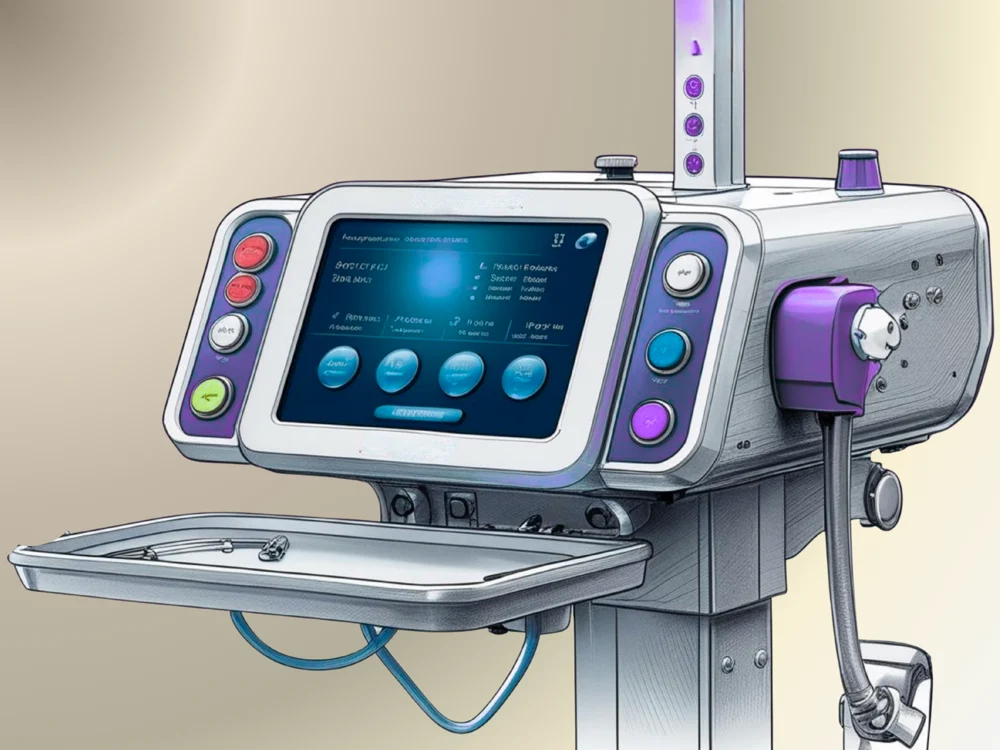
A jet of compressed gas through a restriction pulls a vacuum on the collection chamber, and the eye is connected to that chamber through the probe. The surgeon commands a vacuum with the pedal; the flow is then whatever the port, the needle and the fluid in front of it allow. Nothing in the machine measures or controls the flow, and nothing needs to: the pressure difference is the setting and the flow is the consequence.
Also called: Vitrectomy Machine. Arabic: نظام استئصال الزجاجية. Device Lab 32 of 69 in BMEssentia Medical City, 2 configurations.
Overview: the configurations
Vacuum-controlled vitrectomy console with a Venturi pump
A jet of compressed gas through a restriction pulls a vacuum on the collection chamber, and the eye is connected to that chamber through the probe. The surgeon commands a vacuum with the pedal; the flow is then whatever the port, the needle and the fluid in front of it allow. Nothing in the machine measures or controls the flow, and nothing needs to: the pressure difference is the setting and the flow is the consequence.
Flow-controlled vitrectomy console with a peristaltic roller pump
Rollers occlude a soft segment of the aspiration line and carry a fixed volume of fluid per revolution, so the pump commands a flow directly and the vacuum in the line is whatever that flow costs. Against an open port the vacuum is low. Against an occluded one no flow can be delivered, so the pump simply compresses the line and the vacuum climbs - at a rate the commanded flow divided by the line compliance, and no faster - until it reaches the limit that was set.
How it works: the main parts
What each part does, from the Vitrectomy System lessons in the 3D Device Lab.
- Console enclosure, chassis, mast and castors
- A cabinet about a metre high on four castors, with a screen on a swivel arm above it, a bay in the front face for a cassette, and a tall mast off the back corner carrying a bottle of saline. Two brakes on the front castors and none behind.
- Touch fascia, fluidics display and pressure readouts
- A wide glass fascia on a swivel arm, split into a fluidics window and a narrower cutter window, with four hard keys under the glass and a mechanical vacuum gauge beside it. The fluidics window carries pressures and flow on one axis.
- Dual-linear foot pedal and its side switches
- A treadle on a base with a guard hoop over it, a raised heel pad behind, and a switch on each flank. The treadle moves in two directions, down, and side to side, and the two axes do different things.
- Compressed-gas supply, regulator and accumulator
- Low in the cabinet: a small compressor on rubber mounts, a steel accumulator beside it, a regulator with a relief port on top, a clear water trap and a connector on the back panel for the theatre’s own air pipeline. It is noisy, it is the heaviest thing in the machine, and it is the single source for everything pneumatic, the cutter’s drive, the forced infusion if the machine has one, and the vacuum jet if it has one.
- Infusion pressure source and irrigation bottle
- A half-litre bottle of balanced salt solution hanging inverted from the mast, and, depending on the configuration, either a pinch clamp and a graduated mast, or a regulated air line into the bottle’s own vent with a transducer beside it. This is the side of the balance that holds the eye up.
- Infusion tubing, drip chamber and pinch valve
- A spike into the bottle, a clear chamber below it with fluid standing in the bottom, then about two metres of wide-bore tubing down the mast, through a pinch valve on the console, and away across the floor to the eye. A stopcock on the console body.
- Valved trocar cannulae and the infusion cannula
- Three short metal tubes through the white of the eye, each with a flange lying flat on the surface and a soft valve inside it. One carries the infusion, one the light probe, one the instrument.
- Vitrectomy probe, outer needle and guillotine port
- A moulded handpiece the size of a thick pen with a steel needle half a millimetre across projecting from it, two thin gas lines and one fluid line leaving the back. The tip of the needle is CLOSED.
Explore it in the Device Lab
- The balance, and the pressure nothing measures: Set the applied infusion pressure, then sweep the aspiration and watch the eye. The relationship is a straight line with a slope, and the slope is the resistance of the infusion path.
- Raising the rate to lower the flow: The one idea, on the bench. Fix everything else and sweep the cut rate, then read the mean flow.
- Occlusion break, on each configuration: Occlude the port, let the vacuum build, then release it, and read what comes out and what happens to the pressure.
- A loop closed on an estimate: Turn the pressure compensation on and off while sweeping the flow, then lie to it about the gauge in use.
- A dose with no display: Sweep the working distance and read the irradiance, then compute how long a given radiant exposure takes at each distance.
Common faults and what to check
Most reported device problems (FDA MAUDE)
| Device problem | Reports |
|---|---|
| Device Issue | 609 |
| Replace | 577 |
| Thermal Decomposition of Device | 559 |
| Failure to Cut | 466 |
| Fitting Problem | 268 |
| Device Displays Incorrect Message | 238 |
Raw counts of adverse event reports for this device type (FDA product code HQE), all years. Not adjusted for the number of units in use, so they show what gets reported, not failure rates. Report text is never copied.
Planned maintenance checks
From the BMEssentia procedure library: every 12 months, about 60 minutes, electrical class I, applied part type BF.
| Check | Pass when |
|---|---|
| Console, footswitch and handpieces Inspect the console, the footswitch, the fluidics bay and reusable handpieces. | No damage. |
| Electrical safety Test to IEC 62353. | Within limits. |
| Fluidics, cutter and illumination Run the manufacturer's test: vacuum, cut rate, infusion pressure and illumination. | Pass. |
Test instruments: Electrical safety analyser; The manufacturer's test chamber and cassette.
Recent FDA recalls
| Recall | Product and reason |
|---|---|
| Z-2322-2026 2026-06-05 | D.O.R.C. Dutch Opthalmic Research Center Intl B.V.: TDC VELOCE", 23G Two Dimensional Cutter - 20k CPM An increase in incidence in complaints of a loose outer knife and reports of the outer knife becoming loose during use. Root cause: Process design. |
| Z-2323-2026 2026-06-05 | D.O.R.C. Dutch Opthalmic Research Center Intl B.V.: TDC VELOCE", 25G Two Dimensional Cutter - 20k CPM An increase in incidence in complaints of a loose outer knife and reports of the outer knife becoming loose during use. Root cause: Process design. |
| Z-2324-2026 2026-06-05 | D.O.R.C. Dutch Opthalmic Research Center Intl B.V.: TDC VELOCE", 27G Two Dimensional Cutter - 20k CPM An increase in incidence in complaints of a loose outer knife and reports of the outer knife becoming loose during use. Root cause: Process design. |
| Z-0306-2026 2025-10-24 | Alcon Research LLC: Brand Name: Alcon Laboratories, Inc. Due to incomplete seals in the pouch which provide the sterile barrier. Root cause: Process control. |
| Z-3265-2018 2018-08-08 | Bausch & Lomb Inc: Bausch + Lomb Stellaris Elite 20 GA Vit Cutter, Model BL5626, 7500 cpm, packaged in sterile pouches, 6/shipper. The back cap separates from the body of the vitrectomy cutter. Root cause: Nonconforming Material/Component. |
From the FDA recall database (openFDA), newest first, imported 2026-10-22. 37 recalls on record for this device type. Recall text is the FDA's public text; each recall links to the official record.
Learn it, see it in 3D, ask about it
- Ask Essentia about the Vitrectomy System: answers from named sources, with the device open in its 3D Device Lab beside the answer.
- The Vitrectomy System on the BMEssentia Platform: the Device Library course, 13 sections from physics to maintenance.
- BMEssentia Medical City: Device Lab 32, the Vitrectomy System fully assembled in 3D, with lab tasks and the simulations.
Previous: Cranial Drill. Next: Retinal Laser. All 69 devices.
Ask about the Vitrectomy System
Sign in with your BMEssentia account, or create one, and ask anything about this device.
Ask Essentia