

Essentia / Devices / Cranial Drill
Device Lab 31
Cranial Drill
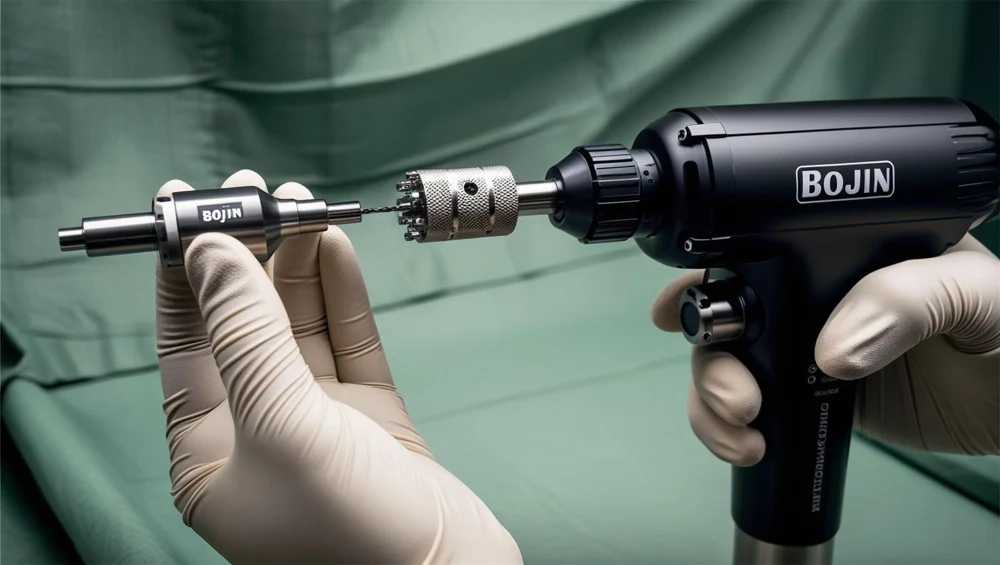
A two-part tool on a Hudson shank: an outer conical cutter about fourteen millimetres across that makes the hole, and an inner pilot drill of four millimetres that leads it by two. Between them is a clutch held together by nothing but the axial load coming back up the pilot. Drive it with a light hand and it will not cut at all, because the pilot's share of the thrust never reaches the spring preload.
Also called: Cranial Perforator, Craniotome. Arabic: مثقاب الجمجمة. Device Lab 31 of 69 in BMEssentia Medical City, 2 configurations.
Overview: the configurations
Self-arresting perforator, 14 mm cutter over a 4 mm pilot
A two-part tool on a Hudson shank: an outer conical cutter about fourteen millimetres across that makes the hole, and an inner pilot drill of four millimetres that leads it by two. Between them is a clutch held together by nothing but the axial load coming back up the pilot. Drive it with a light hand and it will not cut at all, because the pilot's share of the thrust never reaches the spring preload.
Craniotome, 2.3 mm bur over a dural footplate
A small fluted bur of a little over two millimetres running at tens of thousands of revolutions a minute, with a polished steel footplate fitted round its nose. The footplate is introduced through a hole the perforator has already made and slides in the epidural space with the bone above it and the dura below it. The bur flute is held a fixed one millimetre above the footplate's lower face, so what it cuts is the bone the footplate is riding under, and the tool is fed sideways along the line of the flap rather than pushed into the bone.
How it works: the main parts
What each part does, from the Cranial Drill lessons in the 3D Device Lab.
- Control console, irrigation pump and footswitch
- A wheeled box at chest height with a small screen, six keys, two knobs and two round gauges on its front, a roller pump bolted to one side and a saline bag on a pole above it. A two-pedal footswitch lies on the floor with a cable running back up to it.
- Drive motor and torque-speed curve
- A sealed can about thirty millimetres across at the back of the handpiece, with a ring of exhaust slots and a muffler behind it. It is the only part of the set that does work, and everything in front of it exists to deliver what it makes to two millimetres of bone.
- Handpiece body, bearings and nose
- A knurled aluminium barrel about twenty-six millimetres across and a hundred and twenty long, tapering to a smaller nose at the front. It is the part a hand actually holds, and its diameter and knurl are the reason a hand can hold it steadily while pushing on it.
- Hudson coupling and tool retention
- A short socket in the nose of the handpiece with a knurled sleeve round it and three small balls set into its wall. Twist the sleeve, push a shank in, release it, and the tool is held.
- Trigger, throttle and speed regulation
- A lever under the barrel on a pivot pin, with a small collar beside it marked for a safe position and a run position. Pressing it starts the tool; it has travel in it, so it is a throttle rather than a switch.
- Supply hose and its connectors
- A braided hose about eleven millimetres across, a metre and a half of it, running from a fitting on the console to a collar nut on the back of the handpiece. It is the least regarded part of the set and it is in series with everything.
- Irrigation nozzle, line and flow setting
- A bag of saline on a pole, a drip chamber, a roller clamp, a length of tubing through the pump head, and then a line clipped along the barrel to a small nozzle beside the nose that is aimed at the cutting edge. The nozzle is the whole point: everything upstream of it exists to get fluid to that one place.
- Motor cooling, exhaust and swarf clearance
- A muffler behind the motor with ten exhaust slots round it, four rings of baffle, and at the other end of the barrel a clear shroud round the nose with a small suction stub coming off it. Two flows, going in opposite directions, doing two different jobs.
Explore it in the Device Lab
- The clutch sees a fixed fraction of your hand: Set a thrust and read what the comparator is actually being given, then find the thrust below which the tool will not cut at all.
- The release is fast. That is not the problem: Derive the release and then compare it against the room it has. Two numbers, both closed form, and neither of them depends on how hard bone is to cut.
- What it cannot tell from bone: Load the flutes and watch the comparator stay satisfied through a breakthrough. Then work out how little it takes.
- What the speed tells you, and on which drive: Change the drive and watch what happens to the one piece of feedback the operator has.
- A margin that cannot be spent, only bent: Change every control on the bench and watch the clearance not move.
Common faults and what to check
Most reported device problems (FDA MAUDE)
| Device problem | Reports |
|---|---|
| Overheating of Device | 13,025 |
| Break | 5,914 |
| Vibration | 2,761 |
| Device Operates Differently Than Expected | 2,499 |
| Fracture | 2,434 |
| Excessive Heating | 2,432 |
Raw counts of adverse event reports for this device type (FDA product code HBE, HBC), all years. Not adjusted for the number of units in use, so they show what gets reported, not failure rates. Report text is never copied.
Planned maintenance checks
From the BMEssentia procedure library: every 12 months, about 45 minutes, electrical class I, applied part type BF.
| Check | Pass when |
|---|---|
| Console, handpieces and footswitch Inspect the console, motor, hoses or cables, attachments and the footswitch. | No damage. |
| Electrical safety Test the console to IEC 62353. | Within limits. |
| Speed, irrigation and overheating Measure speed; run irrigation; run for the manufacturer's test time and feel for heat. | Per manufacturer; no overheating. |
Test instruments: Tachometer; Electrical safety analyser.
Recent FDA recalls
| Recall | Product and reason |
|---|---|
| Z-2555-2026 2026-06-24 | SURGIFY MEDICAL OY: Surgify Halo, 3.0 mm, Extendable, Model/Catalog Number: 30.000.SEE.U2 Potential for burr breakage, occurring during bi-portal endoscopic spinal surgery (BESS). Root cause: Under Investigation by firm. |
| Z-2556-2026 2026-06-24 | SURGIFY MEDICAL OY: Surgify Halo, 3.0 mm, Short, Model/Catalog Number: 30.070.NVG.U2 Potential for burr breakage, occurring during bi-portal endoscopic spinal surgery (BESS). Root cause: Under Investigation by firm. |
| Z-2557-2026 2026-06-24 | SURGIFY MEDICAL OY: Surgify Halo, 3.0 mm, Long, Model/Catalog Number: 30.125.NVG.U2 Potential for burr breakage, occurring during bi-portal endoscopic spinal surgery (BESS). Root cause: Under Investigation by firm. |
| Z-2558-2026 2026-06-24 | SURGIFY MEDICAL OY: Surgify Halo, 4.0 mm, Extendable, Model/Catalog Number: 40.000.SEE.H1 Potential for burr breakage, occurring during bi-portal endoscopic spinal surgery (BESS). Root cause: Under Investigation by firm. |
| Z-2559-2026 2026-06-24 | SURGIFY MEDICAL OY: Surgify Halo, 4.0 mm, Extendable, Model/Catalog Number: 40.000.SEE.U1 Potential for burr breakage, occurring during bi-portal endoscopic spinal surgery (BESS). Root cause: Under Investigation by firm. |
From the FDA recall database (openFDA), newest first, imported 2026-10-22. 297 recalls on record for this device type. Recall text is the FDA's public text; each recall links to the official record.
Learn it, see it in 3D, ask about it
- Ask Essentia about the Cranial Drill: answers from named sources, with the device open in its 3D Device Lab beside the answer.
- The Cranial Drill on the BMEssentia Platform: the Device Library course, 13 sections from physics to maintenance.
- BMEssentia Medical City: Device Lab 31, the Cranial Drill fully assembled in 3D, with lab tasks and the simulations.
Previous: Prosthetic Limbs. Next: Vitrectomy System. All 69 devices.
Ask about the Cranial Drill
Sign in with your BMEssentia account, or create one, and ask anything about this device.
Ask Essentia