

Essentia / Devices / Retinal Laser
Device Lab 33
Retinal Laser
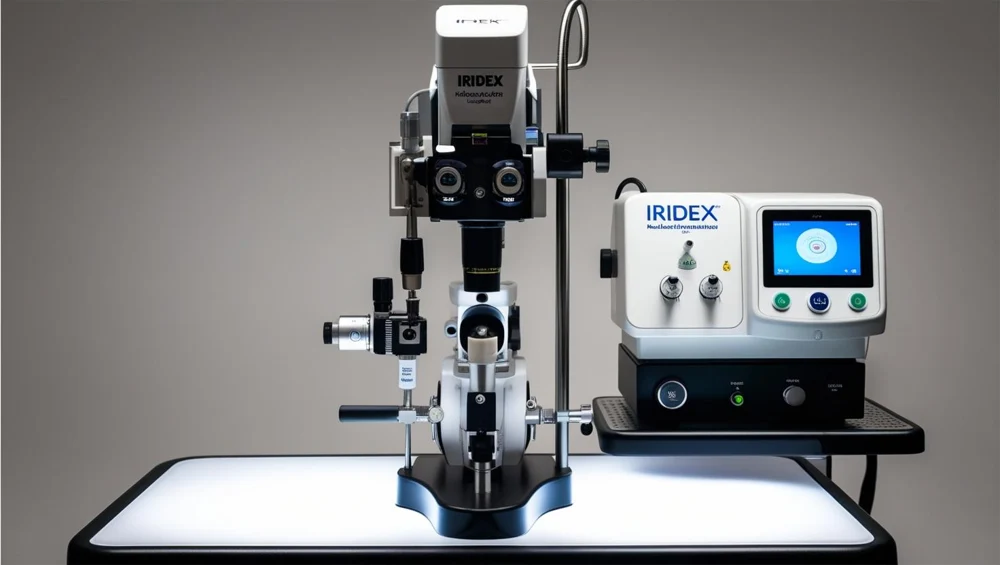
One spot at a time. The surgeon holds the patient’s eye with a contact lens, steers a mirror with a joystick until the aiming spot is where the burn should go, and presses a footswitch for about a tenth of a second. The whole optical train is a slit lamp with a laser folded into its illumination path, and the only thing that decides where the energy lands is a surgeon’s hand on a joystick and the magnification of whichever lens is against the cornea.
Also called: Photocoagulation Laser. Arabic: ليزر الشبكية. Device Lab 33 of 69 in BMEssentia Medical City, 2 configurations.
Overview: the configurations
Slit-lamp single spot, long pulse
One spot at a time. The surgeon holds the patient’s eye with a contact lens, steers a mirror with a joystick until the aiming spot is where the burn should go, and presses a footswitch for about a tenth of a second. The whole optical train is a slit lamp with a laser folded into its illumination path, and the only thing that decides where the energy lands is a surgeon’s hand on a joystick and the magnification of whichever lens is against the cornea.
Pattern-scanning delivery, short pulse
The same slit lamp, the same contact lens and the same source, with a two-axis galvanometer and a telecentric relay in front of the delivery optics. One press of the footswitch places a whole array of spots, a grid, an arc or a ring, in a few hundred milliseconds, aimed once rather than aimed for each spot.
How it works: the main parts
What each part does, from the Retinal Laser lessons in the 3D Device Lab.
- Mains inlet, key switch, remote interlock and emergency stop
- A recessed plate on the back of the console carrying an appliance inlet, a fuse drawer, an earth stud and two things no other device in this library has on that face: a key barrel with nothing in it, and a small round socket labelled for a remote contact. On the top of the console, within reach of a hand that is not holding anything, a red mushroom.
- Laser source, resonator and frequency-doubling stage
- An aluminium plate bolted to the chassis with everything standing on it: a copper block with a small window in one face, two short rods held in mounts with adjustment screws, two mirrors, a pair of lenses and a polished ferrule socket in the wall of the console. It looks like a bench rather than like a circuit, and that is what it is.
- Thermoelectric cooler, heatsink and airway
- A thin white plate under the optical bench with wires to it, a finned aluminium block at one end, a small axial fan in a guarded housing, an intake grille in one side of the console and louvres in the other. A bead thermistor is clamped to the crystal mount with a spot of compound on it.
- Internal power monitor and closed-loop control
- A small glass plate at forty-five degrees in the beam path inside the console, a metal can with a window in it looking at the faint reflection from it, a board with a screwdriver-slot trimmer on it, and a legend beside it. It is a couple of centimetres of hardware and it decides everything the machine believes about itself.
- Mechanical safety shutter and beam dump
- A small solenoid with a plunger, a thin blade on a pivot, a blackened finned block a centimetre behind the blade, and a microswitch beside the pivot. At rest the blade is across the beam and the beam is on the block.
- Armoured delivery fibre and its connectors
- A grey armoured lead a couple of metres long with a polished metal connector at each end, a rubber boot behind each connector and three yellow bands printed along the sheath. Unscrew a connector and there is a ferrule with a bright dot in the middle of it, two hundred micrometres across, which is where all the power is.
- Slit lamp, illumination tower and binocular microscope
- A stereo microscope on a cross-slide with two angled eyepieces, a column beside it carrying a lamp housing with a drum and a filter wheel on it, and a prism arm reaching down towards where a face goes. A joystick on the base moves the whole instrument in three axes.
- Aiming beam and its coaxiality adjustment
- A small red diode block inside the console, a thin glass plate at forty-five degrees a few centimetres downstream of it, two brass-headed screws behind the plate, and an intensity knob on the fascia. At the eye, a small red spot that moves when the joystick moves.
Explore it in the Device Lab
- The quotient the eye supplies: Set a power and a spot size, then read two irradiances: the one at the pupil, and the one at the retina. The ratio between them is the whole device in a single number.
- Thermal confinement, and why the pulse length changes the lesion: Hold the power and the spot and sweep the exposure from a few milliseconds to half a second, and watch three numbers move: the peak temperature, how far the heat has travelled, and the depth of the lesion.
- Which layer gets the energy, and why the wavelength decides: Step through the available wavelengths at a fixed power and read four numbers: what the media take, what the neural retina takes, what the pigment epithelium takes and what the choroid behind it takes.
- The damage integral, and why a burn looks like a switch: Raise the power slowly with everything else fixed and watch the damage integral rather than the temperature. The temperature rises smoothly and in proportion; the integral does not.
- The beam in the room, and why distance does not help: Put the nearest other person at five metres and walk them in to twenty centimetres, and watch how much power their pupil collects. It barely changes, and that is the finding.
Common faults and what to check
Most reported device problems (FDA MAUDE)
| Device problem | Reports |
|---|---|
| Break | 6 |
| Firing Problem | 5 |
| Mechanical Problem | 4 |
| Device Operational Issue | 3 |
| Failure to Deliver Energy | 3 |
| Gas/Air Leak | 3 |
Raw counts of adverse event reports for this device type (FDA product code HQB), all years. Not adjusted for the number of units in use, so they show what gets reported, not failure rates. Report text is never copied.
Planned maintenance checks
From the BMEssentia procedure library: every 12 months, about 60 minutes, electrical class I, applied part type B.
Laser safety follows IEC 60825-1 and IEC 60601-2-22; the laser protection adviser sets the local rules.
| Check | Pass when |
|---|---|
| Delivery, fibre and room Inspect the slit-lamp adapter or fibre, filters, the warning sign, eyewear and the key. | No damage; eyewear rated for the wavelength. |
| Electrical safety Test to IEC 62353. | Within limits. |
| Power and aiming Measure delivered power at three settings; check aiming beam alignment. | Within the stated accuracy; beams aligned. |
| Safety controls Test the emergency stop, key switch and interlock. | Each stops emission. |
Test instruments: Laser power meter for the wavelength; Electrical safety analyser.
Standards engineers test against
IEC 60601-2-22: surgical, cosmetic, therapeutic and diagnostic lasers
The particular standard for medical laser equipment, used together with IEC 60825-1 (laser product safety and classes).
IEC 60825-1: laser product safety and classes
The base standard for laser products.
Recent FDA recalls
| Recall | Product and reason |
|---|---|
| Z-1245-2026 2026-02-04 | Vortex Surgical Inc.: Vortex Surgical There may be voids located in the seal of Tyvek pouches associated with identified catalog numbers and lots. Root cause: Employee error. |
| Z-1246-2026 2026-02-04 | Vortex Surgical Inc.: Oertli There may be voids located in the seal of Tyvek pouches associated with identified catalog numbers and lots. Root cause: Employee error. |
| Z-1004-2026 2025-12-30 | Vortex Surgical Inc.: Vortex Surgical 25ga Illuminated Flex-Tip Laser Probe, Catalog Number VS0135.25 Reason for the voluntary recall is some products in this lot are not passing through a 25ga cannula smoothly. Root cause: Component design/selection. |
| Z-0581-2026 2025-11-21 | Alcon Research LLC: CONSTELLATION ULTRAVIT 10K and CONSTELLATION HYPERVIT 20K, Description/REF: XXX Root cause: Component change control. |
| Z-0872-2014 2014-01-30 | Synergetics Inc: Standard tubing set, Synergetics, Inc., length 10 ft, sterile / EO, 17570. Packed 6 units per box. Manufactured for Faulty seals on the outer pouch of various, double-pouched, single-use, sterile, ophthalmic devices could result in seal failure. Root cause: Use error. |
From the FDA recall database (openFDA), newest first, imported 2026-10-22. 32 recalls on record for this device type. Recall text is the FDA's public text; each recall links to the official record.
Learn it, see it in 3D, ask about it
- Ask Essentia about the Retinal Laser: answers from named sources, with the device open in its 3D Device Lab beside the answer.
- The Retinal Laser on the BMEssentia Platform: the Device Library course, 13 sections from physics to maintenance.
- BMEssentia Medical City: Device Lab 33, the Retinal Laser fully assembled in 3D, with lab tasks and the simulations.
Previous: Vitrectomy System. Next: Endoscope. All 69 devices.
Ask about the Retinal Laser
Sign in with your BMEssentia account, or create one, and ask anything about this device.
Ask Essentia