

Device Lab 67
TENS
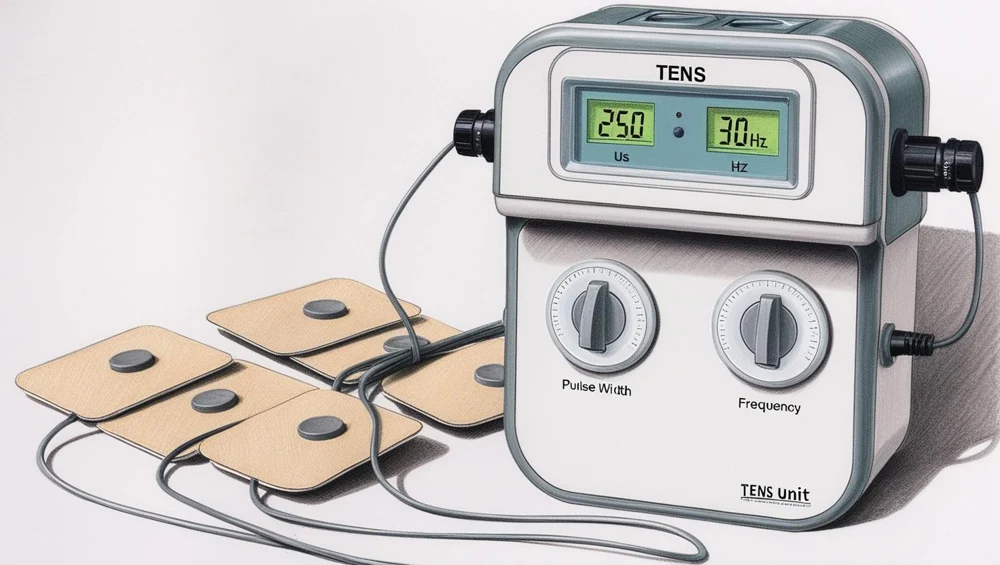
A step-up converter holds a compliance rail and a regulated sink pulls a set current through whatever the contact turns out to be. Charge per phase is the amplitude times the pulse width, exactly, so both controls are charge controls and the delivered dose is the same on any skin. What changes with the contact is the VOLTAGE the stage has to produce, and the current density, and neither of those is measured.
Also called: Tens Unit, Transcutaneous Electrical Nerve Stimulation. Arabic: التحفيز الكهربائي العصبي عبر الجلد. Device Lab 67 of 69 in BMEssentia Medical City, 2 configurations.
Overview: the configurations
Constant-current output stage, biphasic symmetric, two channels
A step-up converter holds a compliance rail and a regulated sink pulls a set current through whatever the contact turns out to be. Charge per phase is the amplitude times the pulse width, exactly, so both controls are charge controls and the delivered dose is the same on any skin. What changes with the contact is the VOLTAGE the stage has to produce, and the current density, and neither of those is measured.
Constant-voltage output stage, biphasic symmetric, two channels
A regulated voltage is applied across the pair and the contact decides the current. The skin is capacitive, so the current is a spike that decays inside the first fraction of the pulse: the charge that gets through is very nearly the contact capacitance times the voltage, and the capacitance is proportional to the contact area.
How it works: the main parts
What each part does, from the TENS lessons in the 3D Device Lab.
- Nine-volt primary cell and compartment
- 5 millimetres, with two studs of deliberately different diameters on one end. The asymmetry is the whole of how it cannot be fitted backwards: there is no electronics anywhere in the handset doing that job, it is done by two pieces of brass being different sizes.
- Step-up converter and compliance rail
- A twelve-millimetre transformer with six visible windings, a switching device beside it and a small reservoir capacitor, occupying one end of the board. It turns nine volts into a rail of sixty, and that rail is not a specification about the output, it is a specification about how bad the contact is allowed to get.
- Timing core and pulse generator
- A seven-millimetre package with a crystal beside it, and it is the part that makes the waveform a waveform. It decides when each phase starts, how long it lasts, and how exactly the second phase mirrors the first.
- Amplitude control
- One key on the fascia, marked up and down, stepping in milliamps from zero to eighty. It is the only control on this device that anybody moves during use, and it is the only actuator on the only feedback loop the whole system has.
- Pulse width control
- A key marked in microseconds, from fifty to three hundred. On one of these two configurations it is the second charge control and on the other it does very nearly nothing, and the fascia is identical on both.
- Pulse rate control
- A key marked in hertz, from two to a hundred and fifty. Of the three settings on this device it is the one with the least effect on any single pulse and the most effect on what an hour adds up to, which makes it the one most often misread.
- Series direct-current blocking capacitor
- Two ten-microfarad capacitors on the board, one in series with each channel’s output. They are the only parts in the handset whose entire job is to make a number zero, and the number is the charge the waveform failed to cancel.
- Inter-channel isolation gap
- Three millimetres of bare board between two copper regions, with nothing in it. It is the only component on this device that is defined by the absence of anything, and the absence is what it is for.
Explore it in the Device Lab
- Take three quarters of the contact away and change no setting at all: This is the device, and it takes one slider to show it. 25.
- Find out where on a pad the current actually goes in: Ask where the current crosses and the intuition says evenly. It is not close to even, and the arithmetic is exact for an equipotential disc on a resistive half-space: the local density is one over twice the square root of one minus the squared radius fraction, as a multiple of the mean.
- Account for the charge that does not cancel: A biphasic waveform sends charge one way and then sends it back. It sends it back imperfectly, because the two phases are produced by hardware with a tolerance, and the residue is exact: the mismatch times the amplitude times the width times the rate.
- Double the pulse width on each configuration and compare: Both machines have a pulse-width control. On one of them it is the charge control and on the other it is very nearly inert, and the difference is not a design preference, it falls out of the interface time constant.
- Move the pads apart and watch a depth and a density trade: Two contacts separated by a distance put a pattern into the tissue, and on the perpendicular bisector it is closed form: the density goes as the separation over the three-halves power of a quarter of the separation squared plus the depth squared.
Common faults and what to check
Most reported device problems (FDA MAUDE)
| Device problem | Reports |
|---|---|
| Device Operates Differently Than Expected | 33 |
| Inappropriate/Inadequate Shock/Stimulation | 14 |
| Patient-Device Incompatibility | 14 |
| Temperature Problem | 13 |
| Electrical /Electronic Property Problem | 12 |
| Therapeutic or Diagnostic Output Failure | 11 |
Raw counts of adverse event reports for this device type (FDA product code GZJ, NUH), all years. Not adjusted for the number of units in use, so they show what gets reported, not failure rates. Report text is never copied.
Planned maintenance checks
From the BMEssentia procedure library: every 12 months, about 15 minutes, electrical class II, applied part type BF.
| Check | Pass when |
|---|---|
| Unit and leads Inspect the case, controls and lead wires. | No damage. |
| Output Measure output into the load at low and maximum settings. | Within accuracy; no output above the maximum. |
Test instruments: Oscilloscope and load resistor (500 Ω or the manufacturer's).
Standards engineers test against
IEC 60601-2-10: nerve and muscle stimulators
The particular standard for nerve and muscle stimulators, including TENS.
Recent FDA recalls
| Recall | Product and reason |
|---|---|
| Z-1440-2012 2012-04-19 | Synaptic Corp: Synaptic 3600 and 3800 with Cranial Electrical Stimulation manufactured by Synaptic USA, Aurora, CO. Device was distributed without marketing approval. Root cause: PMA. |
| Z-2105-2011 2011-04-28 | Neuro Resource Group Inc: Inter x 5002 Device, Inter x Professional Sport Device, Inter x 1000 Personal Device, and Inter x Personal Sport Product package contains alcohol prep pads recalled by Triad Group because the prep pads have the potential to be contaminated with an objectionable organism. Root cause: Material/Component Contamination. |
| Z-1207-2007 2007-09-01 | Avazzia, Inc: Avazzia Tennant Biomodulator Plastic Cases may crack due to manufacturing by the supplier not meeting specifications Root cause: Other. |
| Z-1208-2007 2007-09-01 | Avazzia, Inc: Avazzia BEST-RSI Plastic Cases may crack due to manufacturing by the supplier not meeting specifications Root cause: Other. |
| Z-1209-2007 2007-09-01 | Avazzia, Inc: Avazzia Med-Best Therapeutic Massager Plastic Cases may crack due to manufacturing by the supplier not meeting specifications Root cause: Other. |
From the FDA recall database (openFDA), newest first, imported 2026-10-22. 7 recalls on record for this device type. Recall text is the FDA's public text; each recall links to the official record.
Learn it, see it in 3D, ask about it
- Ask Essentia about the TENS: answers from named sources, with the device open in its 3D Device Lab beside the answer.
- The TENS on the BMEssentia Platform: the Device Library course, 13 sections from physics to maintenance.
- BMEssentia Medical City: Device Lab 67, the TENS fully assembled in 3D, with lab tasks and the simulations.
Previous: Auditory Amplifiers. Next: X-ray. All 69 devices.
Ask about the TENS
Sign in with your BMEssentia account, or create one, and ask anything about this device.
Ask Essentia