

Essentia / Devices / Auditory Amplifiers
Device Lab 66
Auditory Amplifiers
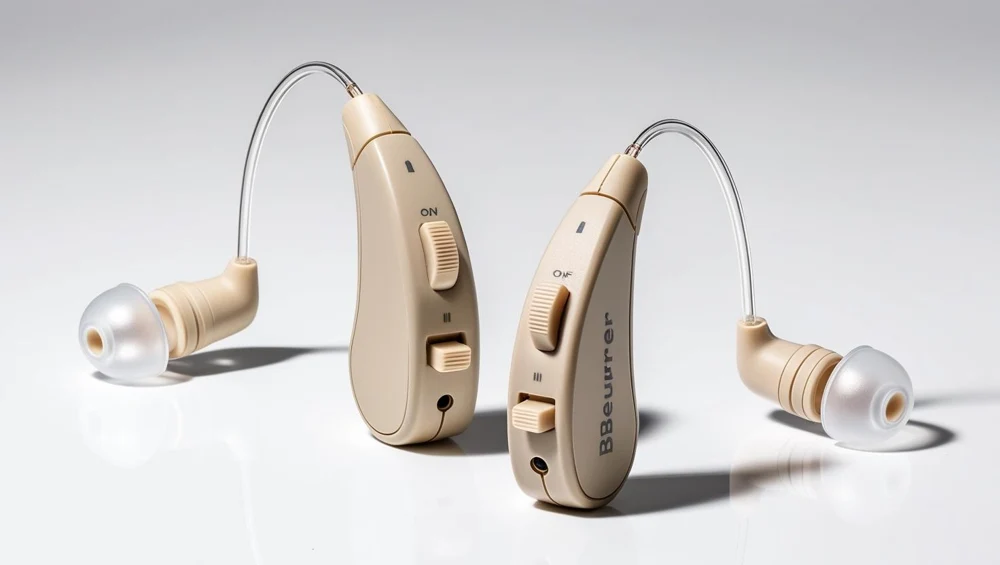
A behind-the-ear case carrying the microphones and the processor, with the receiver itself on a thin wire down into the canal and a flexible dome whose flutes leave the canal substantially open.
Also called: Hearing Aid, Auditory Amplifier. Arabic: المضخمات السمعية. Device Lab 66 of 69 in BMEssentia Medical City, 2 configurations.
Overview: the configurations
Receiver-in-canal, open dome
A behind-the-ear case carrying the microphones and the processor, with the receiver itself on a thin wire down into the canal and a flexible dome whose flutes leave the canal substantially open.
Behind-the-ear receiver, tubed to a vented custom mould
The receiver stays inside the behind-the-ear case and its output travels down a length of tubing, through an earhook, into a custom mould that seals the canal apart from one drilled parallel vent.
How it works: the main parts
What each part does, from the Auditory Amplifiers lessons in the 3D Device Lab.
- Microphone inlet ports and wind screens
- 80 mm across, each with a fine woven screen set just below the surface and a moulded surround that keeps a finger off it. They are the only way sound gets into this device, and they are also the place the device hears itself.
- Front MEMS microphone
- 50 mm wide and just under a millimetre tall, sitting immediately behind the forward inlet port. Its diaphragm is etched from silicon, a few microns thick, moving perhaps a nanometre for an ordinary conversational sound.
- Rear MEMS microphone
- 0 mm behind it along the case. On its own it does nothing the front one does not.
- Microphone preamplifier and anti-alias filter
- A small amplifier and its filter sitting a millimetre from the microphones, with four passive components beside it. It does two jobs that sound unrelated and are not: it lifts a very small signal before anything can spoil it, and it removes everything above the converter's usable band before the converter is allowed to see it.
- Sigma-delta analogue-to-digital converter
- The converter that turns the amplified microphone signal into numbers. It is a sigma-delta design, which means it samples far faster than the audio needs and uses very few bits at each sample, then trades that speed back for resolution in a digital filter.
- Digital processor and filterbank
- 0 mm package, the largest piece of silicon in the device, carrying the filterbank and every processing stage as firmware. It splits the incoming stream into bands, works on each one separately, and puts them back together.
- Wide-dynamic-range compression stage
- A labelled plate on the signal chain of the schematic board, because this stage is firmware inside the processor rather than a separate piece of silicon. Its job is to take a range of input levels far wider than the wearer can use and fit it into one that is narrower, and every consequence in this device that depends on level starts here.
- Adaptive feedback canceller
- The second plate on the signal chain, and the one that is most often misunderstood. It does not block the return path and it does not reduce the gain.
Common faults and what to check
Most reported device problems (FDA MAUDE)
| Device problem | Reports |
|---|---|
| Detachment Of Device Component | 99 |
| Material Separation | 71 |
| Component Falling | 36 |
| Device, removal of (non-implant) | 32 |
| Break | 18 |
| Fitting Problem | 18 |
Raw counts of adverse event reports for this device type (FDA product code ESD, QUH), all years. Not adjusted for the number of units in use, so they show what gets reported, not failure rates. Report text is never copied.
Planned maintenance checks
From the BMEssentia procedure library: every 12 months, about 30 minutes, electrical class II.
The audiometer used to fit hearing aids is calibrated annually to ISO 389 by a calibration lab; aids are tested in a test box (IEC 60118-7).
| Check | Pass when |
|---|---|
| Aids, tubing and batteries Inspect the shell, tubing, receivers and battery contacts. | No damage. |
| Test box measurement Measure output and gain in the test box. | Within specification. |
Test instruments: Hearing aid test box; Audiometer calibration (external, ISO 389).
Recent FDA recalls
| Recall | Product and reason |
|---|---|
| Z-0583-2020 2019-09-18 | GN Hearing A/S: Behind-the-Ear hearing aids, Model Numbers: Q962-DRW, T561-DRW, T562-DRW, T762-DRW, T777-DW, AMZ964-DRW, ET588-DWH, GN Hearing received reports from our manufacturing site in US regarding a software bug in our service & repair tool which affected the capture and restoration of user data in a limited number of repaired hearing aids. Root cause: Other. |
| Z-0584-2020 2019-09-18 | GN Hearing A/S: In-the-Ear hearing aids, Model Numbers: T9ITC-DW-LP, FT6ITC-D-MP, FT6ITE-D-MP, FT8CIC-MP, FT8ITC-W-HP, FT8ITC-W-LP, GN Hearing received reports from our manufacturing site in US regarding a software bug in our service & repair tool which affected the capture and restoration of user data in a limited number of repaired hearing aids. Root cause: Other. |
| Z-0094-2019 2018-08-31 | Widex A/S: Widex BABY hearing aid (referred to as BABY440), powered by zinc-air batteries size 10 The reason for this field action is due to the mounting of a non-tamper-resistant (ordinary) battery drawer on some BABY440 hearing aids. Root cause: Employee error. |
| Z-1681-2010 2010-05-26 | InSound Medical, Inc.: InSound Medical, Inc, Lyric in-canal hearing aid. Manufacturing error could result in electrolyte leakage from the product's battery. Root cause: Process design. |
From the FDA recall database (openFDA), newest first, imported 2026-10-22. 4 recalls on record for this device type. Recall text is the FDA's public text; each recall links to the official record.
Learn it, see it in 3D, ask about it
- Ask Essentia about the Auditory Amplifiers: answers from named sources, with the device open in its 3D Device Lab beside the answer.
- The Auditory Amplifiers on the BMEssentia Platform: the Device Library course, 13 sections from physics to maintenance.
- BMEssentia Medical City: Device Lab 66, the Auditory Amplifiers fully assembled in 3D, with lab tasks and the simulations.
Previous: Centrifuge. Next: TENS. All 69 devices.
Ask about the Auditory Amplifiers
Sign in with your BMEssentia account, or create one, and ask anything about this device.
Ask Essentia