

Essentia / Devices / PCNL System
Device Lab 21
PCNL System
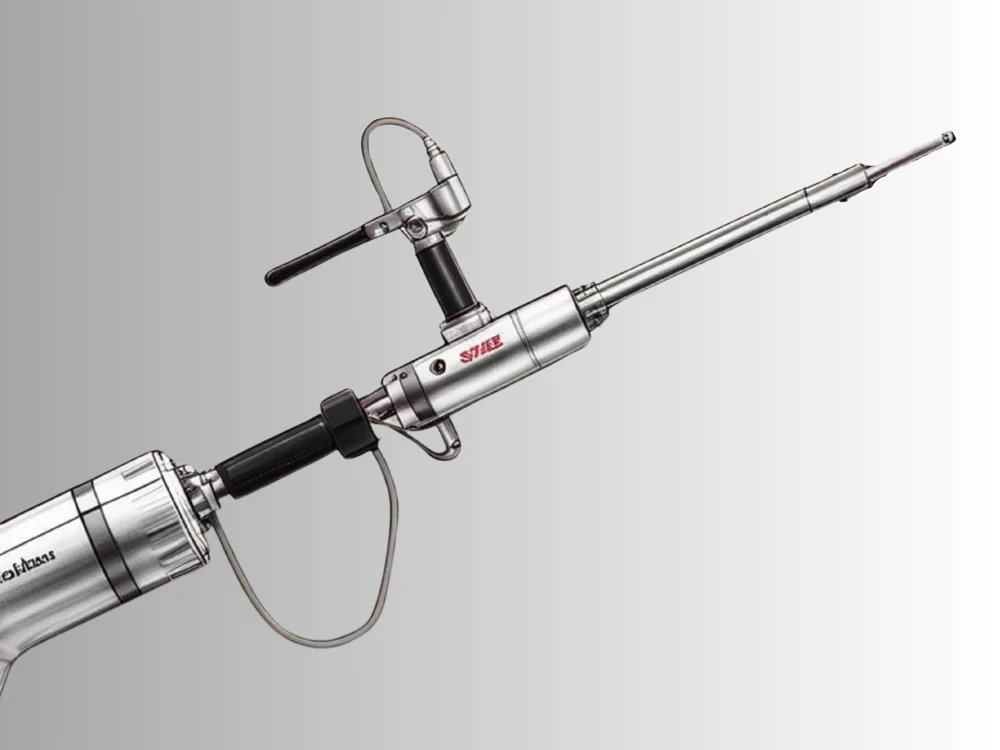
A handpiece in which compressed air drives a small projectile down a short barrel into the back of a solid probe, transmitting one impact per cycle at a rate the operator sets. The probe passes down the working channel of a 24 French rigid nephroscope, which sits inside the access sheath. There is no lumen in the probe and no aspiration anywhere on the system, so fragments are picked out individually with a grasper passed down the same channel, and the instrument is withdrawn and reinserted for each retrieval.
Also called: Percutaneous Nephrolithotomy, Nephroscope. Arabic: نظام تفتيت حصى الكلى عبر الجلد. Device Lab 21 of 69 in BMEssentia Medical City, 2 configurations.
Overview: the configurations
Pneumatic ballistic lithotripter, solid probe
A handpiece in which compressed air drives a small projectile down a short barrel into the back of a solid probe, transmitting one impact per cycle at a rate the operator sets. The probe passes down the working channel of a 24 French rigid nephroscope, which sits inside the access sheath. There is no lumen in the probe and no aspiration anywhere on the system, so fragments are picked out individually with a grasper passed down the same channel, and the instrument is withdrawn and reinserted for each retrieval.
Ultrasonic lithotripter, hollow probe with integrated suction
A piezoelectric stack behind a horn, driving a hollow titanium probe at its own resonance, with the probe lumen connected to a suction pump through a trap. The probe passes down the working channel of a 26 French rigid nephroscope, larger than the ballistic configuration needs because a hollow probe with a usable lumen cannot be made as slender as a solid one. Fragments are drawn up the lumen as they are produced, so the instrument stays in the sheath for most of the case and the fragments arrive in the trap rather than on a grasper.
How it works: the main parts
What each part does, from the PCNL System lessons in the 3D Device Lab.
- Percutaneous access sheath and its bore
- A short rigid tube with a bevelled tip and a flared collar at the outer end, thirty French across and nine and a half millimetres in the bore, standing in a tract about a hundred and twenty millimetres long. It is the only structure holding the route open, and it is the outflow path of the entire procedure.
- Rigid nephroscope, offset eyepiece and working channel
- A straight rigid instrument with an eyepiece offset to one side, a light post, an irrigation tap and a working channel running the length of it. It is the object that does everything: it carries the optics, the light, the irrigant and the probe.
- Rod-lens telescope and the light post
- A sealed optical train running the length of the nephroscope: a train of glass rods with thin air gaps between them, an objective at the distal end, an eyepiece at the proximal end, and a fibre bundle alongside it ending at a post on the side of the instrument. It is the only reason anybody can work inside the sheath at all.
- The clearance between the sheath and the instrument
- Not an object at all. A ring-shaped space, four tenths of a millimetre to three quarters of a millimetre wide depending on what is standing in the sheath, running the length of the tract.
- Irrigation bags, the hanger and the height that drives the inflow
- Two or three bags of warmed irrigant on a hanger near the top of the mast, one running and the others waiting, with a scale on the mast recording how high the hanger is. The height is the drive.
- Irrigation set, drip chamber, warmer and roller clamp
- Two metres of clear tubing, four millimetres in the bore, with a spike at one end, a drip chamber below it, a warming section, a roller clamp and a connector for the nephroscope tap. It looks like the most substantial part of the inflow path and it is very nearly the least important part of it.
- The scope irrigation channel and its resistance
- 80 millimetres across and three hundred millimetres long, running inside the nephroscope from the irrigation tap to the tip. It is the shortest part of the inflow path, the smallest object in this lesson, and the largest single resistance anywhere in the device.
- Drape pocket, collection bag and the weighed recovery
- A pocket moulded into the drape below the access site, a length of tubing from it to a graduated bag on the frame, and a set of scales. It collects what comes back up the annulus, and the number it produces is the only measured quantity in the whole fluid argument.
Explore it in the Device Lab
- The pressure nobody sets and nobody reads: Leave every instrument alone and move only the bag height. Read the cavity pressure on the bench schematic and the inflow on the flow readout at one metre, then at half a metre, then at a quarter. Then put the bag back and change the ureteric bore instead.
- Two French of instrument, and a factor of four: Set the sheath to 30 French and leave it there for the whole experiment. Put a 24 French nephroscope in it and read the pressure. Change only the nephroscope size to 26 French and read it again.
- What a second outflow subtracts, and where it crosses zero: This experiment needs the configuration that has a lumen. Set the suction to nothing and read the cavity pressure. Raise it to 200 mL/min and read it again.
- A temperature rise with no upper bound: Again the configuration with a lumen. Set the drive power and read the temperature rise of the stream leaving the probe at 200 mL/min, then at 50, then at 20. Then leave the flow alone and change the power instead.
- A push that is not zero, and one that is exactly zero: Two experiments side by side, one on each configuration, both of them about a single quantity: the impulse delivered to the stone.
Common faults and what to check
Most reported device problems (FDA MAUDE)
| Device problem | Reports |
|---|---|
| Break | 34 |
| Detachment of Device or Device Component | 7 |
| Poor Quality Image | 7 |
| Crack | 5 |
| Material Separation | 5 |
| No Display/Image | 5 |
Raw counts of adverse event reports for this device type (FDA product code FGA, PPE), all years. Not adjusted for the number of units in use, so they show what gets reported, not failure rates. Report text is never copied.
Planned maintenance checks
From the BMEssentia procedure library: every 12 months, about 60 minutes, electrical class I, applied part type BF.
| Check | Pass when |
|---|---|
| Scopes, sheaths and handpieces Inspect optics, sheaths, lithotripter probes and the irrigation tubing. | No damage; optics clear. |
| Electrical safety Test consoles to IEC 62353. | Within limits. |
| Irrigation pressure Check the pump's pressure display against the reference at the clinical limit. | Within accuracy; limit stops the pump. |
| Lithotripter Run the manufacturer's output test. | Pass. |
Test instruments: Electrical safety analyser; Pressure reference for the irrigation pump; Leak tester (flexible scopes).
Standards engineers test against
IEC 60825-1: laser product safety and classes
The base standard for laser products.
Recent FDA recalls
| Recall | Product and reason |
|---|---|
| Z-3218-2024 2024-09-24 | Karl Storz Endoscopy: Karl Storz - Endoskope , REF: 27092AMA, Hopkins Telescope 6, Rx only, CE 0123 Various medical device product IFUs contain reprocessing modalities that have not been reviewed and/or approved for safety and efficacy by the FDA. Root cause: Process design. |
| Z-3219-2024 2024-09-24 | Karl Storz Endoscopy: Karl Storz - Endoskope , REF: 27093AA Hopkins Telescope 6, Rx only, CE 0123 Various medical device product IFUs contain reprocessing modalities that have not been reviewed and/or approved for safety and efficacy by the FDA. Root cause: Process design. |
| Z-3220-2024 2024-09-24 | Karl Storz Endoscopy: Karl Storz - Endoskope , REF: 27292AMA, Hopkins Telescope 6, Rx only, CE 0123 Various medical device product IFUs contain reprocessing modalities that have not been reviewed and/or approved for safety and efficacy by the FDA. Root cause: Process design. |
| Z-3221-2024 2024-09-24 | Karl Storz Endoscopy: Karl Storz - Endoskope , REF: 27293AA, Hopkins Telescope 6, Rx only, CE 0123 Various medical device product IFUs contain reprocessing modalities that have not been reviewed and/or approved for safety and efficacy by the FDA. Root cause: Process design. |
| Z-3222-2024 2024-09-24 | Karl Storz Endoscopy: Karl Storz - Endoskope , REF: 27294AA, Hopkins Telescope 6, 18 Fr, Rx only, CE 0123 Various medical device product IFUs contain reprocessing modalities that have not been reviewed and/or approved for safety and efficacy by the FDA. Root cause: Process design. |
From the FDA recall database (openFDA), newest first, imported 2026-10-22. 8 recalls on record for this device type. Recall text is the FDA's public text; each recall links to the official record.
Learn it, see it in 3D, ask about it
- Ask Essentia about the PCNL System: answers from named sources, with the device open in its 3D Device Lab beside the answer.
- The PCNL System on the BMEssentia Platform: the Device Library course, 13 sections from physics to maintenance.
- BMEssentia Medical City: Device Lab 21, the PCNL System fully assembled in 3D, with lab tasks and the simulations.
Previous: EP Mapping System. Next: Haemodialysis Machine. All 69 devices.
Ask about the PCNL System
Sign in with your BMEssentia account, or create one, and ask anything about this device.
Ask Essentia