

Essentia / Devices / EP Mapping System
Device Lab 20
EP Mapping System
Ten sticky discs on the skin and the cable loom that runs from them to the cart. On a monitor they would be the whole story; here they are the reference everything else is measured against, and almost nobody looks at them until one falls off.
Also called: Ep Mapping, Cardiac Mapping System, Electroanatomic Mapping. Arabic: نظام رسم خرائط الفيزيولوجيا الكهربية. Device Lab 20 of 69 in BMEssentia Medical City, 2 configurations.
How it works: the main parts
What each part does, from the EP Mapping System lessons in the 3D Device Lab.
- Multielectrode mapping catheter
- A steerable tube a little over two millimetres across and more than a metre long, carrying anywhere from ten to sixty-four small ring electrodes near its far end. It is the instrument that actually collects the map, one contact at a time or a thousand contacts a minute depending on its shape.
- Irrigated ablation catheter
- The instrument that does the treatment. Same shaft and steering as a mapping catheter, but ending in a single larger electrode with holes in it, through which saline runs continuously while energy is delivered.
- Catheter connection cables
- The reusable cables between the sterile catheters and the equipment. Each one is a bundle of dozens of individually screened conductors terminating in a multi-pin connector, and they are the part of this system that breaks.
- Patient interface unit
- The box on the cart with two rows of coloured sockets across its face. Everything that touches the patient plugs in here, and everything that plugs in here is on the wrong side of an electrical barrier from the rest of the room.
- Multichannel recording amplifier
- The module that turns signals of a few hundred microvolts into something a computer can work with, across sixty-four to two hundred and fifty-six channels at once, while a radiofrequency generator is running a metre away.
- Programmed stimulator
- The part of the system that makes the heart do something rather than watching it. It paces through the same catheters that are recording, in precisely timed sequences, to provoke the rhythm the case exists to treat.
- Mapping workstation
- A computer in the bottom of the cart, and the part of this device that does the most while being the least visible. It turns a few thousand located points into a chamber you can rotate on a screen.
- Map and electrogram displays
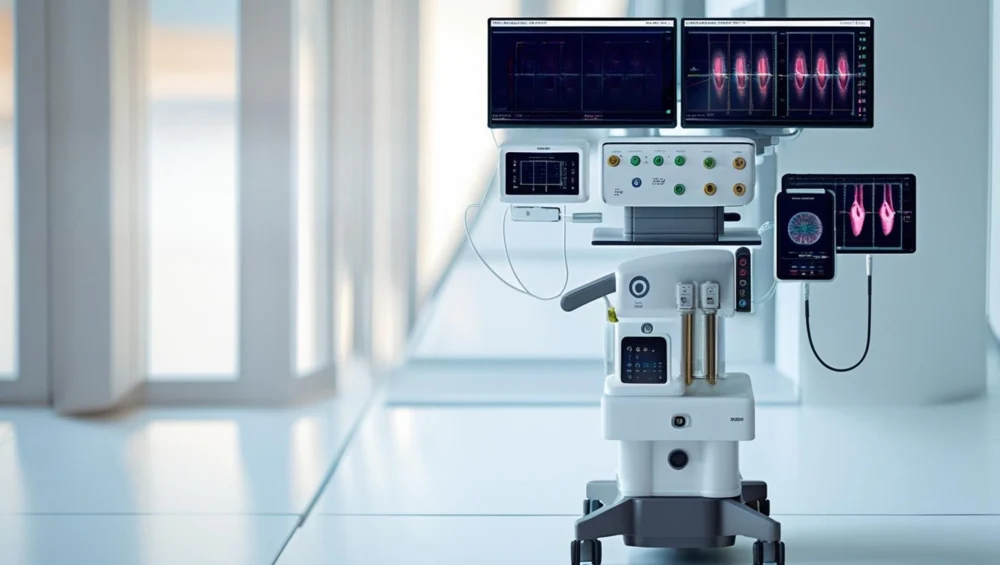
- Two large screens on a crossbar above the cart, and in a real laboratory several more on a boom over the table. One shows the chamber being built, the other shows the signals it is being built from.
Common faults and what to check
Most reported device problems (FDA MAUDE)
| Device problem | Reports |
|---|---|
| Material Twisted/Bent | 826 |
| Communication or Transmission Problem | 739 |
| Display or Visual Feedback Problem | 508 |
| Patient Device Interaction Problem | 418 |
| Material Deformation | 385 |
| Device Displays Incorrect Message | 384 |
Raw counts of adverse event reports for this device type (FDA product code DQK, DRF), all years. Not adjusted for the number of units in use, so they show what gets reported, not failure rates. Report text is never copied.
Planned maintenance checks
From the BMEssentia procedure library: every 12 months, about 120 minutes, electrical class I, applied part type CF.
| Check | Pass when |
|---|---|
| Junction boxes, cables and patches Inspect the amplifier, catheter input boxes, cables and the mapping reference patches. | No damage. |
| Electrical safety Test the system to IEC 62353; the cath lab is a Group 2 location. | PE ≤ 0.30 Ω; equipment leakage ≤ 500 µA; applied part CF ≤ 50 µA. |
| Recording channels Feed the simulator to every intracardiac and surface channel. | Every channel correct. |
| Stimulator Measure pacing output into the load and the coupling interval accuracy. | Within the manufacturer's accuracy. |
Test instruments: Multi-channel signal simulator; Electrical safety analyser; Stimulator load.
Recent FDA recalls
| Recall | Product and reason |
|---|---|
| Z-2518-2025 2025-09-04 | Merge Healthcare, Inc.: Merge Hemo, Model RCSV2, Model/Catalog Number 99-01172-00, software versions 11.1 and 11.1.1 Merge Healthcare has been informed by Schiller AG (Baar, Switzerland) of an issue with the Schiller ARGUS PB-3000 Patient Data Module (PDM) where certain units trigger an error message on the Merge Hemo Client (Pressure. Root cause: Process control. |
| Z-2438-2024 2024-07-25 | Siemens Medical Solutions USA, Inc: Sensis Vibe systems with software version VD15B in combination with Sensis High End Server -Intended to be used as a If the Sensis documentation functionality is used during adding of once-per-study reporting events (e.g., Type 1 events, as further defined in the administrator manual), the possibility exists that the application could. Root cause: Software design. |
| Z-2439-2024 2024-07-25 | Siemens Medical Solutions USA, Inc: Sensis Vibe systems with software version VD15B in combination with VM VIRTUAL SERVER If the Sensis documentation functionality is used during adding of once-per-study reporting events (e.g., Type 1 events, as further defined in the administrator manual), the possibility exists that the application could. Root cause: Software design. |
| Z-2440-2024 2024-07-25 | Siemens Medical Solutions USA, Inc: Sensis Vibe systems with software version VD15B in combination with AXIOM Sensis Post If the Sensis documentation functionality is used during adding of once-per-study reporting events (e.g., Type 1 events, as further defined in the administrator manual), the possibility exists that the application could. Root cause: Software design. |
| Z-2441-2024 2024-07-25 | Siemens Medical Solutions USA, Inc: Sensis Vibe systems with software version VD15B-Intended to be used as a diagnostic and administrative tool supporting If the Sensis documentation functionality is used during adding of once-per-study reporting events (e.g., Type 1 events, as further defined in the administrator manual), the possibility exists that the application could. Root cause: Software design. |
From the FDA recall database (openFDA), newest first, imported 2026-10-22. 50 recalls on record for this device type. Recall text is the FDA's public text; each recall links to the official record.
Learn it, see it in 3D, ask about it
- Ask Essentia about the EP Mapping System: answers from named sources, with the device open in its 3D Device Lab beside the answer.
- The EP Mapping System on the BMEssentia Platform: the Device Library course, 13 sections from physics to maintenance.
- BMEssentia Medical City: Device Lab 20, the EP Mapping System fully assembled in 3D, with lab tasks and the simulations.
Previous: Defibrillator. Next: PCNL System. All 69 devices.
Ask about the EP Mapping System
Sign in with your BMEssentia account, or create one, and ask anything about this device.
Ask Essentia