

Essentia / Devices / Pacemaker
Device Lab 24
Pacemaker
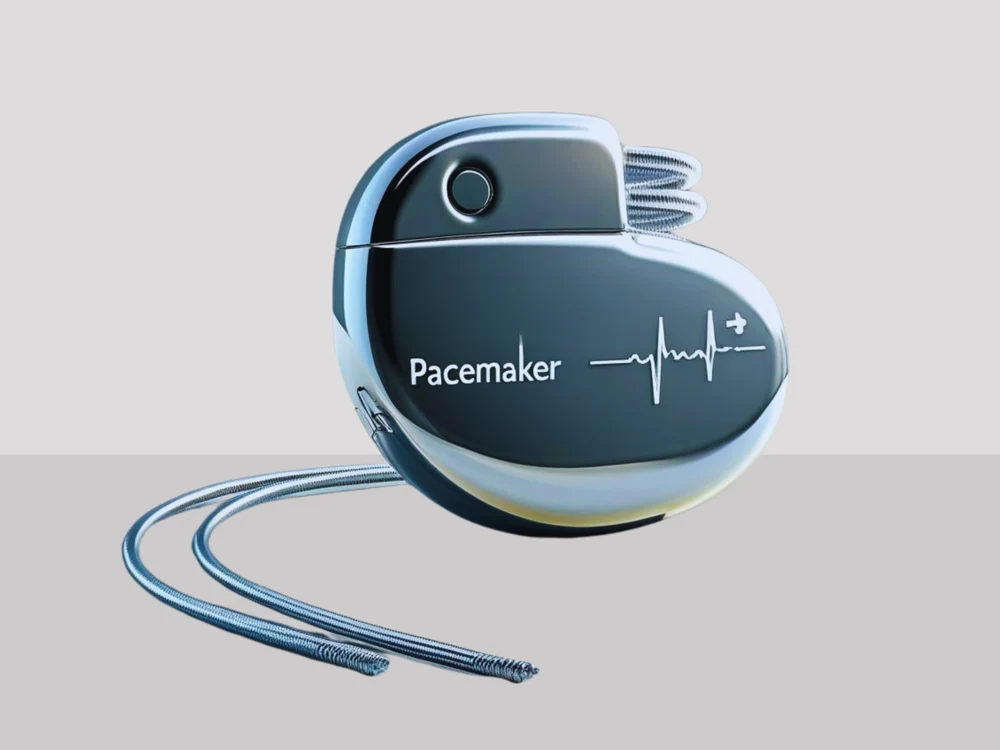
A sealed generator beneath the upper chest connects to one ventricular lead. It senses local ventricular electrical activity and supplies a small pacing pulse when its timing rules call for one.
Also called: Cardiac Pacemaker. Arabic: جهاز تنظيم ضربات القلب. Device Lab 24 of 69 in BMEssentia Medical City, 5 configurations.
Overview: the configurations
Single-chamber transvenous pacemaker
A sealed generator beneath the upper chest connects to one ventricular lead. It senses local ventricular electrical activity and supplies a small pacing pulse when its timing rules call for one.
Dual-chamber transvenous pacemaker
A generator connects to separate right atrial and right ventricular leads. Two sensing channels and coordinated timers allow the device to respond to activity in both chambers.
Cardiac resynchronisation pacemaker · CRT-P
A pacing-only resynchronisation system coordinates right and left ventricular stimulation. The illustrated arrangement also has an atrial lead. Its left ventricular lead follows a coronary vein on the outside of the left ventricle.
Leadless ventricular pacemaker
A miniature sealed pacemaker sits inside the right ventricle. Its battery, electronics and electrodes occupy one capsule. This representative ventricular configuration has neither a chest pocket nor a transvenous lead.
How it works: the main parts
What each part does, from the Pacemaker lessons in the 3D Device Lab.
- Hermetic generator enclosure
- The implanted generator is the small metal unit under the skin. It encloses the energy source and electronics; it is not the electrode that normally sits against the heart.
- Lead connector header
- The header receives the proximal ends of the implanted leads. It is the transition from the generator to the lead system.
- Hermetic feedthrough
- Conductors must leave a sealed implanted enclosure while its interior remains protected from body fluids. The feedthrough is the engineered boundary that makes those two requirements compatible.
- Battery and energy reserve
- The battery supplies energy for sensing, timing, communication and pacing. A pacemaker spends much of its life listening and keeping time, not producing continuous large pulses.
- Timing controller and memory
- The controller decides when an eligible sensed event resets a timer and when a pacing pulse is due. It does not simply produce a fixed tick regardless of what the heart is doing.
- Sensing amplifier and input protection
- The sensing channel listens for the small electrical signal available at the pacing electrodes. It conditions that signal and decides whether an event meets its detection rules.
- Implant communication interface
- The implant communication interface exchanges data with the external programmer. It lets the clinical team inspect settings and stored evidence without physically opening the generator.
- Activity sensor and rate-response input
- Some pacing systems use sensor information to adapt pacing behaviour when intrinsic rate response is inadequate. In this representative transvenous model, an activity sensor reports movement to the controller.
Common faults and what to check
Most reported device problems (FDA MAUDE)
| Device problem | Reports |
|---|---|
| Premature Discharge of Battery | 15,683 |
| Pacing Problem | 13,826 |
| Appropriate Device Problem Term/Code Not Available | 9,590 |
| Over-Sensing | 8,509 |
| Failure to Interrogate | 7,877 |
| Failure to Capture | 6,935 |
Raw counts of adverse event reports for this device type (FDA product code DXY, NVZ), all years. Not adjusted for the number of units in use, so they show what gets reported, not failure rates. Report text is never copied.
Planned maintenance checks
From the BMEssentia procedure library: every 12 months, about 45 minutes, electrical class I, applied part type CF.
Implanted pacemakers are not maintained by engineering. The hospital's equipment is the programmer, the pacing system analyser and the external temporary pacemakers; implants need traceable storage and an MRI-conditional record.
| Check | Pass when |
|---|---|
| Programmer, wand and cables Inspect the programmer, the wand or telemetry head, the analyser cables and the temporary pacemaker. | No damage. |
| Electrical safety Test the mains-powered programmer and analyser to IEC 62353. | PE ≤ 0.30 Ω (Class I); applied part CF ≤ 50 µA. |
| External temporary pacemaker output Pace into the analyser at several mA and rate settings; check sensing with the analyser's signal. | Within the manufacturer's accuracy. |
| Programmer software and implant stock Confirm the programmer runs the manufacturer's current software; audit the implant stock dates and the traceability record. | Current software; no expired implants; every implant traceable. |
Test instruments: Pacemaker and pacer analyser (for the external temporary pacemaker); Electrical safety analyser.
Recent FDA recalls
| Recall | Product and reason |
|---|---|
| Z-2168-2025 2025-07-23 | Medtronic, Inc.: Medtronic CareLink SmartSync Patient Connector, Model Number 24967 with the following software components: In prior SmartSync application versions, the Abort button stopped the test that was selected. Root cause: Software design. |
| Z-2169-2025 2025-07-23 | Medtronic, Inc.: Medtronic CareLink SmartSync Device Manager, Model Number 24967A with the following software components: In prior SmartSync application versions, the Abort button stopped the test that was selected. Root cause: Software design. |
| Z-1924-2025 2025-06-06 | Medtronic, Inc.: Azure S DR MRI SureScan, Product number W3DR01 Identified devices may experience sudden battery power failure without alarm, power supply power-on-resets, and interruption of therapy. Root cause: Process change control. |
| Z-0551-2025 2024-11-26 | Abbott Medical: Merlin@home Transmitter REF EX1100 Due to heart transmitter not being able to upgrade to the current software version in the field after experiencing a power interruption during a prior over-the-wire software download. Root cause: Software design. |
| Z-0552-2025 2024-11-26 | Abbott Medical: Merlin@home with the MerlinOnDemand capability Transmitter REF EX1150 Due to heart transmitter not being able to upgrade to the current software version in the field after experiencing a power interruption during a prior over-the-wire software download. Root cause: Software design. |
From the FDA recall database (openFDA), newest first, imported 2026-10-22. 115 recalls on record for this device type. Recall text is the FDA's public text; each recall links to the official record.
Learn it, see it in 3D, ask about it
- Ask Essentia about the Pacemaker: answers from named sources, with the device open in its 3D Device Lab beside the answer.
- The Pacemaker on the BMEssentia Platform: the Device Library course, 13 sections from physics to maintenance.
- BMEssentia Medical City: Device Lab 24, the Pacemaker fully assembled in 3D, with lab tasks and the simulations.
Previous: Peritoneal Dialysis. Next: VNS. All 69 devices.
Ask about the Pacemaker
Sign in with your BMEssentia account, or create one, and ask anything about this device.
Ask Essentia