

Device Lab 25
VNS
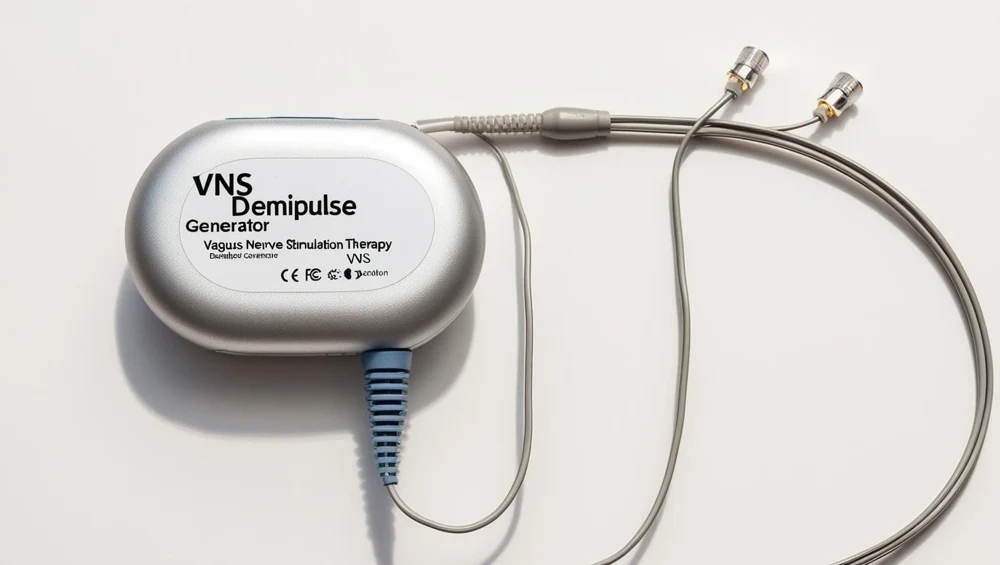
0 C derived from the drawn block rather than typed in. There is no second interface: the only way energy gets into this device is at the factory, and the only way the empty one leaves is in an operating theatre.
Also called: Vagus Nerve Stimulator, Vagal Nerve Stimulator. Arabic: محفز العصب المبهم. Device Lab 25 of 69 in BMEssentia Medical City, 2 configurations.
Overview: the configurations
Primary-cell pulse generator, replaced at depletion
0 C derived from the drawn block rather than typed in. There is no second interface: the only way energy gets into this device is at the factory, and the only way the empty one leaves is in an operating theatre.
Rechargeable pulse generator, energy coupled through the skin
7 V, behind a resonant receive coil, a rectifier and a temperature sensor that throttles the charge. It buys a renewable budget and pays for it with a whole second interface through the skin, with its own coupling, alignment and heating arithmetic.
How it works: the main parts
What each part does, from the VNS lessons in the 3D Device Lab.
- Hermetic titanium enclosure and weld seam
- A flat titanium box, 52 mm by 46 mm and 8 mm thick, with corners you could hold in a closed hand. It is welded shut.
- Ceramic-to-metal hermetic feedthrough
- A small ceramic disc at one end of the can with four platinum pins passing straight through it. It is the only place in the whole sealed volume where anything crosses from inside to outside, and it is about seven millimetres across.
- Moulded connector header
- The moulded block sitting on the top edge of the can, about 13 mm deep and 10 mm tall, made of a translucent amber epoxy so that everything inside it can be seen. It is where the lead plugs in.
- Lead bore, setscrew block and sealing septum
- A small metal block inside the header with a bore through it for the lead and a threaded hole at right angles for a setscrew. Above the setscrew sits a silicone septum that reseals itself after the driver is withdrawn.
- Low-power controller, timing reference and program store
- A single low-power integrated circuit on the hybrid board, about seven millimetres square, with the timing reference beside it. It decides when a pulse happens and how wide it is, and it holds the stored parameters between one telemetry session and the next.
- Switched-capacitor voltage multiplier
- A switched-capacitor voltage multiplier: a handful of capacitors and switches occupying about five millimetres by four on the board. It takes the cell rail and makes a higher one, in whole multiples and nothing in between.
- Programmable constant-current output stage
- The programmable constant-current source: about six millimetres by five, sitting next to the multiplier. It is what actually makes the pulse, and what makes it is a current rather than a voltage.
- Series direct-current blocking capacitor
- 7 microfarads, five millimetres by three by two, wired in series between the output stage and the feedthrough. It is the largest passive component on the board and it is there to guarantee one thing: that no direct current reaches the tissue.
Common faults and what to check
Most reported device problems (FDA MAUDE)
| Device problem | Reports |
|---|---|
| High impedance | 9,439 |
| Fracture | 4,391 |
| Device remains implanted | 2,557 |
| Explanted | 2,415 |
| Device Operates Differently Than Expected | 2,341 |
| Battery Problem | 1,797 |
Raw counts of adverse event reports for this device type (FDA product code LYJ), all years. Not adjusted for the number of units in use, so they show what gets reported, not failure rates. Report text is never copied.
Planned maintenance checks
From the BMEssentia procedure library: every 12 months, about 20 minutes, electrical class II, applied part type BF.
Implants are not maintained in-house. Engineering looks after the programming tablet and wand and the implant stock records.
| Check | Pass when |
|---|---|
| Programmer and wand Inspect the tablet, wand and cable. | No damage. |
| Communication and software Interrogate a demonstration unit; confirm the software version. | Communicates; current version. |
Recent FDA recalls
| Recall | Product and reason |
|---|---|
| Z-1072-2025 2025-01-31 | LivaNova USA, Inc.: SenTiva, REF: 1000 Vagus nerve stimulator generators may stop delivering stimulation due to an internal, mechanically activated component that may become stuck in a closed position, which may result in patients returning to baseline. Root cause: Device Design. |
| Z-1073-2025 2025-01-31 | LivaNova USA, Inc.: SenTiva, REF: 1000C, Generators Part of the VNS Therapy System with Microburst Stimulation. Vagus nerve stimulator generators may stop delivering stimulation due to an internal, mechanically activated component that may become stuck in a closed position, which may result in patients returning to baseline. Root cause: Device Design. |
| Z-1067-2025 2025-01-30 | LivaNova USA, Inc.: Brand Name: SenTiva" Their is a potential that implanted pulse generators may stop delivering therapy due to an internal component issue. Root cause: Device Design. |
| Z-1068-2025 2025-01-30 | LivaNova USA, Inc.: Brand Name: SenTiva DUO" Their is a potential that implanted pulse generators may stop delivering therapy due to an internal component issue. Root cause: Device Design. |
| Z-0532-2022 2021-12-02 | LivaNova USA, Inc.: Vagus Nerve Stimulation (VNS) Therapy Leads, PerenniaDURA, Model: 303. Model 303-20 PereniaDURA Lead (2.0 mm electrode A manufacturing issue may cause the silicone tubing wall thickness of vagus nerve stimulation leads to be less than the design specification. Root cause: Process change control. |
From the FDA recall database (openFDA), newest first, imported 2026-10-22. 37 recalls on record for this device type. Recall text is the FDA's public text; each recall links to the official record.
Learn it, see it in 3D, ask about it
- Ask Essentia about the VNS: answers from named sources, with the device open in its 3D Device Lab beside the answer.
- The VNS on the BMEssentia Platform: the Device Library course, 13 sections from physics to maintenance.
- BMEssentia Medical City: Device Lab 25, the VNS fully assembled in 3D, with lab tasks and the simulations.
Previous: Pacemaker. Next: Cochlear Implant. All 69 devices.
Ask about the VNS
Sign in with your BMEssentia account, or create one, and ask anything about this device.
Ask Essentia