

Device Lab 61
Otoscope
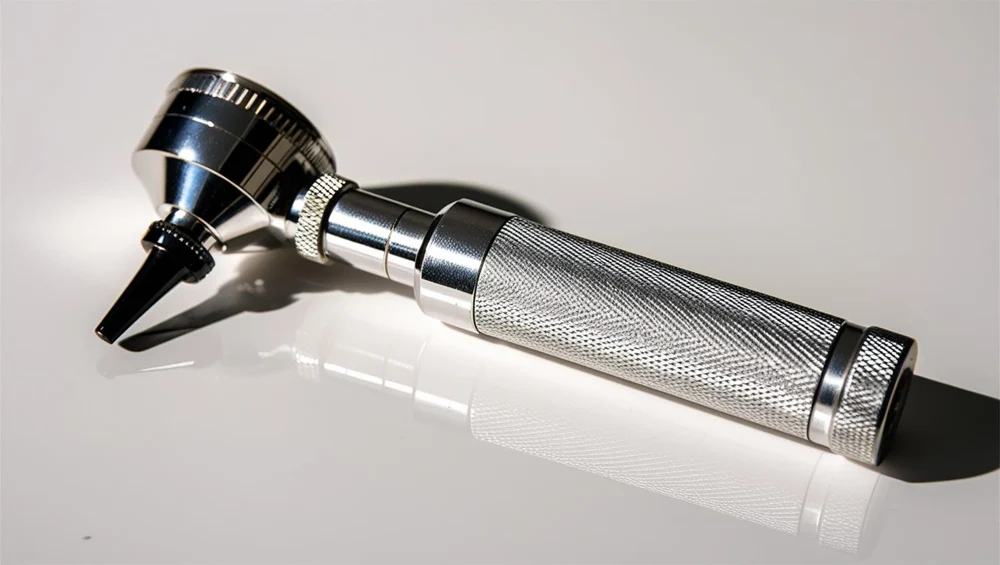
A closed head. Glass is sealed into the viewing aperture, an O-ring seals the speculum to its mount, and a port takes a rubber bulb. Squeezing the bulb steps the pressure in a volume made of speculum, canal and instrument, and the membrane answers by moving.
Also called: Auriscope. Arabic: منظار الأذن. Device Lab 61 of 69 in BMEssentia Medical City, 2 configurations.
Overview: the configurations
Sealed pneumatic diagnostic head with insufflation bulb
A closed head. Glass is sealed into the viewing aperture, an O-ring seals the speculum to its mount, and a port takes a rubber bulb. Squeezing the bulb steps the pressure in a volume made of speculum, canal and instrument, and the membrane answers by moving.
Open operating head with swing-aside magnifier
The same handle and the same illumination, with the glass swung aside so an instrument can pass down the speculum under direct view. There is no sealed volume, no port and no bulb.
How it works: the main parts
What each part does, from the Otoscope lessons in the 3D Device Lab.
- Rechargeable handle and cell
- The handle is a battery and a mechanical datum pretending to be a grip. 5 millimetres across, and the whole 237 millimetre length of the instrument is stacked on top of it: 16 millimetres of end cap, 130 of handle, 14 of collar, 55 of head and 22 of speculum.
- Rheostat collar and lamp current control
- A knurled ring around the top of the handle that sets the current reaching the emitter. Forty ribs, a single index mark, and a sweep of about 300 degrees between its ends.
- LED emitter and collimating optic
- A single emitting die, one millimetre square, behind a small collimating optic in a brushed can at the base of the head. Everything the instrument will ever show is limited by what leaves this square millimetre, and the limit is not a brightness, it is a geometry.
- Illumination fibre bundle
- Nine strands of illumination-grade fibre running 48 millimetres from the emitter can to the ring at the end of the head, gathered in a ferrule and splayed around the observation path. The bundle is how the light gets past the eye without going through it.
- Annular illumination exit ring
- The open ring at the distal end of the head where the illumination leaves. Outer diameter equal to the speculum bore, inner diameter three quarters of it, and a black shroud behind so that nothing scatters straight back up the observation path.
- Diagnostic head shell
- 5 at its top. It is the part somebody recognises an otoscope by, and on the sealed configuration it is also a wall of the volume being pressurised.
- Sealed viewing lens and retaining ring
- A flat disc of glass 22 millimetres across, held by a chromed retaining ring against a rubber gasket. On this configuration it is not an optic in any interesting sense.
- Coaxial observation stop
- 75. Two and a half tenths of a millimetre separate the two, and that gap is the entire glare strategy of the sealed head.
Common faults and what to check
Most reported device problems (FDA MAUDE)
| Device problem | Reports |
|---|---|
| Overheating of Device | 3 |
| Fire | 2 |
| Material Split, Cut or Torn | 2 |
| Melted | 2 |
| Smoking | 2 |
| Thermal Decomposition of Device | 2 |
Raw counts of adverse event reports for this device type (FDA product code ERA), all years. Not adjusted for the number of units in use, so they show what gets reported, not failure rates. Report text is never copied.
Planned maintenance checks
From the BMEssentia procedure library: every 24 months, about 10 minutes, electrical class II, applied part type B.
| Check | Pass when |
|---|---|
| Head, lens and handle Inspect the lens, the speculum mount and the battery contacts. | No damage or corrosion. |
| Light and insufflation Check the light and, if fitted, the insufflation seal. | Works and holds pressure. |
Recent FDA recalls
| Recall | Product and reason |
|---|---|
| Z-1962-2025 2025-06-11 | Baxter Healthcare Corporation: 2.5 V replacement rechargeable batteries for Hillrom WELCH ALLYN PocketScope handles, Product Code 72600 The replacement rechargeable batteries inserted into the Welch Allyn PocketScope handles have the potential to cause a short circuit in the handle, which can lead to exposure to excessive heat and user burns. Root cause: Under Investigation by firm. |
From the FDA recall database (openFDA), newest first, imported 2026-10-22. 1 recalls on record for this device type. Recall text is the FDA's public text; each recall links to the official record.
Learn it, see it in 3D, ask about it
- Ask Essentia about the Otoscope: answers from named sources, with the device open in its 3D Device Lab beside the answer.
- The Otoscope on the BMEssentia Platform: the Device Library course, 13 sections from physics to maintenance.
- BMEssentia Medical City: Device Lab 61, the Otoscope fully assembled in 3D, with lab tasks and the simulations.
Previous: Ophthalmoscope. Next: Dermatoscope. All 69 devices.
Ask about the Otoscope
Sign in with your BMEssentia account, or create one, and ask anything about this device.
Ask Essentia