

Essentia / Devices / Ophthalmoscope
Device Lab 60
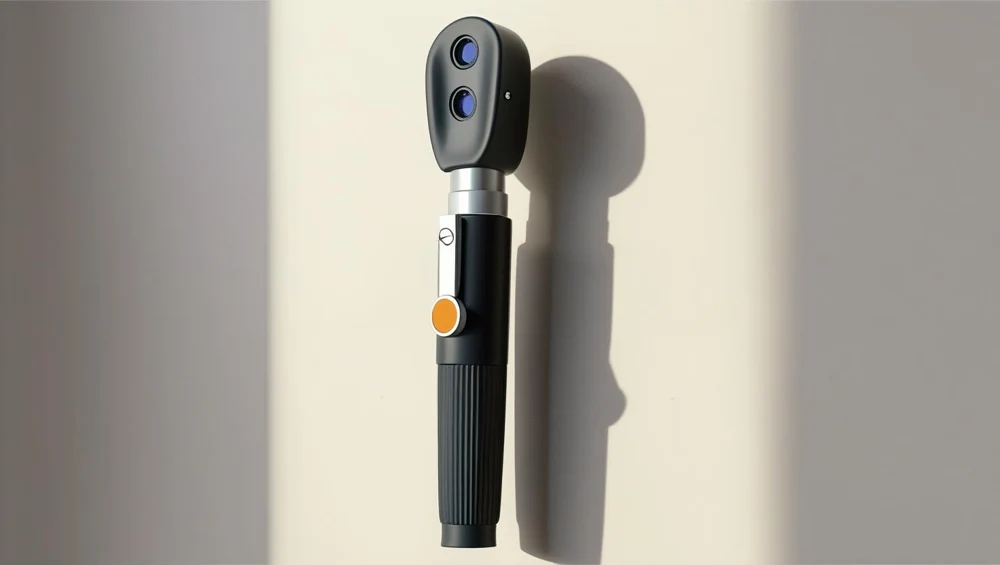
Ophthalmoscope
513 mm from the cornea with the brow rest against the examiner's forehead. 293243 mm is unvignetted.
Also called: Fundoscope. Arabic: منظار العين. Device Lab 60 of 69 in BMEssentia Medical City, 2 configurations.
Overview: the configurations
Direct ophthalmoscope, hand-held head at the brow
513 mm from the cornea with the brow rest against the examiner's forehead. 293243 mm is unvignetted.
Head-mounted binocular indirect with a +20 D condensing lens
000 mm from the cornea. 90919 mm inside the pupil.
How it works: the main parts
What each part does, from the Ophthalmoscope lessons in the 3D Device Lab.
- Charger base and transformer well
- A moulded block on the instrument rail with two cylindrical wells, a brass contact disc at the bottom of each, and a small lit lamp on the front face per well. It is the only part of this device that is never in the darkened part of the examination, and that is not an accident: it lives on the rail by the door, where its own indicator lamps cannot reach the patient.
- Coiled mains supply cable
- 5 mm rubber-jacketed cable running from the outlet on the back of the charger base, down behind the instrument rail, across to a wall socket. It is the least interesting part of the device to look at and the easiest to get wrong in a model, because a cable drawn between two correct endpoints will happily pass through the floor in the middle.
- Rechargeable power handle
- A 30 mm metal barrel 148 mm long, slightly tapered, holding a lithium cell, a brass terminal at the top and a chromed base disc at the bottom that is the charging contact. In the direct configuration it is what the examiner holds; in the indirect one an equivalent cell sits in the lamp house on the headband.
- Rheostat collar and brightness index
- A knurled collar 33 mm across between handle and head, carrying eighteen raised knurls and one lit amber index mark. Turning it changes the current to the source.
- White LED source and its reflector
- A 6 mm white emitter 9 mm long sitting in a polished conical reflector 11 mm across, with brass contacts behind it. In the direct head it sits 8 mm off the optical axis; in the indirect headset it sits in a house above the viewing tubes.
- Collimating condenser
- 5 mm thick in a metal mount, immediately in front of the source. Its job is to turn the source’s diverging output into a beam of a definite width, because the next three elements all work on a beam of a definite width and none of them can work on a cone.
- Aperture wheel
- A 26 mm blackened disc with five real openings in it, indexed by detents, sitting in the illumination path. Large, small, pinhole, slit and a fixation target.
- Filter wheel
- A 24 mm blackened disc carrying four glass elements: clear, a green red-free, a cobalt blue, and a neutral density. It sits after the aperture wheel, and unlike the aperture wheel it changes nothing geometrical at all.
Common faults and what to check
Most reported device problems (FDA MAUDE)
| Device problem | Reports |
|---|---|
| Electrostatic Discharge | 5 |
| Intraprocedure, fire or flash during | 3 |
| Close, difficult to | 1 |
| Failure to Align | 1 |
| Failure to Fire | 1 |
| Fire | 1 |
Raw counts of adverse event reports for this device type (FDA product code HLI), all years. Not adjusted for the number of units in use, so they show what gets reported, not failure rates. Report text is never copied.
Planned maintenance checks
From the BMEssentia procedure library: every 24 months, about 15 minutes, electrical class I, applied part type B.
| Check | Pass when |
|---|---|
| Heads, handles and coil cords Inspect the heads, lenses, apertures and the coil cords. | No damage. |
| Electrical safety of the wall unit Test the wall transformer to IEC 62353. | Within limits for its class. |
| Light, apertures and lens wheel Check every aperture, filter and lens step. | All work. |
Test instruments: Electrical safety analyser (wall transformer).
Recent FDA recalls
| Recall | Product and reason |
|---|---|
| Z-0477-2022 2021-11-03 | Haag-Streit USA Inc: OCT-Camera 211 01 A1, Running software iOCT-Control 3 v1.4 Malfunction of the automatic laser beam shut-off, the OCT unit might not recognize whether the laser beam is safely switched off Root cause: Software design (manufacturing process). |
| Z-0008-2018 2017-07-27 | Optovue, Inc.: iVue with Normative Database, Device Listing Number D185549. FDA determined that a 510(k) is needed for the Vault Mapping software (also known as Lens Fitting). Root cause: Other. |
| Z-0010-2018 2017-07-27 | Optovue, Inc.: iVue 500 with iScan, D216606. FDA determined that a 510(k) is needed for the Vault Mapping software (also known as Lens Fitting). Root cause: Other. |
| Z-1498-2016 2016-03-16 | Optovue, Inc.: iVue and iVue 500 (now called iScan) OCT systems with software version 2016.0.0.127 (USA only) and 2016.1.0.127 (out of A software anomaly was detected that affects Optovue iVue and iVue 500 with Normative Database that may display images of the same eye rather than right and left if user scrolls on the map. Root cause: Under Investigation by firm. |
| Z-1441-2013 2013-05-31 | Optovue, Inc.: Optovue iVue with Normative Database (NDB) with Software Version 3.0 and 3.1. Colors from the NDB comparison for Ganglion Cell Complex thickness in the singular OU report in iVue version 3.0 (US) and 3.1(international) are different from those in the individual iWellness ID and OS reports. Root cause: Software design. |
From the FDA recall database (openFDA), newest first, imported 2026-10-22. 7 recalls on record for this device type. Recall text is the FDA's public text; each recall links to the official record.
Learn it, see it in 3D, ask about it
- Ask Essentia about the Ophthalmoscope: answers from named sources, with the device open in its 3D Device Lab beside the answer.
- The Ophthalmoscope on the BMEssentia Platform: the Device Library course, 13 sections from physics to maintenance.
- BMEssentia Medical City: Device Lab 60, the Ophthalmoscope fully assembled in 3D, with lab tasks and the simulations.
Previous: Laryngoscope. Next: Otoscope. All 69 devices.
Ask about the Ophthalmoscope
Sign in with your BMEssentia account, or create one, and ask anything about this device.
Ask Essentia