

Essentia / Devices / Dermatoscope
Device Lab 62
Dermatoscope
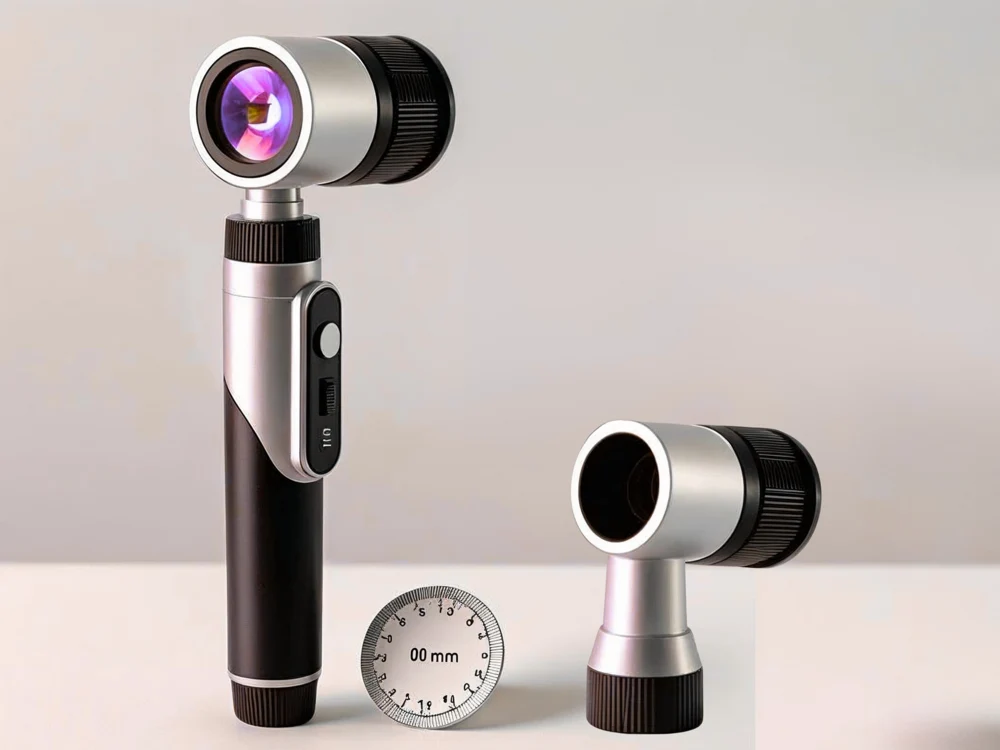
A polariser on the illumination and an analyser crossed with it on the observation. 646 per cent air-to-skin reflection still forms; it is rejected because a specular reflection preserves the polarisation that made it while multiply scattered light does not.
Also called: Dermoscope. Arabic: منظار الجلد. Device Lab 62 of 69 in BMEssentia Medical City, 2 configurations.
Overview: the configurations
Cross-polarised head with stand-off spacer
A polariser on the illumination and an analyser crossed with it on the observation. 646 per cent air-to-skin reflection still forms; it is rejected because a specular reflection preserves the polarisation that made it while multiply scattered light does not.
Immersion contact head with coupling fluid
A coated glass plate pressed against the skin with a fluid between them. 1035 per cent with mineral oil.
How it works: the main parts
What each part does, from the Dermatoscope lessons in the 3D Device Lab.
- Rechargeable lithium-ion cell and charge contacts
- 7 volts nominal and 800 milliamp-hours, lying inside the grip where your hand closes on it. It is the least interesting component in the instrument and it is the one that decides which head you can work with all afternoon.
- Constant-current emitter driver and brightness control
- A constant-current switching driver on a board about fourteen by thirty millimetres, tucked below the cell. It holds the emitter current at whatever the brightness control asks for, regardless of what the cell voltage is doing as it discharges.
- Six-emitter illumination ring
- Six white emitters on an annular board, spaced sixty degrees apart on a ring of nine millimetres radius, sitting twelve millimetres above the skin plane and facing it. The ring is not a styling choice.
- Ring diffuser and light-guide collar
- A ring of moulded light guide with a frosted emitting face, sitting just below the emitter board and surrounding the imaging bore. It takes six point sources and turns them into six small area sources, which is what stops the field carrying six hot spots and what makes the Lambertian model a fair description of them.
- Illumination polariser ring
- A ring of dichroic polarising film sitting directly beneath the diffuser, covering the illumination path and nothing else. Every photon that leaves the head toward the skin has been through it; nothing on the return path has.
- Stand-off spacer cone and graticule
- 000 millimetres off the skin, with a graticule window in its wall and a soft rim that rests on the surface. It touches the patient and it does not touch the light: the twenty-two millimetres it protects are filled with air, which means the four point six four six per cent reflection is still there.
- Achromatic doublet objective, 25 mm focal length
- A cemented achromatic doublet of twenty-five millimetre focal length in an anodised cell, with a four-millimetre aperture stop in front of it. It is the only imaging element in the instrument and it fixes, on its own, the magnification, the numerical aperture, the resolution and the depth of field.
- Crossed analyser in the observation pupil
- A small disc of polarising film, three and a half millimetres across, sitting in the observation pupil just below the objective with its transmission axis at ninety degrees to the illumination polariser. It is the second half of the crossed pair and it is where the whole cross-polarised strategy either works or does not.
Common faults and what to check
Planned maintenance checks
From the BMEssentia procedure library: every 24 months, about 10 minutes, electrical class II, applied part type B.
| Check | Pass when |
|---|---|
| Lens and contact plate Inspect the lens and the contact plate for scratches. | No scratches in the field of view. |
| Light modes and camera link Check polarised and non-polarised light and the camera or phone adapter if used. | All modes work; images store to the right record. |
Recent FDA recalls
No FDA recalls were found for this device type's product codes in the last import.
Learn it, see it in 3D, ask about it
- Ask Essentia about the Dermatoscope: answers from named sources, with the device open in its 3D Device Lab beside the answer.
- The Dermatoscope on the BMEssentia Platform: the Device Library course, 13 sections from physics to maintenance.
- BMEssentia Medical City: Device Lab 62, the Dermatoscope fully assembled in 3D, with lab tasks and the simulations.
Previous: Otoscope. Next: Stethoscope. All 69 devices.
Ask about the Dermatoscope
Sign in with your BMEssentia account, or create one, and ask anything about this device.
Ask Essentia