

Essentia / Devices / Laryngoscope
Device Lab 59
Laryngoscope
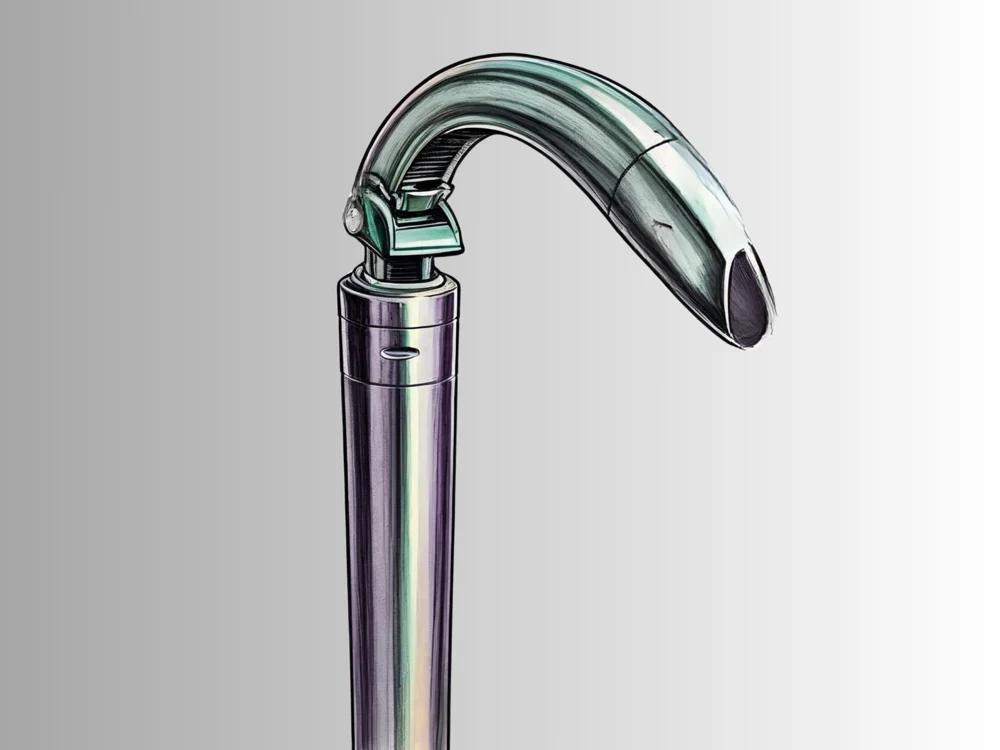
A rigid curved spatula on a hook-on handle, lit by a fibre bundle that carries light from the handle lamp to a polished exit port near the tip. The blade is reusable stainless and goes through a wash and a steam cycle between uses.
Also called: Video Laryngoscope. Arabic: منظار الحنجرة. Device Lab 59 of 69 in BMEssentia Medical City, 2 configurations.
Overview: the configurations
Curved direct blade, size 3, fibre-optic illumination
A rigid curved spatula on a hook-on handle, lit by a fibre bundle that carries light from the handle lamp to a polished exit port near the tip. The blade is reusable stainless and goes through a wash and a steam cycle between uses.
Hyperangulated blade, distal camera, single-use shell
A hyperangulated spatula carried in a single-use shell over a reusable optical stick. The objective and its LED sit at the tip, past the corner, and the image arrives on a screen through an umbilical.
How it works: the main parts
What each part does, from the Laryngoscope lessons in the 3D Device Lab.
- Handle barrel
- The handle is the input arm of a lever, and almost everything else about it follows from that. It is a hollow stainless barrel that your hand closes around, and the resultant of that grip acts at one point roughly two thirds of the way down it.
- Knurled grip band
- The knurled band is where the hand actually meets the instrument, and it is the only part of the device designed around the fact that the operator may be wearing wet gloves. It is a moulded elastomer sleeve with raised longitudinal ribs, bonded over the middle third of the barrel.
- Cell stack
- Two cells in series, stacked nose to tail inside the handle barrel, held down by a return spring at the bottom and making contact at the top. They are the entire energy supply for the light, and on both configurations the light is the only thing that lets anybody see anything at all.
- Hook-on fitting and latch contact
- The hook-on fitting is the interface between the handle and the blade, and it is doing three jobs at once. It is a hinge, so the blade can be folded for storage.
- Lamp housing
- The lamp housing is the small can that holds the emitter, sets where it points and gets rid of its heat. On both configurations it sits at the top of the handle just below the saddle, angled so its output aims into whatever is latched on.
- Light-emitting diode
- The emitter is a small white light-emitting diode on a carrier, sitting behind the housing window. It is the origin of the entire optical chain on both configurations, and it is the point at which a quantity of electrical energy becomes a quantity of luminous flux poured into a cone.
- Blade heel and locking bar
- The heel is the thick block at the near end of the blade that engages the hook bar and turns the whole spatula into a rigid extension of the handle. It carries the slot that drops onto the bar, the face the latch pawl catches, and the pad the contact pin presses against.
- Spatula
- The spatula is the curved blade proper: the long, shallow trough that runs from the heel out to the tip. It is the output arm of the lever and it is also the part that decides where the output arm ends, because the straight line from the hinge to the tip is the distance every reaction is divided by.
Common faults and what to check
Most reported device problems (FDA MAUDE)
| Device problem | Reports |
|---|---|
| No Display/Image | 2,388 |
| Erratic or Intermittent Display | 1,303 |
| Break | 1,120 |
| Optical Problem | 886 |
| Display or Visual Feedback Problem | 810 |
| Poor Quality Image | 460 |
Raw counts of adverse event reports for this device type (FDA product code CCW, CAL), all years. Not adjusted for the number of units in use, so they show what gets reported, not failure rates. Report text is never copied.
Planned maintenance checks
From the BMEssentia procedure library: every 12 months, about 15 minutes, electrical class II, applied part type B.
| Check | Pass when |
|---|---|
| Handle, blades and contacts Inspect the handle, the blade hinge and the electrical contacts; check the battery compartment for corrosion. | No corrosion; blade locks open. |
| Light and image Open each blade and check the light; for video units check the image and battery level. | Bright steady light; clear image. |
Test instruments: Light meter (optional).
Recent FDA recalls
| Recall | Product and reason |
|---|---|
| Z-2182-2025 2025-08-01 | Flexicare Medical (Dongguan) Ltd.: BritePro Solo Single-Use Fiber Optic Mini Handle and Blade Laryngoscope handles may not illuminate as intended. Root cause: Nonconforming Material/Component. |
| Z-2183-2025 2025-08-01 | Flexicare Medical (Dongguan) Ltd.: BritePro Solo Single-Use Fiber Optic Handle and Blade Laryngoscope handles may not illuminate as intended. Root cause: Nonconforming Material/Component. |
| Z-2184-2025 2025-08-01 | Flexicare Medical (Dongguan) Ltd.: BritePro Solo Mini with Pro Miller Blade Size 1.5, Laryngoscope handles may not illuminate as intended. Root cause: Nonconforming Material/Component. |
| Z-2185-2025 2025-08-01 | Flexicare Medical (Dongguan) Ltd.: Britepro Solo Stubby Single-Use Fiber Optic Laryngoscope Handle Laryngoscope handles may not illuminate as intended. Root cause: Nonconforming Material/Component. |
| Z-2186-2025 2025-08-01 | Flexicare Medical (Dongguan) Ltd.: BritePro Solo Mini Single-Use Fiber Optic Laryngoscope Handle Laryngoscope handles may not illuminate as intended. Root cause: Nonconforming Material/Component. |
From the FDA recall database (openFDA), newest first, imported 2026-10-22. 64 recalls on record for this device type. Recall text is the FDA's public text; each recall links to the official record.
Learn it, see it in 3D, ask about it
- Ask Essentia about the Laryngoscope: answers from named sources, with the device open in its 3D Device Lab beside the answer.
- The Laryngoscope on the BMEssentia Platform: the Device Library course, 13 sections from physics to maintenance.
- BMEssentia Medical City: Device Lab 59, the Laryngoscope fully assembled in 3D, with lab tasks and the simulations.
Previous: Nebulizer. Next: Ophthalmoscope. All 69 devices.
Ask about the Laryngoscope
Sign in with your BMEssentia account, or create one, and ask anything about this device.
Ask Essentia