

Essentia / Devices / Nebulizer
Device Lab 58
Nebulizer
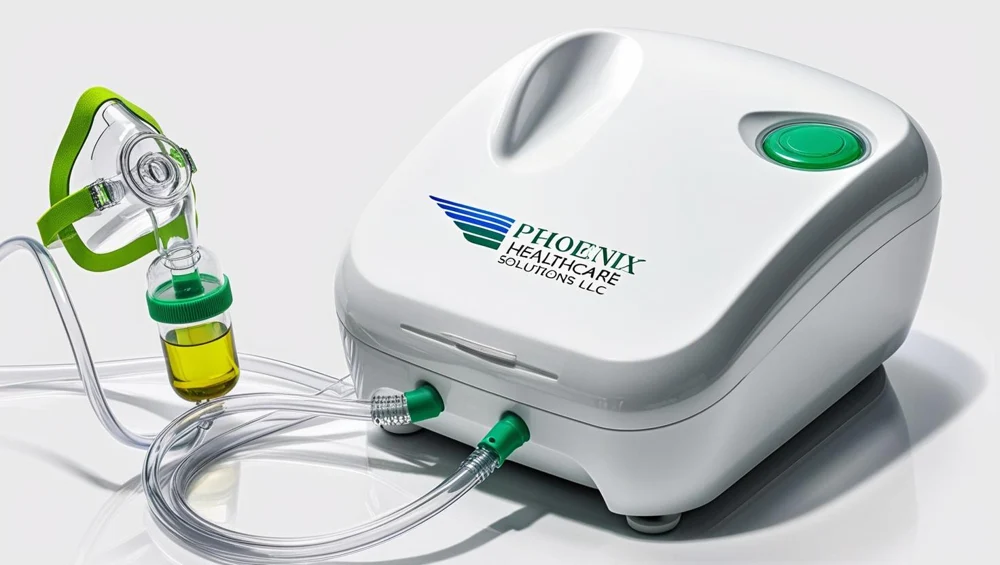
A bench compressor drives air through small-bore tubing into the base of a separate transparent cup with a conical lower body. The gas leaves a jet orifice at close to the speed of sound, the pressure drop beside it draws liquid up a feed channel (the venturi), the liquid is sheared into a spray, and the spray is thrown at an internal baffle that captures every large droplet and drains it back. What leaves through the cup top to the mouthpiece or mask is what the baffle let past.
Also called: Nebuliser. Arabic: جهاز الرذاذ. Device Lab 58 of 69 in BMEssentia Medical City, 2 configurations.
Overview: the configurations
Pneumatic jet cup driven by a bench compressor
A bench compressor drives air through small-bore tubing into the base of a separate transparent cup with a conical lower body. The gas leaves a jet orifice at close to the speed of sound, the pressure drop beside it draws liquid up a feed channel (the venturi), the liquid is sheared into a spray, and the spray is thrown at an internal baffle that captures every large droplet and drains it back. What leaves through the cup top to the mouthpiece or mask is what the baffle let past.
Self-contained vibrating-mesh unit
A palm-sized handheld unit carrying its mask on a short elbow, with a small liquid reservoir closed by a hinged lid. A piezoelectric ring vibrates a perforated plate at about a hundred kilohertz and each of about a thousand micrometre-scale apertures ejects droplets on its own. There is no compressor, no tubing and no gas flow anywhere in it; two cells and an oscillator are the whole energy source.
How it works: the main parts
What each part does, from the Nebulizer lessons in the 3D Device Lab.
- Enclosure and stand
- The enclosure holds the energy source and keeps it upright and away from the liquid. On the jet configuration it is a moulded clamshell box standing on a table or the floor, with a recess that stores the cup, mask and tubing; on the mesh configuration it is the palm-sized body of the handset itself.
- Power switch and indicator
- The power switch starts the energy source and its lit indicator says the source is running. On the jet unit it is a mains rocker switch with a lamp in it; on the handset it is a push button with a small light, drawing on the cells.
- Compressor intake filter
- A small felt or fibre pad behind a grille on the side of the compressor box, through which every litre of air the pump compresses is drawn. It keeps room dust out of the piston and, ultimately, out of the air that atomises the medicine.
- Piston compressor and motor
- A small electric motor driving a piston in a cylinder, with reed valves that let air in on the down-stroke and push it out on the up-stroke. It sits on soft mounts inside the box and is the whole energy source of the jet configuration: it supplies both the energy that shatters the liquid and the gas that carries the droplets away.
- Small-bore air tubing
- Two metres of clear plastic tube, 4 mm in bore, carrying compressed air from the compressor spigot to the connector under the cup. It is usually ignored, coiled in the storage recess, and it is the part most often stood on, rolled over or trapped under a bed wheel.
- Jet orifice
- 6 mm across at the top of a nozzle moulded into the base of the cup. Compressed air from the tubing arrives below it and leaves through it as a fine, very fast jet.
- Medication reservoir and cup body
- The reservoir holds the liquid medicine, usually a few millilitres, while it is turned into aerosol. On the jet configuration it is the transparent cup with a conical lower body; on the mesh unit it is a small well sitting on the back of the vibrating plate.
- Fill opening and graduations
- The opening the liquid is poured or squeezed into, with graduation marks in millilitres on the clear wall. On the jet cup it is the open top of the cup body under its screw-on top; on the mesh unit it is the mouth of the small reservoir under its hinged lid.
Explore it in the Device Lab
- The baffle: a size filter whose setting is the gas speed: This investigation is for the jet cup. Leave the faults alone and watch the size-distribution screen on the bench sizer while moving two controls: "Compressor dead-head pressure" (pumpMaxPressure) and "Flow area past the baffle" (bafflePassage). Read the cut d50, the mass median and the fraction in the one-to-five band each time.
- A throat already at the speed of sound: This investigation is for the jet cup; on the mesh unit there is no gas path at all. 5 bar and watch the flow and the pressure at the cup. 36 mm, which is also exactly what the "Dried drug has crusted the jet orifice" fault does.
- What the carrier gas takes away with it: This investigation is mainly for the jet cup, with the mesh unit as its control. Watch the dose budget board while moving "Volume loaded into the reservoir" (fillVolume) from 4 mL to 2 mL and to 8 mL, and read the vapour rate, the cooling, the fraction emitted and the concentration left in the residual. Then switch to the mesh unit and do the same.
- A plate whose faults change the clock and never the cloud: This investigation is for the mesh unit. 2, then inject "Dried residue is blocking apertures". 0 V, and finally inject "The piezo ring has debonded from the plate" and look at the indicator.
- From the cup to the airways: the dose budget, one factor at a time: This investigation is for both configurations. Watch the dose budget board, which multiplies four factors: the fraction of the fill that leaves the reservoir, the fraction made while the person is breathing in, the fraction that does not go round the seal, and the fraction of the mass in the one-to-five band. Move "Expiratory to inspiratory time" (ieRatio) between 1 and 3, move "Fraction lost round the mask seal" (maskLeak), and inject "The exhalation valve leaflet is stuck".
Common faults and what to check
Most reported device problems (FDA MAUDE)
| Device problem | Reports |
|---|---|
| Failure to Deliver | 420 |
| Leak/Splash | 222 |
| Connection Problem | 176 |
| Infusion or Flow Problem | 174 |
| Break | 170 |
| No Flow | 132 |
Raw counts of adverse event reports for this device type (FDA product code CAF), all years. Not adjusted for the number of units in use, so they show what gets reported, not failure rates. Report text is never copied.
Planned maintenance checks
From the BMEssentia procedure library: every 12 months, about 15 minutes, electrical class II, applied part type BF.
| Check | Pass when |
|---|---|
| Unit, filter and tubing Inspect the inlet filter, tubing connector and case. | Filter clean. |
| Output Measure compressor output or check the mesh aerosol output. | Per manufacturer. |
Test instruments: Pressure gauge or flow meter (compressor).
Recent FDA recalls
| Recall | Product and reason |
|---|---|
| Z-2514-2023 2023-09-14 | MEDLINE INDUSTRIES, LP - Northfield: HUDSON RCI Addipak, UNIT DOSE VIALS, 5mL Sterile 0.9% NaCl Solution for Inhalation USP. REF RHUD59U Product dispositioned for scrap for sterility failure investigation that was inadvertently shipped to customers. Root cause: Process control. |
| Z-1516-2021 2021-03-31 | Smiths Medical ASD Inc.: ACE MDI Spacer with Small Mask - Product Usage: designed to assist with the delivery of aerosolized medications from The firm became aware via complaints that one lot of ACE MDI Spacers with Small Masks and one lot of Palm Cups (Large) may have incorrect shipping box labels. Root cause: Process control. |
| Z-0710-2019 2019-02-04 | Medex Cardio-Pulmonary Inc., d.b.a. Smiths Medical Company: Portex 350 ml Sterile Water Humidifier w/5psi Adapt. Lack of sterility assurance: leaking containers which could lead to exposure to infectious agents. Root cause: Process control. |
| Z-0711-2019 2019-02-04 | Medex Cardio-Pulmonary Inc., d.b.a. Smiths Medical Company: Portex 550 ml Sterile Water Humidifier w/5psi Adapt. Lack of sterility assurance: leaking containers which could lead to exposure to infectious agents. Root cause: Process control. |
| Z-0712-2019 2019-02-04 | Medex Cardio-Pulmonary Inc., d.b.a. Smiths Medical Company: Portex 1000 ml Sterile Water USP Pour Bottle Lack of sterility assurance: leaking containers which could lead to exposure to infectious agents. Root cause: Process control. |
From the FDA recall database (openFDA), newest first, imported 2026-10-22. 36 recalls on record for this device type. Recall text is the FDA's public text; each recall links to the official record.
Learn it, see it in 3D, ask about it
- Ask Essentia about the Nebulizer: answers from named sources, with the device open in its 3D Device Lab beside the answer.
- The Nebulizer on the BMEssentia Platform: the Device Library course, 13 sections from physics to maintenance.
- BMEssentia Medical City: Device Lab 58, the Nebulizer fully assembled in 3D, with lab tasks and the simulations.
Previous: Phototherapy Unit. Next: Laryngoscope. All 69 devices.
Ask about the Nebulizer
Sign in with your BMEssentia account, or create one, and ask anything about this device.
Ask Essentia