

Essentia / Devices / Phototherapy Unit
Device Lab 57
Phototherapy Unit
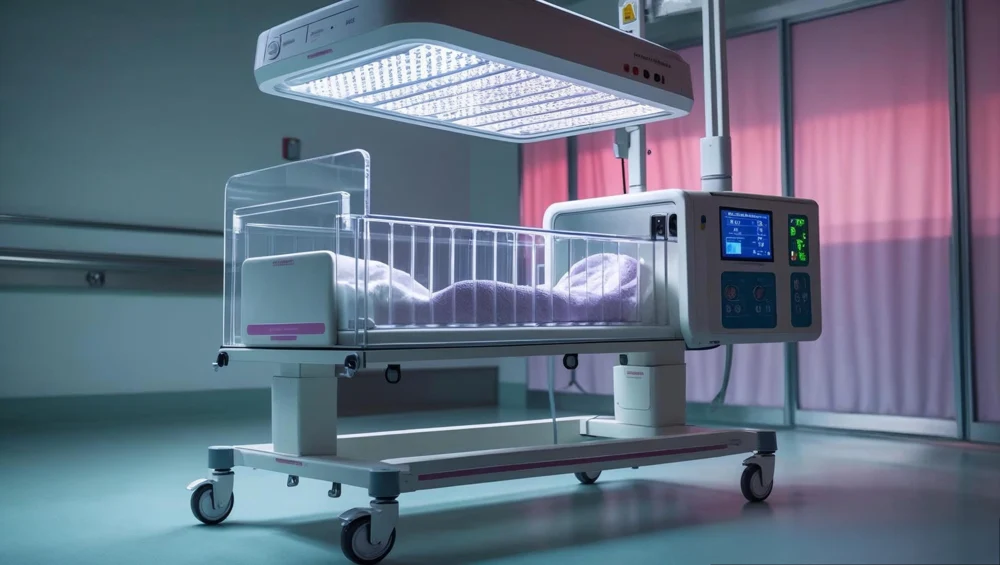
Forty-eight royal-blue emitters on a metal-core board behind a diffuser and a polycarbonate window, in a slim head on an arm over an open cot. Almost everything it radiates falls inside the absorption band, the whole light-facing aspect of the infant is treated at once, and the irradiance at the skin is set by how far above the mattress somebody left the head, which is a number on a scale nobody records and which the geometry of the room keeps changing.
Also called: Bili Light. Arabic: وحدة العلاج الضوئي. Device Lab 57 of 69 in BMEssentia Medical City, 2 configurations.
Overview: the configurations
Overhead LED array
Forty-eight royal-blue emitters on a metal-core board behind a diffuser and a polycarbonate window, in a slim head on an arm over an open cot. Almost everything it radiates falls inside the absorption band, the whole light-facing aspect of the infant is treated at once, and the irradiance at the skin is set by how far above the mattress somebody left the head, which is a number on a scale nobody records and which the geometry of the room keeps changing.
Fibre-optic biliblanket
A 220 watt quartz-halogen lamp in a box on a low cart, a dichroic band-pass filter, a fibre bundle, and a woven fibre-optic pad laid against the skin. The filter and the bundle between them throw away more than ninety per cent of the lamp’s radiant power and multiply the spectral overlap more than twentyfold, which is the entire reason an incandescent source can be pressed against a baby at all. The distance is zero and stays zero.
How it works: the main parts
What each part does, from the Phototherapy Unit lessons in the 3D Device Lab.
- Mains inlet, fuse and protective earth
- An appliance inlet, a fuse drawer, a rocker switch with a neon leg in it and an earth stud, all on one recessed plate at the back of whichever enclosure the configuration has. The neon is the only thing on either machine that tells you a supply has arrived.
- Constant-current driver and output stage
- A chassis tray with one populated board in it: reservoir capacitors, a switching transformer, an output stage on a small heatsink, a sense resistor, a connector out to the source, and a screwdriver-slot trimmer that nobody thinks about. That trimmer sets the radiant output of the whole machine.
- Heatsink, fan and cooling airway
- A finned aluminium block clamped to the source through a thermal pad, a fan in a guarded housing, an intake grille and a set of exhaust louvres somewhere else. On the configuration that hangs over the cot the block is in the head and the fan is not, it is down in the column enclosure, cooling the driver instead.
- Control fascia and irradiance selector
- A raked panel with a small display window, five membrane keys, a rotary drive selector and printed legends beside all of them. Read it from end to end and the significant thing is what is not on it: there is no irradiance anywhere, and there is a greyed line of text saying so.
- Treatment timer and source-hours counter
- Two counters behind the same fascia, and the difference between them is the point. One is a digital window that counts this treatment and is reset by a key.
- Thermal cut-out and source-fail detection
- Two small, unglamorous circuits that between them are the only automatic protections on the machine. A bimetal disc clamped to the source’s thermal path with a relay in series with the source, and a comparator watching the driver’s sense shunt for a source that has gone open circuit.
- Hand-held spectral irradiance meter
- A moulded hand-held box with a small display, two keys, a band-select switch, and a sensor head on a lead. It is not part of either machine, it is the only thing in the system that knows the dose, and on most units it lives in a drawer.
- Distance-irradiance chart and rating plate
- A printed label on the back of the enclosure with a short table on it: a distance in one column and an irradiance in the other, a waveband, and the words "new source". Beside it a rating plate giving the source type and the electrical classification.
Explore it in the Device Lab
- Two lamps that look the same and differ sixfold: Fit four different sources in turn at the same drive and the same distance, and watch two numbers move in opposite directions: the irradiance inside the absorption band, and how bright the thing looks.
- The falloff, and why it is not inverse square: Sweep the head from a hundred and fifty millimetres to seven hundred and watch the irradiance. Then plot what an inverse-square law would have predicted from one of those readings, and look at the gap.
- The third factor, and it is a nappy: Hold the irradiance fixed and change nothing but what the infant is wearing and how it is lying, and watch the dose rate move by a fifth.
- What ninety per cent of a lamp is thrown away for: On the contact configuration, take the band-pass out of its holder and watch two numbers rise. One of them is the blue irradiance, which looks like an improvement. The other is the total irradiance at a pad that is against skin.
- The only feedback path, and nobody checks it: There is exactly one instrument in this system that measures the quantity the treatment depends on, and it belongs to neither machine. Put the fault in it and watch what happens: nothing. There is nothing in the device that can disagree with it.
Common faults and what to check
Most reported device problems (FDA MAUDE)
| Device problem | Reports |
|---|---|
| Overheating of Device | 421 |
| Melted | 419 |
| Device Issue | 83 |
| Device Operational Issue | 47 |
| Low Test Results | 45 |
| Output Problem | 19 |
Raw counts of adverse event reports for this device type (FDA product code LBI), all years. Not adjusted for the number of units in use, so they show what gets reported, not failure rates. Report text is never copied.
Standards engineers test against
IEC 60601-2-50: infant phototherapy equipment
The particular standard for neonatal phototherapy.
Recent FDA recalls
| Recall | Product and reason |
|---|---|
| Z-0923-2020 2019-12-11 | Lumitex Inc: Giraffe Blue Spot PT LiteTM Phototherapy System, Model Numbers M1224917, M1231533, M1225025, M1224961, M1224958, There is a potential for some systems built between 2014 and Jan 2018 to have a light output falling below the recommended minimum output. Root cause: Device Design. |
| Z-1924-2017 2017-04-14 | Natus Medical Incorporated: Second generation neoBLUE LED Phototherapy Light (neoBLUE 2) sold between 2003 and 2008. Catalog Part Number 010066. Top The second generation neoBLUE 2 lights with a black band, sold from 2003 to 2008, are recalled so it will eliminate the possibility that a neoBLUE system may have a replacement board installed which allows it to be used. Root cause: Component change control. |
| Z-0769-2017 2016-12-15 | Natus Medical Incorporated: Updated Natus neoBLUE blanket LED Phototherapy Systems. It provides phototherapy underneath the infant and can be used The firm sent the Technical Bulletin to consignees who received the reliability updated neoBLUE blanket LED Phototherapy Systems between March 2016 to August 2016. Root cause: Device Design. |
| Z-1503-2017 2016-11-18 | Ohmeda Medical: Giraffe Spot PT Certain power cords could overheat. Root cause: Under Investigation by firm. |
| Z-0770-2017 2016-10-28 | Natus Medical Incorporated: Natus neoBLUE blanket LED Phototherapy system, neonatal phototherapy. Used to provide treatment for neonatal neoBLUE blanket LED Phototherapy System distributed since release of the product in 2011 is recalled due to customer complaints regarding discoloration/ degradation of fiberoptic bundle at connection of pad and box. Root cause: Device Design. |
From the FDA recall database (openFDA), newest first, imported 2026-10-22. 14 recalls on record for this device type. Recall text is the FDA's public text; each recall links to the official record.
Learn it, see it in 3D, ask about it
- Ask Essentia about the Phototherapy Unit: answers from named sources, with the device open in its 3D Device Lab beside the answer.
- The Phototherapy Unit on the BMEssentia Platform: the Device Library course, 13 sections from physics to maintenance.
- BMEssentia Medical City: Device Lab 57, the Phototherapy Unit fully assembled in 3D, with lab tasks and the simulations.
Previous: Infusion Pump. Next: Nebulizer. All 69 devices.
Ask about the Phototherapy Unit
Sign in with your BMEssentia account, or create one, and ask anything about this device.
Ask Essentia