

Essentia / Devices / Cardiac Monitor
Device Lab 38
Cardiac Monitor
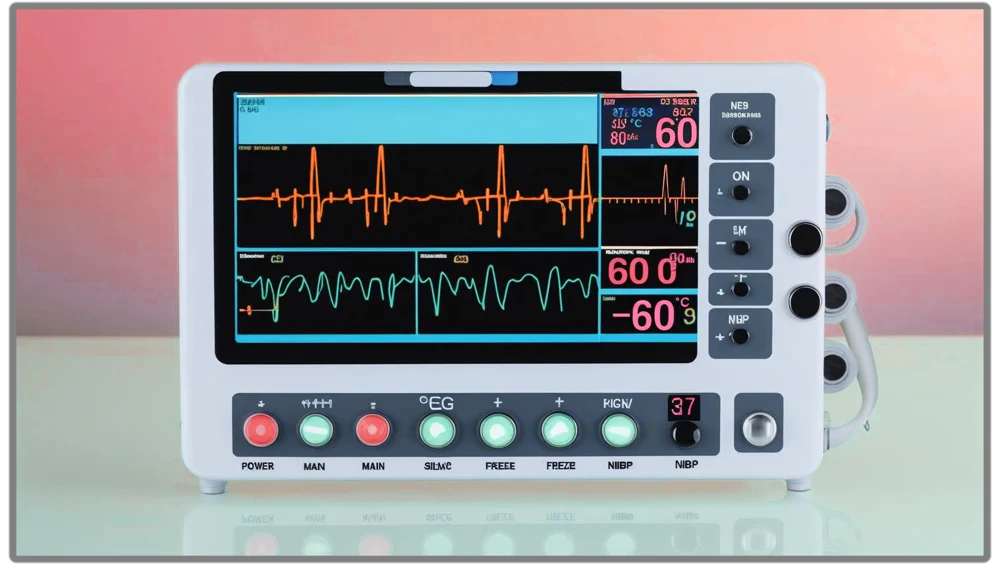
Five electrodes on the torso, three limb positions, a driven reference and one chest position, giving seven leads, of which three carry information and four are arithmetic. The passband runs from half a hertz to forty, and there is a mains notch filter available, because nothing here is going to be measured to a tenth of a millivolt.
Also called: Patient Monitor, Bedside Monitor. Arabic: جهاز مراقبة القلب. Device Lab 38 of 69 in BMEssentia Medical City, 2 configurations.
Overview: the configurations
Bedside monitoring, five electrodes
Five electrodes on the torso, three limb positions, a driven reference and one chest position, giving seven leads, of which three carry information and four are arithmetic. The passband runs from half a hertz to forty, and there is a mains notch filter available, because nothing here is going to be measured to a tenth of a millivolt.
Diagnostic acquisition, ten electrodes
Ten electrodes, the same three limb positions and driven reference, plus six precordial positions at published anatomical landmarks, giving twelve leads, of which eight carry information and four are arithmetic. The passband runs from a twentieth of a hertz to a hundred and fifty, and there is no notch filter, because fifty hertz is inside the QRS.
How it works: the main parts
What each part does, from the Cardiac Monitor lessons in the 3D Device Lab.
- Electrode and the electrode-skin interface
- A foam disc fifty millimetres across with a blob of conductive gel in the middle, a small disc of silver coated in silver chloride sitting in the gel, and a stud on the back for the wire to clip to. It costs pennies, it is thrown away after one patient, and it decides the performance of everything behind it.
- Patient leadwires and trunk cable
- A bundle leaving a keyed socket on the front of the monitor, running to a small block that lies on the bed, and fanning out from there into one thin wire per electrode. Each wire ends in a sprung clip.
- Defibrillation protection and input current limiting
- A row of series resistors and a clamp device per channel, sitting between the connector and everything else. They are the largest passive parts on the input board and they exist for an event that may never happen and must be survived if it does.
- Lead selection, input impedance and lead-off detection
- A multiplexer, a set of buffers, and a small source that injects a current far above the signal band into every electrode. Between them they decide which electrodes form which leads, how much the amplifier loads the skin, and whether an electrode is connected at all.
- Instrumentation amplifier
- One chip, a handful of resistors, and the component everybody names when asked what a monitor is. It takes two inputs and produces the difference between them multiplied by a few hundred, and it is not the thing that decides whether that works.
- Driven reference electrode and common-mode feedback
- A fourth electrode with no lead attached to it, and one operational amplifier. It is the only electrode on the patient that the monitor drives rather than listens to, and it is the reason the other electrodes work.
- Sigma-delta digitiser
- One converter per channel, twenty-four bits, running at a few thousand samples a second. It is unremarkable to look at and its specification is decided entirely by something that is not the signal.
- Digital filtering and baseline restoration
- A processor and some code. It is where the passband actually lives, where the baseline is pulled back to the middle of the screen, and where every decision about what to discard is made.
Explore it in the Device Lab
- Where the rejection is actually lost: Set the amplifier rejection and the input impedance where they are, then move only the imbalance between two electrodes and watch what arrives at the input.
- Skin preparation, as a number: Fix the allowance at one millimetre on the trace and solve the same relation backwards for the largest imbalance that fits inside it.
- What a corner frequency costs: Put the standard impulse, three millivolts for a hundred milliseconds, through each high-pass corner in turn and measure the displacement it leaves behind.
- What the top of the band costs: Change only the upper corner and watch a pacing pulse, a rise time and a rejection all move together.
- Twelve leads and eight of anything: Write the leads out as weights on the electrodes and count the independent ones.
Common faults and what to check
Most reported device problems (FDA MAUDE)
| Device problem | Reports |
|---|---|
| No Audible Alarm | 4,029 |
| Device Operates Differently Than Expected | 3,127 |
| Device Alarm System | 3,102 |
| Communication or Transmission Problem | 2,050 |
| Patient Device Interaction Problem | 2,014 |
| Device Displays Incorrect Message | 1,610 |
Raw counts of adverse event reports for this device type (FDA product code DRT, MHX), all years. Not adjusted for the number of units in use, so they show what gets reported, not failure rates. Report text is never copied.
Standards engineers test against
IEC 60601-2-27: ECG monitoring equipment
The particular standard for electrocardiographic monitoring (bedside and central monitors).
IEC 60601-2-34: invasive blood pressure monitoring
The particular standard for invasive pressure monitoring equipment.
Recent FDA recalls
| Recall | Product and reason |
|---|---|
| Z-0199-2027 2026-10-16 | Philips North America: Philips Smart-hopping 2.0 AP 1.4 GHz Unreliable wireless roaming behavior of Smart-hopping 1.0 wireless clients during transport when connecting to Smart-hopping 2.0 infrastructure, resulting in loss of connectivity to the central monitoring system (PIC. Root cause: Software design. |
| Z-0109-2027 2026-10-07 | Mindray DS USA, Inc.: ePM Series Patient Monitor. Patient Monitor Series: ePM 10M/ePM 12M/ePM 12MA/ ePM 15M/ePM 10A Certain monitor operator's manuals contain descriptions that may be insufficient or may require clarification regarding selected physiological alarm functions Root cause: Labeling design. |
| Z-0110-2027 2026-10-07 | Mindray DS USA, Inc.: BeneVision N1 and N-Series Patient Monitor. Patient Monitor: N12/N15/N17/N19/N22. Certain monitor operator's manuals contain descriptions that may be insufficient or may require clarification regarding selected physiological alarm functions Root cause: Labeling design. |
| Z-0113-2027 2026-10-07 | Mindray DS USA, Inc.: BeneView Series. Operator's Manuals: T5 / T8 Certain monitor operator's manuals contain descriptions that may be insufficient or may require clarification regarding selected physiological alarm functions Root cause: Labeling design. |
| Z-0114-2027 2026-10-07 | Mindray DS USA, Inc.: Passport Series Patient Monitor. Operator's Manuals: 8 / 12 / 12M / 17M / V Certain monitor operator's manuals contain descriptions that may be insufficient or may require clarification regarding selected physiological alarm functions Root cause: Labeling design. |
From the FDA recall database (openFDA), newest first, imported 2026-10-22. 305 recalls on record for this device type. Recall text is the FDA's public text; each recall links to the official record.
Learn it, see it in 3D, ask about it
- Ask Essentia about the Cardiac Monitor: answers from named sources, with the device open in its 3D Device Lab beside the answer.
- The Cardiac Monitor on the BMEssentia Platform: the Device Library course, 13 sections from physics to maintenance.
- BMEssentia Medical City: Device Lab 38, the Cardiac Monitor fully assembled in 3D, with lab tasks and the simulations.
Previous: Transcranial Doppler. Next: ECG. All 69 devices.
Ask about the Cardiac Monitor
Sign in with your BMEssentia account, or create one, and ask anything about this device.
Ask Essentia