

Device Lab 13
IVUS
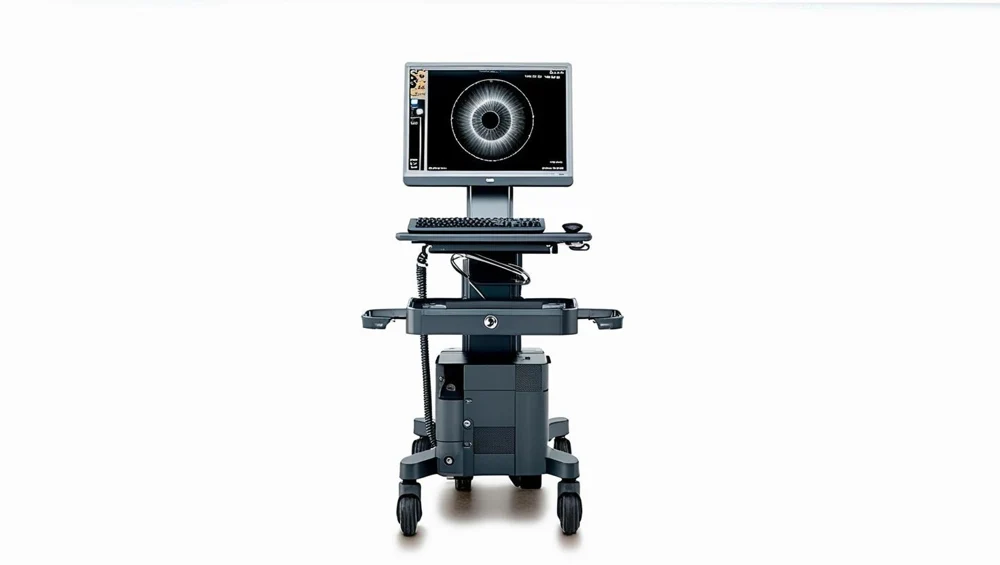
One piezoelectric element, six tenths of a millimetre across, cemented to the end of a flexible torque shaft and spun inside a sealed sheath at eighteen hundred revolutions a minute. It fires two hundred and fifty-six times per turn, so one revolution is one cross-sectional frame and thirty turns a second are thirty frames. The sheath stays still while the shaft inside it rotates, and the space between them has to be filled with saline, because a bubble of air in that gap reflects essentially the whole beam.
Also called: Intravascular Ultrasound. Arabic: الموجات فوق الصوتية داخل الأوعية. Device Lab 13 of 69 in BMEssentia Medical City, 2 configurations.
Overview: the configurations
Mechanically rotated single transducer
One piezoelectric element, six tenths of a millimetre across, cemented to the end of a flexible torque shaft and spun inside a sealed sheath at eighteen hundred revolutions a minute. It fires two hundred and fifty-six times per turn, so one revolution is one cross-sectional frame and thirty turns a second are thirty frames. The sheath stays still while the shaft inside it rotates, and the space between them has to be filled with saline, because a bubble of air in that gap reflects essentially the whole beam.
Solid-state phased array around the tip
Sixty-four elements in a ring around the catheter tip, with the multiplexer and the preamplifiers on a chip immediately behind them, because sixty-four coaxial cores will not fit down a one-millimetre catheter and a signal of a few microvolts will not survive being sent down them if they did. Groups of fourteen adjacent elements are fired together to form one beam, and the group is stepped around the ring electronically. Nothing moves, nothing has to be flushed, and the frame rate is whatever the electronics choose.
How it works: the main parts
What each part does, from the IVUS lessons in the 3D Device Lab.
- Mains inlet, isolation and protective earth
- An appliance inlet, a fuse, an equipotential stud and a rating plate on the back of the rack, and behind them a transformer whose entire purpose is to make sure that no fault anywhere in this machine can put a voltage on the conductor that runs to a transducer inside somebody heart.
- Transmit pulser
- A high-voltage switch that slams a few tens of volts across a piece of piezoelectric ceramic for about fifty nanoseconds and then stops, and then waits for eight microseconds doing nothing at all. On one configuration there is one of them.
- Preamplifier and time-gain compensation
- A low-noise amplifier whose gain climbs while it is listening, and on one of the two configurations it is not in the console at all, it is on a chip inside the catheter tip, a millimetre from the elements, because a signal of a few microvolts will not survive a metre of anything.
- Digitiser
- The most expensive board in the rack, and the reason this device costs what it does. A forty megahertz pulse two cycles long has a bandwidth to match, and sampling it faithfully means converting at a rate that most medical electronics never approaches.
- Envelope detection, compression and polar scan conversion
- The stage that turns a numbered series of echoes into a disc. It rectifies and smooths each line into an envelope, compresses a hundred and twenty decibels of amplitude into the thirty a screen can show, and then writes each line outwards from the centre at the angle the reconstruction believes it was taken at.
- Cross-sectional display and measurement calipers
- A screen showing a disc with a hole in the middle of it, and two tools for tracing a border on that disc and reporting the area it encloses. The number those tools produce is the deliverable of the entire device, and it is the number the one idea of this device is about.
- Longitudinal display and pullback reconstruction
- A second screen showing the vessel along its length, assembled out of the cross-sections by stacking one diameter from each of them side by side. It is the only view on this device that has a length in it, and that length is not measured.
- Console control panel
- A deck of keys, two rotary controls and a trackball, with a small strip above it showing the last area that was measured. Four keys matter: area, distance, bookmark and pullback, and the bookmark is the one that decides whether anybody can find the frame again.
Explore it in the Device Lab
- The cosine that divides every area: Set the tilt to zero, note the area, then step it out in five degree increments and watch two things: the number, and how plausible the picture continues to look.
- The error that costs nothing, and the one that costs everything: Set the tilt to zero and the eccentricity to eighty per cent, and watch the area. Then set the eccentricity back to zero and the tilt to twenty degrees, and watch it again.
- A revolution that closes and is wrong everywhere: On the rotational configuration, introduce a binding shaft and watch the shape of the lumen, then watch the area.
- Sixteen times the speckle for twice the frequency: Turn the flush down to zero on each configuration in turn, and compare the speckle index against the wall line.
- A third dimension made of time: Put the system into a pullback, introduce a slipping carriage, and watch what happens to the lengths. Then switch between a continuous pullback and a gated one and watch the frame spacing.
Common faults and what to check
Most reported device problems (FDA MAUDE)
| Device problem | Reports |
|---|---|
| Retraction Problem | 1,167 |
| Entrapment of Device | 1,074 |
| Poor Quality Image | 1,003 |
| No Display/Image | 804 |
| Detachment of Device or Device Component | 678 |
| Air/Gas in Device | 477 |
Raw counts of adverse event reports for this device type (FDA product code OBJ, OWQ), all years. Not adjusted for the number of units in use, so they show what gets reported, not failure rates. Report text is never copied.
Planned maintenance checks
From the BMEssentia procedure library: every 12 months, about 45 minutes, electrical class I, applied part type CF.
| Check | Pass when |
|---|---|
| Console and patient interface module Inspect the console, the pullback unit and its connector. | No damage. |
| Electrical safety Test to IEC 62353 (cath lab, Group 2). | PE ≤ 0.30 Ω; applied part CF ≤ 50 µA. |
| Pullback and recording Run the pullback at each speed; record and export a test run. | Per manufacturer. |
Test instruments: Electrical safety analyser.
Recent FDA recalls
| Recall | Product and reason |
|---|---|
| Z-2379-2026 2026-06-13 | ARROW INTERNATIONAL, LLC: Description/REF: Lidocaine, Bupivacaine, and 0.9% sodium chloride, the subject of a supplier recall, were included into kits and sets. Root cause: Nonconforming Material/Component. |
| Z-1323-2026 2026-02-06 | Medline Industries, LP: Medline ReNewal Reprocessed ViewFlex Xtra ICE Catheters: These lots of reprocessed catheters may contain small particles of residual material. Root cause: Under Investigation by firm. |
| Z-1324-2026 2026-02-06 | Medline Industries, LP: Reprocessed Biosense Webster SOUNDSTAR eco Diagnostic Ultrasound Catheters: These lots of reprocessed catheters may contain small particles of residual material. Root cause: Under Investigation by firm. |
| Z-1325-2026 2026-02-06 | Medline Industries, LP: Reprocessed Siemens ACUSON AcuNav Diagnostic Ultrasound Catheters: These lots of reprocessed catheters may contain small particles of residual material. Root cause: Under Investigation by firm. |
| Z-0573-2026 2025-11-20 | Sterilmed, Inc.: Brand Name: ACUSON, CATHETER ACUNAV DIAGNOSTIC ULTRASOUND 8FR NOT FOR USE WITH SIEMENS SYSTEM Affected catheters were reprocessed beyond validated cycles. Root cause: Reprocessing Controls. |
From the FDA recall database (openFDA), newest first, imported 2026-10-22. 33 recalls on record for this device type. Recall text is the FDA's public text; each recall links to the official record.
Learn it, see it in 3D, ask about it
- Ask Essentia about the IVUS: answers from named sources, with the device open in its 3D Device Lab beside the answer.
- The IVUS on the BMEssentia Platform: the Device Library course, 13 sections from physics to maintenance.
- BMEssentia Medical City: Device Lab 13, the IVUS fully assembled in 3D, with lab tasks and the simulations.
Previous: TEE Probe. Next: IONM. All 69 devices.
Ask about the IVUS
Sign in with your BMEssentia account, or create one, and ask anything about this device.
Ask Essentia