

Essentia / Devices / Intra-aortic Balloon Pump
Device Lab 9
Intra-aortic Balloon Pump
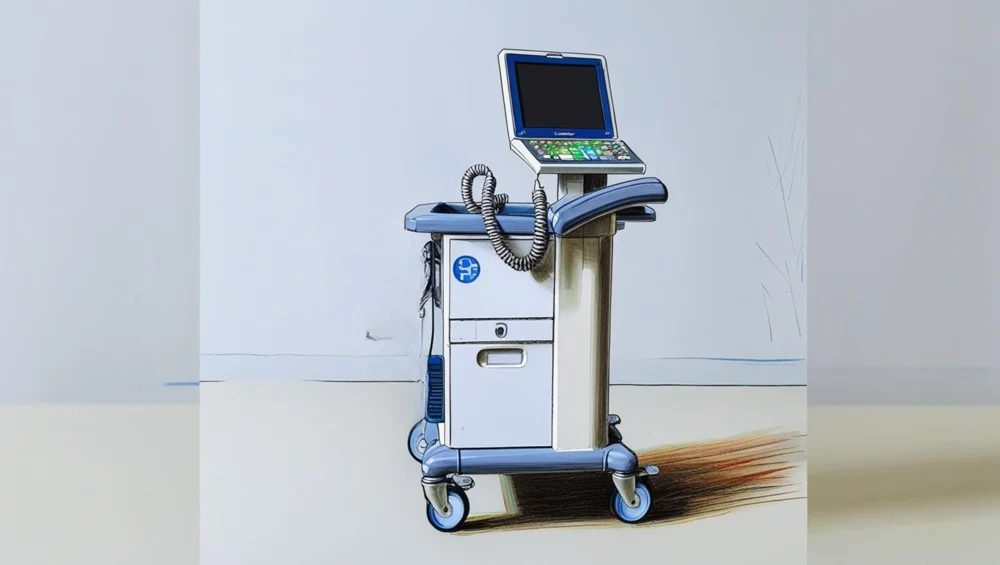
A three-electrode ECG into the console, an R wave detector with a pacing-pulse rejection stage in front of it, and a timing controller that places inflation a learned interval after the R wave and fires deflation on the next R wave. The gas is helium and the balloon is the one the patient’s height indexes.
Also called: Balloon Pump. Arabic: مضخة البالون داخل الأبهر. Device Lab 9 of 69 in BMEssentia Medical City, 2 configurations.
Overview: the configurations
ECG-triggered timing
A three-electrode ECG into the console, an R wave detector with a pacing-pulse rejection stage in front of it, and a timing controller that places inflation a learned interval after the R wave and fires deflation on the next R wave. The gas is helium and the balloon is the one the patient’s height indexes.
Pressure-triggered timing
The arterial pressure waveform from a transducer at the balloon tip into the console, a dicrotic notch detector with an amplitude threshold, a square-wave damping test that decides whether the channel can carry the notch at all, and a timing controller that fires inflation on the detected notch and places deflation a learned interval before the expected upstroke.
How it works: the main parts
What each part does, from the Intra-aortic Balloon Pump lessons in the 3D Device Lab.
- Balloon membrane and its fold
- A sleeve of polyurethane about a tenth of a millimetre thick, a couple of hundred millimetres long and sixteen or so across when it is open, wrapped tightly round the end of a catheter so that it goes down a hole a few millimetres wide. It is the only part of this machine that touches blood and the only part that moves.
- Dual-lumen catheter shaft
- A slim tube about two and a half millimetres across and something over seven hundred millimetres long, stiff enough to be pushed up an artery and flexible enough to follow an aortic arch. It carries printed depth markings along it and ends in a moulded Y hub with two arms, and it is the object the entire device is delivered through.
- Helium shuttle lumen
- A ring-shaped passage a fraction of a millimetre across, running the whole length of the catheter between the outer wall and the central tube. It is invisible, it has no moving parts, and it is the single component that decides whether this machine can work at the heart rate the patient happens to have.
- Central lumen and tip pressure port
- A tube under a millimetre across running down the middle of the catheter, opening at a port just beyond the distal end of the membrane. On the way in it carries a guidewire.
- Radiopaque tip marker and the aortic window
- A short dense band at the tip of the catheter, visible on a radiograph when nothing else useful is, plus the two anatomical limits it has to sit between. This component is not really an object: it is a constraint, and the marker exists so that somebody can check the constraint is being met.
- Introducer sheath and haemostasis valve
- A short tube through the wall of a femoral artery with a valve on the outside end, a small side arm with a tap on it, and a flat wing with two sutures through it. It is the hole this device is delivered through and the reason the leg beyond it has to be looked at every hour.
- Helium cylinder, regulator and contents
- A small aluminium cylinder in a cradle at the back of the console with a coloured collar, a valve, a regulator and a round contents gauge. It holds the only consumable the machine cannot work without, and the only thing that says how much of it is left is a dial somebody has to walk round the back and look at.
- Gas isolator and volume-limited safety chamber
- A clear chamber inside the cabinet with a flexible diaphragm across the middle of it and a graduated scale etched on the outside. On one side of the diaphragm is the gas that goes to the patient; on the other is the gas the console pushes.
Explore it in the Device Lab
- The one number this device has: Leave both instants where they are and change only the arterial compliance. Then change only the balloon volume. Watch what happens to the augmented diastolic pressure and to the afterload reduction, and notice that only one quantity is moving underneath both of them.
- Where the sign changes: Put the balloon volume and the patient where they are and move only the deflation instant, a few milliseconds at a time, from well before the next ejection to well after it. Watch the aortic pressure at the onset of that ejection.
- Why the cylinder contains helium: Change only the gas. Keep the volume, the lumen, the drive pressure and the vacuum exactly where they are, and read off the fill time, the vent time and the rate at which one-to-one assist stops fitting inside a diastole.
- Which instant is guessed: Set the current heart rate and leave it. Then change only the PREVIOUS beat’s rate, and watch which of the two instants moves. Do it on both configurations.
- What the index cannot see: Inject a late deflation and then read the supply-and-demand ratio. It is still well above its unassisted value. Now read the end-diastolic pressure of the following beat and notice that it is higher than it would have been with no balloon at all.
Common faults and what to check
Most reported device problems (FDA MAUDE)
| Device problem | Reports |
|---|---|
| Gas/Air Leak | 5,437 |
| Appropriate Device Problem Term/Code Not Available | 4,163 |
| Leak/Splash | 3,844 |
| Replace | 3,801 |
| Device Displays Incorrect Message | 3,113 |
| Inability to Auto-Fill | 2,985 |
Raw counts of adverse event reports for this device type (FDA product code DSP), all years. Not adjusted for the number of units in use, so they show what gets reported, not failure rates. Report text is never copied.
Planned maintenance checks
From the BMEssentia procedure library: every 12 months, about 75 minutes, electrical class I, applied part type CF.
| Check | Pass when |
|---|---|
| Console, helium and cables Inspect the console, helium cylinder and regulator, the catheter extender and ECG and pressure cables. | No damage; cylinder above the manufacturer's minimum. |
| Electrical safety Test to IEC 62353. | PE ≤ 0.30 Ω; equipment leakage ≤ 500 µA; applied part CF ≤ 50 µA. |
| Triggering and timing With the simulator, trigger on ECG and then on pressure at several heart rates; check inflation and deflation timing markers. | Stable triggering; timing adjustable as described. |
| Alarms Simulate loss of trigger, helium leak (manufacturer's test) and low battery. | Each alarm sounds; pumping responds as designed. |
| Battery Run on battery for the manufacturer's test period. | At least the stated run time. |
Test instruments: Patient simulator (ECG and arterial pressure); Electrical safety analyser.
Recent FDA recalls
| Recall | Product and reason |
|---|---|
| Z-1587-2026 2026-03-19 | Datascope Corp.: Battery Charging Station The Battery Charging Station is an optional dual-bay charger used to charge the Cardiosave IABP Lithium- Ion batteries when they are not being used to operate the IABP. Root cause: Under Investigation by firm. |
| Z-1486-2026 2026-03-03 | Datascope Corp.: CS100 IABP. Software Version CS100 IABP Q.01. The firm has identified that the battery runtime and cycle specifications contained in the devices Instructions for Use (IFU) need to be updated. Root cause: Under Investigation by firm. |
| Z-1487-2026 2026-03-03 | Datascope Corp.: CS300 IABP. Software Version CS300 IABP C.01. The firm has identified that the battery runtime and cycle specifications contained in the devices Instructions for Use (IFU) need to be updated. Root cause: Under Investigation by firm. |
| Z-0931-2026 2025-12-16 | Datascope Corp.: Cardiosave Hybrid The IFU addendum updates the Vibration and Shock Table to reference the correct standards. Root cause: Process change control. |
| Z-0932-2026 2025-12-16 | Datascope Corp.: Cardiosave Rescue The IFU addendum updates the Vibration and Shock Table to reference the correct standards. Root cause: Process change control. |
From the FDA recall database (openFDA), newest first, imported 2026-10-22. 194 recalls on record for this device type. Recall text is the FDA's public text; each recall links to the official record.
Learn it, see it in 3D, ask about it
- Ask Essentia about the Intra-aortic Balloon Pump: answers from named sources, with the device open in its 3D Device Lab beside the answer.
- The Intra-aortic Balloon Pump on the BMEssentia Platform: the Device Library course, 13 sections from physics to maintenance.
- BMEssentia Medical City: Device Lab 9, the Intra-aortic Balloon Pump fully assembled in 3D, with lab tasks and the simulations.
Previous: ECMO. Next: Ventilator. All 69 devices.
Ask about the Intra-aortic Balloon Pump
Sign in with your BMEssentia account, or create one, and ask anything about this device.
Ask Essentia