

Device Lab 8
ECMO
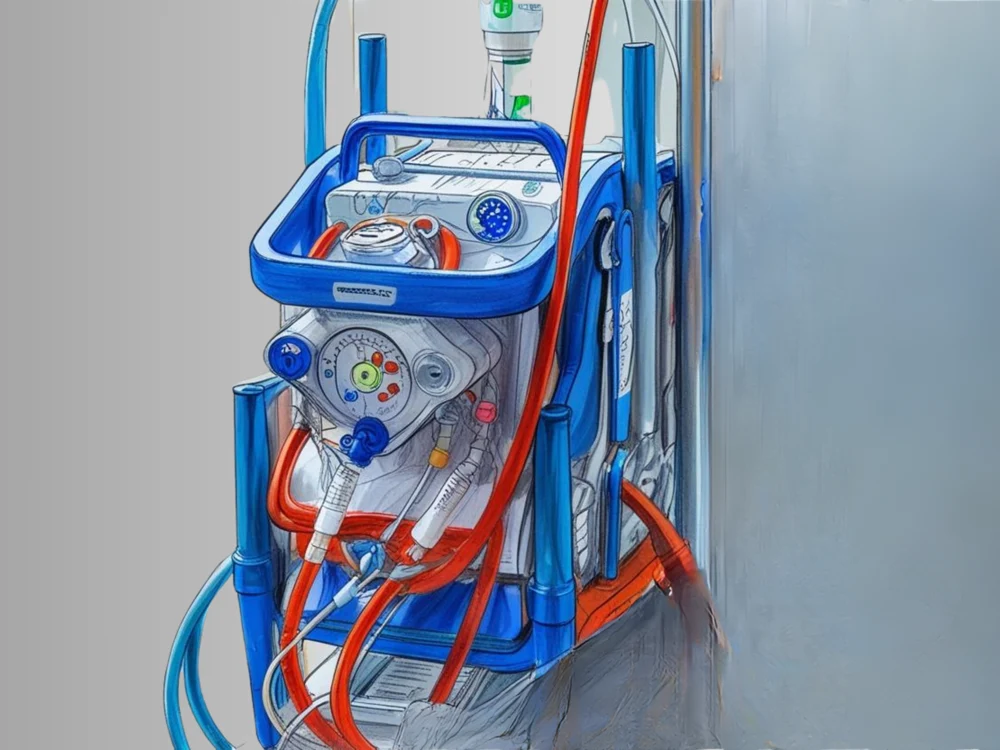
Blood is drained from a vein and returned to a vein. The machine replaces the lungs and nothing else: the patient’s own heart still does all the pumping, and the one failure particular to this arrangement is the circuit treating its own blood instead of the patient’s.
Also called: Extracorporeal Membrane Oxygenation. Arabic: جهاز الأكسجة الغشائية خارج الجسم. Device Lab 8 of 69 in BMEssentia Medical City, 2 configurations.
Overview: the configurations
Veno-venous ECMO
Blood is drained from a vein and returned to a vein. The machine replaces the lungs and nothing else: the patient’s own heart still does all the pumping, and the one failure particular to this arrangement is the circuit treating its own blood instead of the patient’s.
Veno-arterial ECMO
Blood is drained from a vein and returned to an artery. The machine replaces the lungs and the circulation both, which means it runs against whatever the heart is still doing, adds load to it, and starves the limb its return cannula occupies.
How it works: the main parts
What each part does, from the ECMO lessons in the 3D Device Lab.
- Drainage cannula and access
- A wide wire-reinforced tube in a femoral vein, with a pump on the end of it pulling. This is where the whole circuit begins and it is the one part of it that is inside a person for weeks at a time.
- Circuit tubing and connectors
- A few metres of coated plastic between a person and a machine, taped in loops, labelled with white wrap and inspected with a torch several times a day. It is the least impressive component here and the one that gets looked at most.
- Centrifugal blood pump
- A short red cylinder standing on the deck, spinning fast enough that its contents are thrown outward. It is the entire blood path of the pump and it is thrown away with the circuit.
- Flow probe
- A small clamp on the tubing just after the pump, with a cable back to the console. It is the only instrument on this machine that knows what is actually being delivered.
- Pre-membrane pressure and gas
- A transducer and a small sensor head on the line between the pump and the membrane. Together they describe what the pump is pushing into.
- Membrane oxygenator
- A flat diamond of translucent plastic bolted to the front of the cart, with blood crossing it one way and gas the other. It is the lung, and it is the component that decides how long this circuit lasts.
- Air and oxygen blender
- A small box on its own pole with two knobs, a flowmeter window and teal tubing running to it. It sets what the membrane is offered, and it is not part of the cart.
- Heater-cooler and water circuit
- A separate wheeled box standing beside the cart with two water lines running to the oxygenator. It never touches blood and it has caused more concern than most things that do.
Common faults and what to check
Most reported device problems (FDA MAUDE)
| Device problem | Reports |
|---|---|
| Fluid/Blood Leak | 261 |
| Communication or Transmission Problem | 90 |
| Mechanical Problem | 82 |
| Output Problem | 81 |
| Incorrect, Inadequate or Imprecise Result or Readings | 79 |
| Leak/Splash | 78 |
Raw counts of adverse event reports for this device type (FDA product code QJZ, BYS), all years. Not adjusted for the number of units in use, so they show what gets reported, not failure rates. Report text is never copied.
Planned maintenance checks
From the BMEssentia procedure library: every 6 months, about 120 minutes, electrical class I, applied part type CF.
| Check | Pass when |
|---|---|
| Console, drive and cart Inspect the console, the pump drive, the hand crank, flow and pressure sensors, cables, gas lines and the cart brakes. | No damage; hand crank engages the pump head. |
| Electrical safety Test console and heater-cooler to IEC 62353. | PE ≤ 0.30 Ω; equipment leakage ≤ 500 µA; applied part CF ≤ 50 µA. |
| Flow and pressure accuracy Run a primed test loop and compare displayed flow with the reference probe at low, mid and high flow; check pressure readings against the reference. | Within the manufacturer's accuracy. |
| Battery run time From full charge, run on battery at the stated flow to the low-battery alarm. | At least the manufacturer's stated time. |
| Alarms Trigger the low-flow, pressure, bubble (if fitted) and power-fail alarms. | Each alarm sounds and shows. |
| Heater-cooler hygiene Check the disinfection log and water tests against the manufacturer's schedule. | Up to date; no overdue disinfection. |
Test instruments: Ultrasonic flow probe reference; Pressure reference; Electrical safety analyser; Thermometer reference.
Recent FDA recalls
| Recall | Product and reason |
|---|---|
| Z-1822-2024 2024-05-15 | Fresenius Medical Care Holdings, Inc.: Novalung sensor box is a component of the Novalung Console (F30000162)-Indicated for long-term (> 6 hours) respiratory/ Issue related to Novalung sensor box, which is a component of the Novalung Console (Part Number F30000163). Root cause: Device Design. |
| Z-1309-2024 2024-03-19 | Mc3 Inc: NautilusTM ECMO Oxygenator with Balance Biosurface-used in extracorporeal life support procedures to oxygenate blood, May have increased water path restriction within the heat exchanger, leading to degraded heat exchange performance during use. Root cause: Process control. |
| Z-1310-2024 2024-03-19 | Mc3 Inc: NautilusTM Smart ECMO Module with Balance Biosurface-used in extracorporeal life support procedures to oxygenate blood, May have increased water path restriction within the heat exchanger, leading to degraded heat exchange performance during use. Root cause: Process control. |
| Z-0562-2022 2021-12-07 | Fresenius Medical Care Holdings, Inc.: Novalung Sensor Box (F30000163) a component of Novalung Console (F30000162)- Error messages 206 (yellow) and 208 (red) technical failure, flow measurement during use of the Novalung System imply that the communication between flow sensor and sensor box is interrupted. Root cause: Under Investigation by firm. |
From the FDA recall database (openFDA), newest first, imported 2026-10-22. 4 recalls on record for this device type. Recall text is the FDA's public text; each recall links to the official record.
Learn it, see it in 3D, ask about it
- Ask Essentia about the ECMO: answers from named sources, with the device open in its 3D Device Lab beside the answer.
- The ECMO on the BMEssentia Platform: the Device Library course, 13 sections from physics to maintenance.
- BMEssentia Medical City: Device Lab 8, the ECMO fully assembled in 3D, with lab tasks and the simulations.
Previous: Cardiopulmonary Bypass. Next: Intra-aortic Balloon Pump. All 69 devices.
Ask about the ECMO
Sign in with your BMEssentia account, or create one, and ask anything about this device.
Ask Essentia