

Essentia / Devices / Ventilator
Device Lab 10
Ventilator
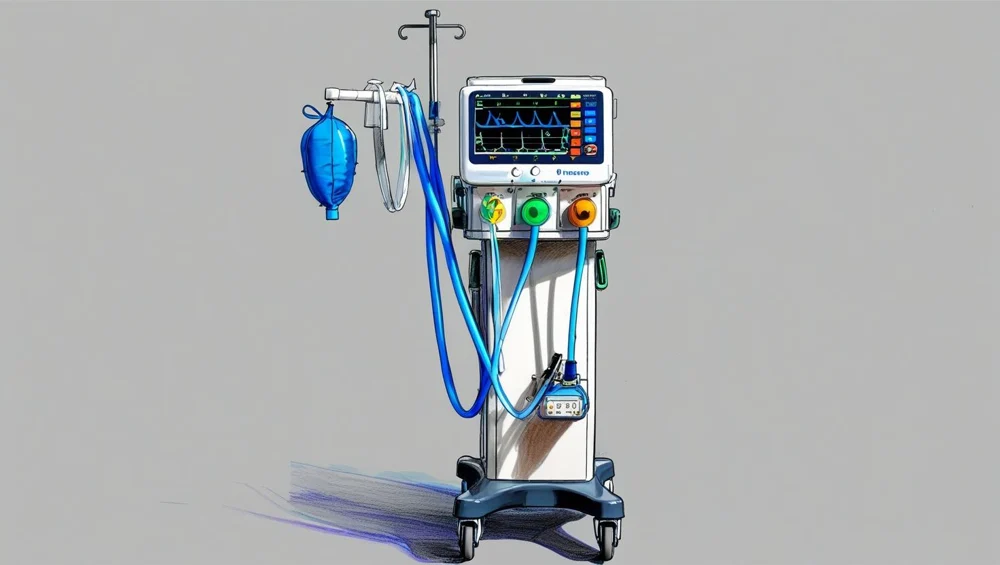
A trolley-mounted turbine supplies air, an oxygen inlet supplies enrichment, and a heated chamber conditions the inspiratory gas. A dual-limb circuit returns exhaled gas through the expiratory valve.
Also called: Mechanical Ventilator, Breathing Machine. Arabic: جهاز التنفس الاصطناعي. Device Lab 10 of 69 in BMEssentia Medical City, 2 configurations.
Overview: the configurations
ICU turbine ventilator
A trolley-mounted turbine supplies air, an oxygen inlet supplies enrichment, and a heated chamber conditions the inspiratory gas. A dual-limb circuit returns exhaled gas through the expiratory valve.
Transport turbine ventilator
A compact turbine ventilator is secured beside a stretcher. A regulated cylinder supplies oxygen, a battery supplies electricity, and a passive heat and moisture exchanger conditions gas at the patient connection.
How it works: the main parts
What each part does, from the Ventilator lessons in the 3D Device Lab.
- Ventilator body
- The ventilator is a controlled gas-delivery and measurement system. Its case brings together a gas source, valves, sensors, electronics and protective functions.
- Display and controls
- The display is the operator’s window into set targets, measured values, breath timing and alarms. A target is an instruction; a measured value is evidence.
- Air turbine and intake filter
- The turbine draws room air through an inlet filter and generates the flow needed by the ventilator. It makes this representative architecture independent of a compressed medical-air outlet.
- Oxygen inlet and regulated supply
- The oxygen inlet connects the ventilator to an appropriate gas source. In the ICU scene a hose reaches a wall outlet; in transport a regulator connects a secured cylinder.
- Gas mixing and inspiratory control
- The mixing and delivery assembly brings together room air and oxygen, then controls the gas sent into the inspiratory limb. It is where a requested breath becomes an actuation task.
- Inspiratory limb
- The inspiratory limb carries conditioned gas from the ventilator toward the patient. Its corrugated wall allows movement, but flexibility does not make it immune to kinking, compression or disconnection.
- Expiratory limb
- The expiratory limb returns exhaled gas from the Y-piece to the ventilator’s expiratory assembly. Expiration is an active part of the control problem even when the patient’s recoil provides the driving pressure.
- Expiratory valve
- The expiratory valve controls the outlet through which exhaled gas leaves the circuit. It helps establish positive end-expiratory pressure, called PEEP.
Explore it in the Device Lab
- Resistance and flow: Resistance describes opposition to gas flow. In this pressure-controlled test, the pressure rise and inspiratory duration are fixed. Increasing resistance slows filling, so less volume enters during the available time.
- Compliance and delivered volume: Compliance describes how much volume changes for a pressure change. A less compliant load is harder to inflate. Keep the pressure rise unchanged and reduce compliance.
- Circuit continuity and leak: A leak provides an unintended path for gas. The simplified model loses delivered flow through that path, reducing effective filling and pressure. Real devices have more complex leak compensation and alarms.
Common faults and what to check
Guided fault cases in the Device Lab
- Circuit disconnected: The patient-side circuit separates and the display reports low delivery. The clinical team is present.
- Increased circuit resistance: Delivered volume falls in the pressure-controlled demonstration.
- Oxygen supply lost: The turbine continues but measured oxygen enrichment falls.
- External power lost: The display reports battery operation during an unexpected unplugging.
Training cases written by BMEssentia for teaching.
Most reported device problems (FDA MAUDE)
| Device problem | Reports |
|---|---|
| Device Displays Incorrect Message | 20,281 |
| Mechanical Problem | 16,023 |
| Output Problem | 12,955 |
| Device Operates Differently Than Expected | 11,870 |
| No Display/Image | 11,220 |
| Battery Problem | 10,664 |
Raw counts of adverse event reports for this device type (FDA product code CBK, ONZ, NOU), all years. Not adjusted for the number of units in use, so they show what gets reported, not failure rates. Report text is never copied.
Recent FDA recalls
| Recall | Product and reason |
|---|---|
| Z-2963-2026 2026-08-14 | Maquet Critical Care AB: GETINGE Y SENSOR Module, SERVO-U, SERVO-N, Model Number 6693662 Maquet Critical Care AB, a subsidiary of Getinge, is voluntarily recalling Y sensor module, part of the SERVO-U/-N ventilator system, due to missing production safety electrical testing. Root cause: Under Investigation by firm. |
| Z-2735-2026 2026-07-28 | ResMed Ltd.: Resmed Astral 100/150 Due to a Supercapacitor electrolyte leakage on Printed Circuit Board Assembly (PCBA) may damage the charger chip, causing fail-safe state and interruption of ventilation therapy. Root cause: Component design/selection. |
| Z-2525-2026 2026-06-23 | Ventec Life Systems, Inc.: VOCSN+Pro package, REF: PRT-00853-000 Respiratory system intended to provide continuous/intermittent ventilator support, may have a damaged back-up battery supporting backup alarm function, which may result in the backup alarm not activating during loss of. Root cause: Vendor change control. |
| Z-1942-2026 2026-05-01 | Ventec Life Systems, Inc.: VOCSN V+Pro package, REF: PRT-01198-000 Respiratory system intended to provide continuous/intermittent ventilator support, may not have been evaluated under all intended high-pressure conditions during production testing, so an oxygen leak condition could. Root cause: Process change control. |
| Z-1646-2026 2026-04-02 | Philips Respironics, Inc.: Philips Respironics Trilogy Evo, Software Version 1.05.15.00. Continuous home-use ventilator device. In some situations, the Obstruction Alarm does not trigger within the timeframe dictated by the relevant standards and may take up to four breaths. Root cause: Software design. |
From the FDA recall database (openFDA), newest first, imported 2026-10-22. 339 recalls on record for this device type. Recall text is the FDA's public text; each recall links to the official record.
Learn it, see it in 3D, ask about it
- Ask Essentia about the Ventilator: answers from named sources, with the device open in its 3D Device Lab beside the answer.
- The Ventilator on the BMEssentia Platform: the Device Library course, 13 sections from physics to maintenance.
- BMEssentia Medical City: Device Lab 10, the Ventilator fully assembled in 3D, with lab tasks and the simulations.
Previous: Intra-aortic Balloon Pump. Next: Anaesthesia Machine. All 69 devices.
Ask about the Ventilator
Sign in with your BMEssentia account, or create one, and ask anything about this device.
Ask Essentia