

Essentia / Devices / Centrifuge
Device Lab 65
Centrifuge
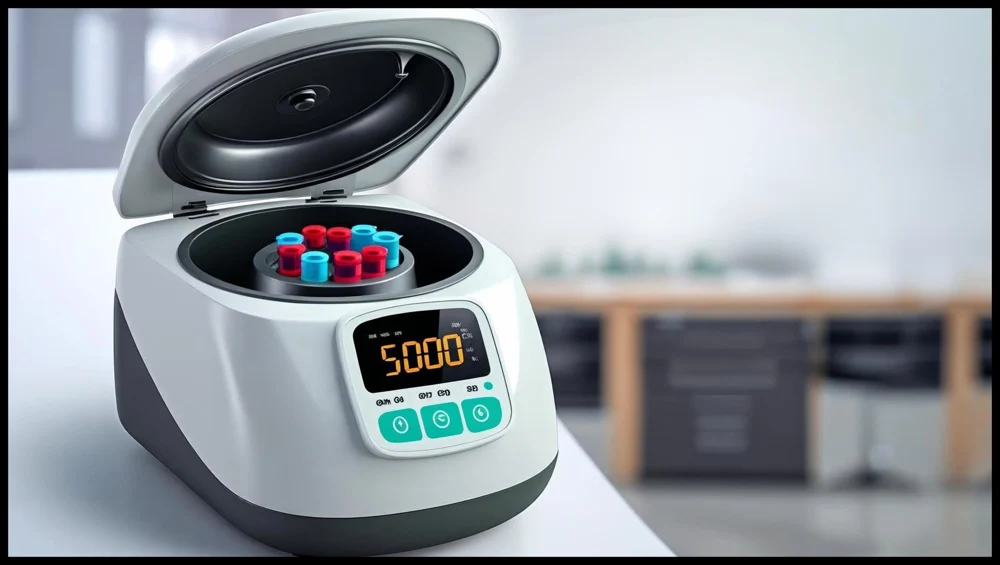
Eight bores cut at thirty degrees into a solid aluminium block, closed at the bottom, with a screw-down lid that seals the whole rotor. The tubes never move relative to the rotor: they sit at thirty degrees standing still and at thirty degrees at four thousand revolutions a minute, and the centrifugal field arrives across them rather than along them.
Also called: Lab Centrifuge. Arabic: جهاز الطرد المركزي. Device Lab 65 of 69 in BMEssentia Medical City, 2 configurations.
Overview: the configurations
Fixed-angle rotor, eight places at 30°
Eight bores cut at thirty degrees into a solid aluminium block, closed at the bottom, with a screw-down lid that seals the whole rotor. The tubes never move relative to the rotor: they sit at thirty degrees standing still and at thirty degrees at four thousand revolutions a minute, and the centrifugal field arrives across them rather than along them.
Swing-out rotor, four buckets on trunnions
A four-armed yoke with a bucket hanging from a pair of trunnion pins on each arm. At rest the buckets hang straight down. As the rotor turns they swing outward until they are horizontal, and they are horizontal long before the machine is anywhere near its working speed, the angle is set by the ratio of centrifugal to gravitational force at the bucket centre of mass, so they are halfway out at about ninety revolutions a minute.
How it works: the main parts
What each part does, from the Centrifuge lessons in the 3D Device Lab.
- Brushless drive motor
- A sealed can about ninety millimetres across hanging under the floor of the chamber, with a fan on its lower end and a cradle of rubber mounts under that. It is the only part of the machine that does work, and everything above it exists to hold what it has made.
- Spindle, taper hub and bearings
- A short steel shaft through the floor of the chamber, carried in two bearings, with a shallow tapered hub on its upper end and a small drive pin standing out of that hub. It is the one mechanical interface between the machine and the rotor, and it is about forty-six millimetres across.
- Motor controller and speed regulation
- A board low in the chassis carrying a heatsink, six switching devices, two large capacitors and a small current shunt. It is the part of the machine that decides what speed means.
- Tachometer and rotor recognition
- A small sensor on a bracket beside the hub, under the floor of the chamber, looking at a ring of twelve magnets on the underside of the rotor. It does two entirely different jobs with one measurement.
- Braking and controlled run-down
- Three resistors on a clamp, a relay, and a setting on the panel. Between them they decide how a rotor carrying several hundred joules is brought to rest, and how long a lid stays locked.
- Enclosure and cast chassis
- A squat moulded box about half a metre across and a third of a metre high, most of whose volume is the round chamber in the middle of it, sitting on a heavy cast base plate with moulded hand recesses in both flanks. It weighs far more than it looks as though it should.
- Rotor chamber and spill bowl
- A stainless steel vessel four hundred millimetres across and a hundred and fifty deep, with a rolled lip at its mouth, a drain at its lowest point and a spigot under it running to a small catch bottle. The rotor turns inside it with clearance all round.
- Lid, window and gas strut
- A moulded lid the full width of the machine, hinged along the back edge, with a round window in the middle of it, a handle across the front and a gas strut on one side that holds it up. It is heavier than it looks.
Explore it in the Device Lab
- The number on the dial is the wrong number: Set a speed and read the field at the three radii at once, then look at what the same dial setting would be in the other rotor.
- The field is not the whole story: Set both rotors to their rated speeds, note that the field averaged over the tube is almost identical, and then time the pellet.
- Separation and destruction are the same number: Put a mass difference between two opposing tubes and watch the force through the spindle, then compare that force with the weight of the mass you moved.
- Where the energy goes, both ways: Bring the rotor to speed, read the stored energy, then stop it with the brake and without it.
- What the lid is actually for: Break a tube at speed in a sealed rotor and in an unsealed one, and try to open the lid while the rotor is still turning.
Common faults and what to check
Most reported device problems (FDA MAUDE)
| Device problem | Reports |
|---|---|
| Break | 150 |
| Device Operates Differently Than Expected | 101 |
| Thermal Decomposition of Device | 94 |
| Device Inoperable | 85 |
| Detachment Of Device Component | 62 |
| Charred | 44 |
Raw counts of adverse event reports for this device type (FDA product code JQC), all years. Not adjusted for the number of units in use, so they show what gets reported, not failure rates. Report text is never copied.
Planned maintenance checks
From the BMEssentia procedure library: every 12 months, about 40 minutes, electrical class I.
| Check | Pass when |
|---|---|
| Rotor, buckets and chamber Inspect the rotor for corrosion and cracks, the buckets, seals and the chamber; check the rotor's life (cycles or years) against the manufacturer. | No corrosion or cracks; within rotor life. |
| Electrical safety Test as Class I laboratory equipment (IEC 61010-1 based checks). | PE ≤ 0.30 Ω; insulation within limits. |
| Speed and timer Measure speed with the tachometer at two set speeds; time a run. | Within the manufacturer's accuracy. |
| Interlocks and imbalance Try to open the lid during a run (it must stay locked); try to start with the lid open; run a deliberate imbalance as the manufacturer allows. | Lid locked; no start; imbalance stops the run. |
Test instruments: Optical tachometer; Calibrated timer; Temperature probe (refrigerated models).
Recent FDA recalls
| Recall | Product and reason |
|---|---|
| Z-1048-2019 2019-02-06 | LW Scientific, Inc.: LW Scientific ZIP IQ PCV Centrifuge, ZIC-24HD-75T3 Rev C The clear, plastic, polycarbonate hematocrit rotor may break apart during use and be ejected through the plastic housing, posing a safety hazard to the technician and potentially damaging the surrounding area. Root cause: Device Design. |
| Z-1049-2019 2019-02-06 | LW Scientific, Inc.: LW Scientific ZIP IQ Combo Centrifuge, ZIC-CMBO-2RT3 Rev B The clear, plastic, polycarbonate hematocrit rotor may break apart during use and be ejected through the plastic housing, posing a safety hazard to the technician and potentially damaging the surrounding area. Root cause: Device Design. |
| Z-1050-2019 2019-02-06 | LW Scientific, Inc.: LW Scientific ZIP IQ Combo Centrifuge, ZIC-CMBO-4RT3 Rev B The clear, plastic, polycarbonate hematocrit rotor may break apart during use and be ejected through the plastic housing, posing a safety hazard to the technician and potentially damaging the surrounding area. Root cause: Device Design. |
| Z-0103-2018 2017-10-20 | Terumo BCT, Inc.: HARVEST(R) TERUMOBCT, BMAC-30-07 Bone Marrow Procedure Pack, Private Practice / Clinical Use Only, REF 51416, Rx Only, The patient labels included in the BMAC system procedure packs, catalog numbers 51416 and 51423, are printed with an incorrect lot number, catalog number, and expiry date; the lot number on the procedure pack box label. Root cause: Process control. |
| Z-0104-2018 2017-10-20 | Terumo BCT, Inc.: HARVEST(R) TERUMOBCT, BMAC2-120-01Bone Marrow Procedure Pack, REF 51423, Rx Only, STERILE EO The patient labels included in the BMAC system procedure packs, catalog numbers 51416 and 51423, are printed with an incorrect lot number, catalog number, and expiry date; the lot number on the procedure pack box label. Root cause: Process control. |
From the FDA recall database (openFDA), newest first, imported 2026-10-22. 16 recalls on record for this device type. Recall text is the FDA's public text; each recall links to the official record.
Learn it, see it in 3D, ask about it
- Ask Essentia about the Centrifuge: answers from named sources, with the device open in its 3D Device Lab beside the answer.
- The Centrifuge on the BMEssentia Platform: the Device Library course, 13 sections from physics to maintenance.
- BMEssentia Medical City: Device Lab 65, the Centrifuge fully assembled in 3D, with lab tasks and the simulations.
Previous: Thermometer. Next: Auditory Amplifiers. All 69 devices.
Ask about the Centrifuge
Sign in with your BMEssentia account, or create one, and ask anything about this device.
Ask Essentia