

Essentia / Devices / Defibrillator
Device Lab 19
Defibrillator
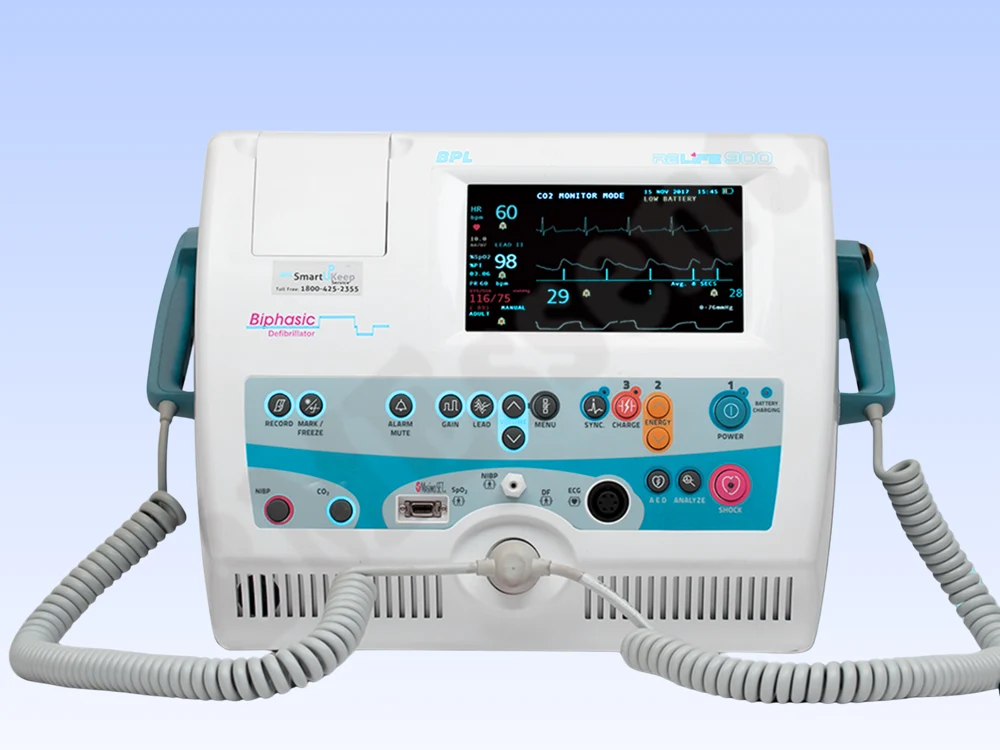
This device spends years in a box on a wall, doing nothing, and then has to work perfectly in the hands of a frightened stranger. That combination, years of nothing followed by one attempt with no second chance, shapes everything about how it is built, tested and stored.
Also called: Defib, Aed, Automated External Defibrillator. Arabic: جهاز إزالة الرجفان. Device Lab 19 of 69 in BMEssentia Medical City, 6 configurations.
How it works: the main parts
What each part does, from the Defibrillator lessons in the 3D Device Lab.
- Display
- There is no ECG trace here and that is deliberate. A manual defibrillator shows a clinician a waveform because a clinician can interpret one.
- Controls
- Count the controls. There are almost none, and that is the single most important design decision in this device.
- Battery
- This battery will sit unused for years and must then supply a full resuscitation without warning. No other battery in this device family has that duty.
- Therapy
- On this device the therapy cable is usually already connected, and that is a decision about users rather than about engineering. A cable a bystander has to plug in correctly, under stress, is a step that can be got wrong.
- Right Pad
- This pad has to be placed correctly by somebody who has never done it, is not being supervised, and is reading a picture. Everything about it, its size, its backing, the diagram printed on it, exists to make a correct placement the obvious one.
- Left Pad
- The second pad completes the circuit, and where it goes decides what the shock reaches. Two electrodes do not deliver therapy to a place; they deliver it along a path between them.
- Capacitor
- This store holds enough energy to stop a heart, inside a device that a member of the public opens on a wall. That it can be operated safely by an untrained person is a claim resting entirely on the fact that they can never reach this component, and that the device decides when it is charged.
- Charger
- This converter has to take a standby battery to defibrillation voltage in the seconds after the device decides to treat, having done almost nothing for years beforehand. It is the least exercised assembly in the device and one of the most critical, which is why the self-test runs it deliberately.
Common faults and what to check
Most reported device problems (FDA MAUDE)
| Device problem | Reports |
|---|---|
| Failure to Power Up | 36,872 |
| Device Displays Incorrect Message | 33,273 |
| Device Operates Differently Than Expected | 32,420 |
| Failure of Device to Self-Test | 24,907 |
| No Display/Image | 12,474 |
| Unable to Obtain Readings | 12,104 |
Raw counts of adverse event reports for this device type (FDA product code MKJ, LDD, DRK, NSA), all years. Not adjusted for the number of units in use, so they show what gets reported, not failure rates. Report text is never copied.
Standards engineers test against
IEC 60601-2-4: defibrillators
The particular standard for cardiac defibrillators (manual and AED).
Recent FDA recalls
| Recall | Product and reason |
|---|---|
| Z-3270-2026 2026-09-25 | HeartSine Technologies Ltd: HeartSine samaritan PAD (Public Access Defibrillator) Products were distributed without the required Maintenance Supplement, which describes an extra check every 3 months in addition to the monthly check. Root cause: Process control. |
| Z-3120-2026 2026-09-04 | HeartSine Technologies Ltd: HeartSine SAM 350P Due to a damaged (over stretched) membrane tail that causes an intermittent fault. Root cause: Process control. |
| Z-2065-2026 2026-05-04 | Physio-Control, Inc.: LIFEPAK 15, REF: 99577-000025, 99577-000047, 99577-001256, 99577-001217, 99577-001241, 99577-001255, 99577-001219, Some defibrillators serviced between July 2023 through November 2025 were serviced without objective evidence that a Performance Inspection Procedure (PIP) was conducted, and the inability to perform the device's. Root cause: Process control. |
| Z-1544-2026 2026-03-10 | Physio-Control, Inc.: PHYSIO CONTROL INFANT/CHILD Reduced Energy Defibrillator Electrodes Due to pediatric defibrillator electrode delamination Root cause: Unknown/Undetermined by firm. |
| Z-0288-2026 2025-10-23 | HeartSine Technologies Ltd: HeartSine Pad-Pak, REF: PAD-PAK-01, PAD-PAK-02, PAD-PAK-03, PAD-PAK-04, PAD-PAK-07, PAD-PAK-03J, PAD-PAK-04J Due to customer complaints, defibrillator pads may contain damage pins that disrupt the mechanical fit and electrical contact. Root cause: Under Investigation by firm. |
From the FDA recall database (openFDA), newest first, imported 2026-10-22. 369 recalls on record for this device type. Recall text is the FDA's public text; each recall links to the official record.
Learn it, see it in 3D, ask about it
- Ask Essentia about the Defibrillator: answers from named sources, with the device open in its 3D Device Lab beside the answer.
- The Defibrillator on the BMEssentia Platform: the Device Library course, 13 sections from physics to maintenance.
- BMEssentia Medical City: Device Lab 19, the Defibrillator fully assembled in 3D, with lab tasks and the simulations.
Previous: Autoclave. Next: EP Mapping System. All 69 devices.
Ask about the Defibrillator
Sign in with your BMEssentia account, or create one, and ask anything about this device.
Ask Essentia