

Essentia / Devices / Cardiopulmonary Bypass
Device Lab 7
Cardiopulmonary Bypass
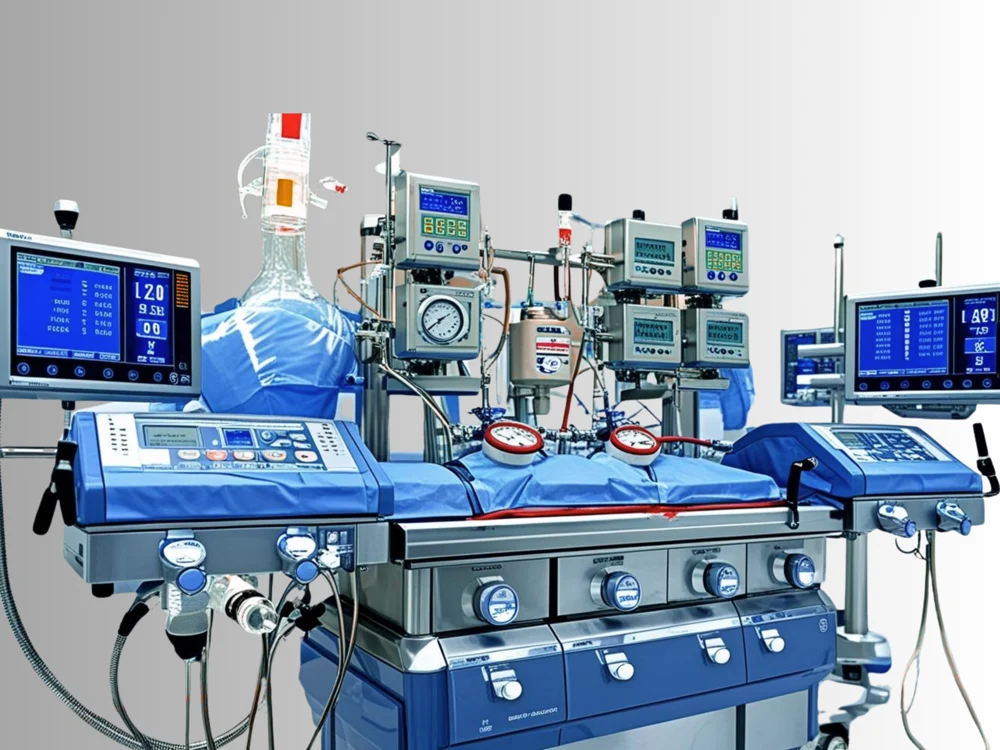
The arterial pump is occlusive and positive displacement. Flow is whatever the rollers sweep, it does not change with what is downstream, and it will deliver air as readily as blood.
Also called: Heart-Lung Machine, Perfusion Pump. Arabic: جهاز القلب والرئة الاصطناعي. Device Lab 7 of 69 in BMEssentia Medical City, 2 configurations.
Overview: the configurations
Roller-pump bypass console
The arterial pump is occlusive and positive displacement. Flow is whatever the rollers sweep, it does not change with what is downstream, and it will deliver air as readily as blood.
Centrifugal-pump bypass console
The arterial pump is non-occlusive. Flow falls as resistance downstream rises, so the speed set is not the flow delivered and it has to be measured. It de-primes rather than pumping air.
How it works: the main parts
What each part does, from the Cardiopulmonary Bypass lessons in the 3D Device Lab.
- Cannulae and patient lines
- Four connections into one opening in a chest, and several metres of half-inch PVC back to a console at the patient’s side. This is the part of the machine that is inside a person, and it is the part that decides how much of everything else there has to be.
- Venous drainage
- A wide tube from the right atrium down to a reservoir, and nothing pulling on it. Blood arrives in this machine because the reservoir is lower than the patient and for no other reason.
- Venous reservoir
- A clear column on the mast with blood in the bottom of it. It is the buffer between what is coming back from the patient and what is being pumped out to them, and its level is the number watched more closely than any other on this machine.
- Oxygenator and heat exchanger
- A clear housing on the mast with blood going in dark at the bottom and coming out red at the top. It is the lung, and in the same shell there is a heat exchanger that sets the patient’s temperature.
- Gas blender and sweep
- A small panel with two flowmeters and a mount for a vaporiser. It decides two things that people constantly confuse: how much oxygen the blood gains, and how much carbon dioxide it loses.
- Heater-cooler unit
- A box on the floor beside the console with a water tank in it. It cools the patient at the start of the operation and warms them at the end, through water that never touches blood, and it is the one part of this machine with an infection story attached to it.
- Arterial filter and bubble trap
- A clear bowl on the arterial line, the last thing blood passes through before it reaches the aorta. It catches what everything upstream let past, and it has a purge line off the top so that what it catches can leave the circuit rather than sit in it.
- Air bubble detector
- A small clamp on the arterial line with an ultrasonic head each side of the tube. It listens for anything that is not blood and stops the pump when it hears it.
Common faults and what to check
Most reported device problems (FDA MAUDE)
| Device problem | Reports |
|---|---|
| Fluid/Blood Leak | 2,720 |
| Device Displays Incorrect Message | 1,977 |
| Leak/Splash | 1,945 |
| Pumping Stopped | 1,675 |
| Device Operates Differently Than Expected | 1,331 |
| Output Problem | 953 |
Raw counts of adverse event reports for this device type (FDA product code DTQ, DWB, DTZ), all years. Not adjusted for the number of units in use, so they show what gets reported, not failure rates. Report text is never copied.
Planned maintenance checks
From the BMEssentia procedure library: every 6 months, about 180 minutes, electrical class I, applied part type CF.
| Check | Pass when |
|---|---|
| Pumps, mast and sensors Inspect each roller pump head, the rollers and guides, mast-mounted modules, detectors and cables. | No wear on rollers; detectors clean. |
| Electrical safety Test the base, modules and heater-cooler to IEC 62353. | PE ≤ 0.30 Ω; equipment leakage ≤ 500 µA; applied part CF ≤ 50 µA. |
| Pump speed and flow Check pump speed against a reference at several settings and the displayed flow for the configured tubing size. | Within the manufacturer's accuracy. |
| Safety detectors Test the level detector and the bubble detector with the manufacturer's method; confirm the arterial pump stops or slows as configured. | Alarm and pump response as configured. |
| Battery and hand cranks Run on battery; confirm every pump can be hand cranked. | At least the stated battery time; cranks fit and turn. |
Test instruments: Tachometer or the manufacturer's speed tool; Pressure reference; Thermometer reference; Electrical safety analyser.
Recent FDA recalls
| Recall | Product and reason |
|---|---|
| Z-1300-2026 2026-02-05 | Maquet Cardiopulmonary Gmbh: Bubble Sensor for 3/8" x 3/32" tubing Internal investigations have identified an issue with the durability of the connecting cable near the connection to the Venous Bubble Sensor. Root cause: Under Investigation by firm. |
| Z-0487-2026 2025-11-10 | Medtronic Perfusion Systems: Affinity NT Oxygenator, Oxygenator with Balance Biosurface and Uncoated Cardiotomy/Venous Reservoir, Product Number 541B Medtronic identified an Affinity NT Oxygenator unit with decreased CO2 gas transfer rates that did not meet performance requirements. Root cause: Under Investigation by firm. |
| Z-1823-2025 2025-05-27 | Maquet Cardiopulmonary Ag: Cardiohelp System HKH 8820 Wall Holder. Mounting bracket designed to hold the CARDIOHELP-i system for interhospital HKH 8820 Wall Holder does not comply with standard DIN EN 1789:20 and has the potential to detach. Root cause: Under Investigation by firm. |
| Z-0571-2025 2024-11-27 | LivaNova Deutschland GmbH: Essenz HLM (Heart-Lung Machine), REF: 49-00-10, with Software Heart-Lung Machine GUI touchscreen may go dark for 10-15 seconds, safety/performance functions remain operational before reset, control maintained through backup control panel, but second reset may occur, may lead to gas. Root cause: Software change control. |
| Z-0224-2025 2024-10-24 | Spectrum Medical Ltd.: Quantum Perfusion Systems for CPB, Roller Pumps use peristaltic action to propel blood through the venous and arterial The ratchet and pawl had an out of tolerance geometry which exhibited as the left bobbin would not lock. Root cause: Component design/selection. |
From the FDA recall database (openFDA), newest first, imported 2026-10-22. 376 recalls on record for this device type. Recall text is the FDA's public text; each recall links to the official record.
Learn it, see it in 3D, ask about it
- Ask Essentia about the Cardiopulmonary Bypass: answers from named sources, with the device open in its 3D Device Lab beside the answer.
- The Cardiopulmonary Bypass on the BMEssentia Platform: the Device Library course, 13 sections from physics to maintenance.
- BMEssentia Medical City: Device Lab 7, the Cardiopulmonary Bypass fully assembled in 3D, with lab tasks and the simulations.
Previous: PEM. Next: ECMO. All 69 devices.
Ask about the Cardiopulmonary Bypass
Sign in with your BMEssentia account, or create one, and ask anything about this device.
Ask Essentia