

Essentia / Devices / Autoclave
Device Lab 18
Autoclave
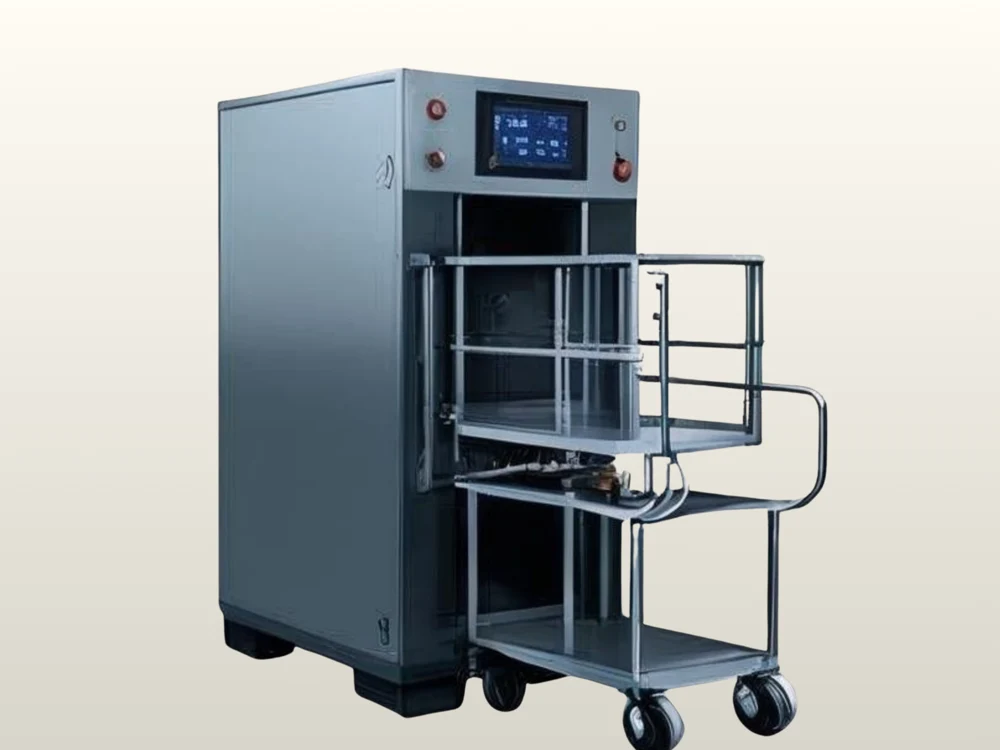
Steam admitted at the top of the chamber and air allowed to fall out of a drain at the bottom. There is no pump, no sub-atmospheric step and nothing at all driving the air except the fact that it is denser than steam. The holding condition is a hundred and twenty-one degrees for fifteen minutes, and the extra twelve minutes over the pre-vacuum cycle are being spent on the same lethality at a lower temperature.
Also called: Steam Steriliser, Steam Sterilizer. Arabic: جهاز التعقيم بالبخار. Device Lab 18 of 69 in BMEssentia Medical City, 2 configurations.
Overview: the configurations
Gravity displacement, solid and fluid loads
Steam admitted at the top of the chamber and air allowed to fall out of a drain at the bottom. There is no pump, no sub-atmospheric step and nothing at all driving the air except the fact that it is denser than steam. The holding condition is a hundred and twenty-one degrees for fifteen minutes, and the extra twelve minutes over the pre-vacuum cycle are being spent on the same lethality at a lower temperature.
Pulsed pre-vacuum, porous and hollow loads
A liquid-ring pump pulls the chamber down to about a tenth of an atmosphere, steam refills it to roughly two bar, and the sequence repeats. Only after that does the temperature phase begin, which is why the cycle chart on the wall of a sterile services department is mostly a sawtooth with a plateau on the end. The holding condition is a hundred and thirty-four degrees for three minutes.
How it works: the main parts
What each part does, from the Autoclave lessons in the 3D Device Lab.
- Chamber vessel and pressure boundary
- A rectangular stainless steel box with radiused corners, about six hundred and sixty millimetres each way and a little deeper, welded from five-millimetre plate, with an aperture at each end and a shallow sump in the floor. Three hundred litres.
- Steam jacket and insulation
- A second shell about twenty millimetres outboard of the chamber, forming a closed annular space around five of its six faces, filled with steam at its own pressure. Outside that, fifty millimetres of insulation blanket, and outside that the painted cladding panels a person actually touches.
- Door, seal and interlock
- A stainless slab with a stiffening rib, a viewing port on the clean side, rising vertically into a headbox above the aperture on a pneumatic ram and a chain. Around the aperture, a hollow silicone gasket in a groove.
- Loading carriage, shelves and the load
- A stainless frame on four castors with a perforated or wire deck at nine hundred millimetres, a second shelf above it, and a push handle. On it: trays, wrapped packs, pouches.
- Plant steam supply, isolation and separator
- A lagged pipe dropping from the ceiling on the service side, with an isolating valve and its hand-wheel, a Y-pattern strainer, and a separator: a small vessel with a baffle in it and its own trap on the bottom. A pressure gauge reads what arrives before anything is done to it.
- Pressure-reducing valve and the superheat it makes
- A cast body with a large spring bonnet on top, an adjusting screw and a lock nut, a small pilot line running back from downstream, and a gauge on the outlet reading the pressure the chamber will see. It is a regulator rather than a restrictor: it holds a set outlet pressure regardless of what the inlet does.
- Integral steam generator and feedwater
- A short fat pressure vessel with domed ends under the chamber, about two hundred millimetres across and three hundred tall, with a bolted element flange low on one side, a sight glass and two level probes, a feedwater pump, a softener cartridge and a blowdown valve at the lowest point.
- Chamber admission valve and baffle
- A diaphragm valve body high on the machine with a pneumatic actuator on top of it and a small solenoid pilot beside that, feeding a pipe that enters the chamber through the jacket and the insulation at the top. Inside the chamber, the pipe ends at a spreader rather than at an open end.
Explore it in the Device Lab
- The pocket the gauge cannot see: Set a wrapped or hollow load and watch four numbers move together: the residual air fraction, the steam partial pressure, the pocket temperature, and the log reductions the pocket achieves.
- An exponent, not a habit: Step the pulse count from one to six and watch the residual air fall. Then change the vacuum floor and watch what happens to the same curve.
- The number that actually decides it: Set the pulse count to three and the leak rate to zero, note the residual air in millibars, then raise the leak rate through the permitted limit and past it.
- Steam that will not condense: Raise the plant supply pressure with the supply dryness at one, and watch the superheat appear. Then lower the dryness a little and watch it vanish.
- Why eight degrees is a factor of six: Hold the time constant and step the temperature, watching F0, the log reductions and the number of survivors from a population of a million.
Common faults and what to check
Most reported device problems (FDA MAUDE)
| Device problem | Reports |
|---|---|
| Leak/Splash | 314 |
| Fluid/Blood Leak | 193 |
| Device Fell | 71 |
| Device Operates Differently Than Expected | 71 |
| Component Falling | 67 |
| Device Tipped Over | 42 |
Raw counts of adverse event reports for this device type (FDA product code FLE), all years. Not adjusted for the number of units in use, so they show what gets reported, not failure rates. Report text is never copied.
Planned maintenance checks
From the BMEssentia procedure library: every 12 months, about 240 minutes, electrical class I.
Periodic tests follow HTM 01-01 / EN 285 for porous-load sterilizers. The annual thermometric test is done by an authorised person (sterilizers).
| Check | Pass when |
|---|---|
| Door, seal and chamber Inspect the door seal, the interlocks, the chamber drain and strainer, the safety valve and the recorder. | Seal intact; door cannot open under pressure. |
| Electrical safety Test the sterilizer's mains supply and earth bonding as a Class I appliance (it has no applied part). | Protective earth ≤ 0.30 Ω (or the installation's limit for fixed equipment). |
| Vacuum leak test Run the vacuum leak test cycle and read the rise in pressure over the test period. | ≤ 1.3 mbar/min. |
| Thermometric test Run a full porous-load cycle with sensors in the chamber drain and the test pack; read equilibration time and the holding temperature band. | Equilibration ≤ 15 s; the sterilization band and holding time of HTM 01-01 Part C held. |
| Safety devices Prove the door interlock, the over-temperature cutout and the safety valve operation as the manufacturer specifies. | Each operates at its set point. |
Test instruments: Thermometric recorder with chamber and load sensors; Calibrated pressure reference; Bowie-Dick test pack.
Standards engineers test against
ISO 15883: washer-disinfectors
The series for washer-disinfectors: part 1 general requirements, part 2 for surgical instruments, part 4 for flexible endoscopes.
EN 285 and ISO 17665: steam sterilization
EN 285 covers large steam sterilizers; ISO 17665 covers the development, validation and routine control of moist heat sterilization.
Recent FDA recalls
| Recall | Product and reason |
|---|---|
| Z-2983-2026 2026-08-18 | Fort Defiance Industries, LLC: Fort Defiance Industries (FDI), Automated Field Steam Sterilizer The Automated Field Steam Sterilizer's water recovery system 120V Amphenol connector may experience an intermittent loss of ground continuity, which could result in an unreliable fault current return path. Root cause: Component design/selection. |
| Z-2285-2023 2023-08-03 | Scican Ltd.: STATCLAVE G4 Chamber Autoclave -Tabletop steam sterilizer intended for use by a health care provider to sterilize The STATCLAVE G4 is a dynamic air removal (prevacuum) tabletop steam sterilizer intended for use by a health care provider to sterilize medical products by means of pressurized steam. Root cause: Employee error. |
| Z-2286-2023 2023-08-03 | Scican Ltd.: STATCLAVE G4 Chamber Autoclave -Tabletop steam sterilizer intended for use by a health care provider to sterilize The STATCLAVE G4 is a dynamic air removal (prevacuum) tabletop steam sterilizer intended for use by a health care provider to sterilize medical products by means of pressurized steam. Root cause: Employee error. |
| Z-0121-2022 2021-08-19 | Fort Defiance Industries, LLC: P2131 Automated Field Steam Sterilizer NSN: 6530-01-641-4641 The rear heater plate and cover assembly that contains the electrical wiring for the heaters does not have sufficient bonding to ground. Root cause: Device Design. |
| Z-0586-2020 2019-10-22 | Steris Corporation: Evolution Loading Car and Transfer Carriage- Accessory to the Sterilizer, Steam The locking pin of the front wheel asse mbly of the Evolution Transfer Carriages may not remain full y engaged with the transfer carriage and result in the transfer carriage and loading car unexpectedly falling forward Root cause: Process control. |
From the FDA recall database (openFDA), newest first, imported 2026-10-22. 18 recalls on record for this device type. Recall text is the FDA's public text; each recall links to the official record.
Learn it, see it in 3D, ask about it
- Ask Essentia about the Autoclave: answers from named sources, with the device open in its 3D Device Lab beside the answer.
- The Autoclave on the BMEssentia Platform: the Device Library course, 13 sections from physics to maintenance.
- BMEssentia Medical City: Device Lab 18, the Autoclave fully assembled in 3D, with lab tasks and the simulations.
Previous: Cryotherapy System. Next: Defibrillator. All 69 devices.
Ask about the Autoclave
Sign in with your BMEssentia account, or create one, and ask anything about this device.
Ask Essentia