

Essentia / Devices / CT Scanner
Device Lab 4
CT Scanner
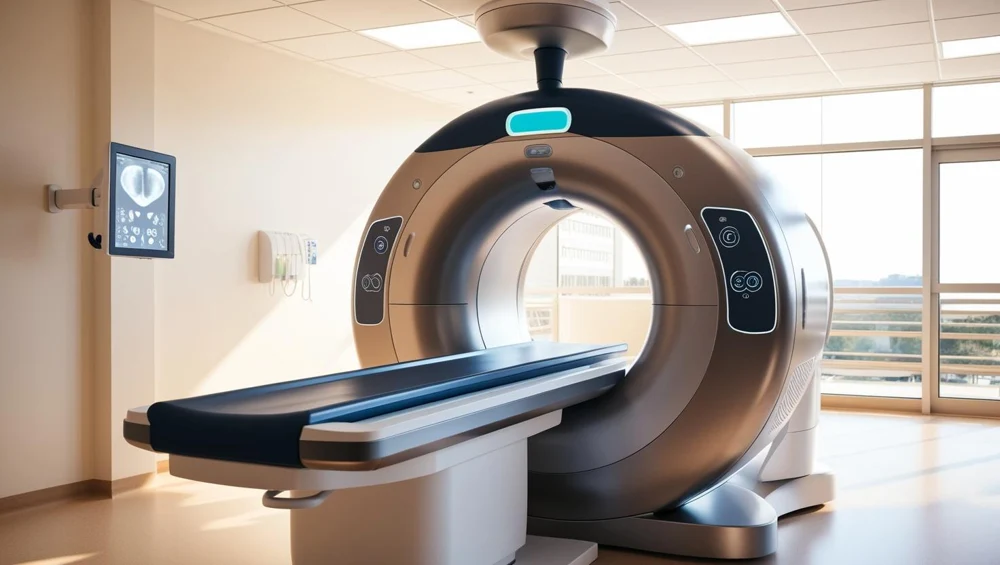
A general-purpose diagnostic scanner. The bore is kept small because it puts the patient nearer the isocentre, which is where the geometry of the measurement is best.
Also called: Computed Tomography, Cat Scan. Arabic: جهاز التصوير المقطعي المحوسب. Device Lab 4 of 69 in BMEssentia Medical City, 2 configurations.
Overview: the configurations
64-slice diagnostic CT
A general-purpose diagnostic scanner. The bore is kept small because it puts the patient nearer the isocentre, which is where the geometry of the measurement is best.
Wide-bore CT simulator
A planning scanner for radiotherapy. It gives up bore economy so that a patient can be scanned in the position they will be treated in, with their immobilisation around them.
How it works: the main parts
What each part does, from the CT Scanner lessons in the 3D Device Lab.
- Gantry covers and front bezel
- The white cabinet with a hole through it. Everything the patient sees of this machine is a cover, and none of it does any imaging.
- Patient aperture
- The tunnel itself, lined and lit, wide enough for a person and not much more. The whole design of the machine is a negotiation about how big this is allowed to be.
- Gantry control panels
- Two small panels set into the front of the machine, either side of the aperture, where a radiographer standing with the patient can reach them without walking anywhere.
- Gantry status display
- A small screen high on the front of the machine, visible from the control room door. It is the only part of the scanner that tells you what it is doing from across the room.
- Stationary frame and base
- The steel structure under the covers that everything else is bolted to, and the feet that transfer all of it into the building.
- Internal alignment lasers
- Three small windows inside the aperture, throwing thin lines of light onto the patient. They are how a person is put where the machine thinks they are.
- Rotating gantry
- The ring inside the covers that carries the whole imaging chain and turns it around the patient, two to four times a second, continuously, for as long as the machine is scanning.
- Slip ring
- Concentric conductive tracks on the back face of the rotor, with brushes riding on them from the stationary frame. It is the reason a CT scanner can rotate indefinitely.
Explore it in the Device Lab
- Dose and noise are the same dial: Halve the tube current and watch two numbers move. The dose halves, exactly, because dose is linear in the number of photons. The noise rises by about forty per cent, because noise falls as the square root of the photons counted.
- The control that changes dose without looking like it: 5 and the scan finishes a third sooner. Two other things happen at the same time and neither is announced: the dose falls by a third and the noise rises.
- Kilovoltage is not a brightness control: Move the kilovoltage from 120 to 140 and the dose rises by about half as much again. Move it down to 80 and it falls to about a third. 7, which is far steeper than anyone expects from a setting that looks linear.
- A resource with a refill rate: Run a demanding protocol back to back and watch the tube heat climb. It falls between studies, but by less than each study adds, so the line drifts upward through the session until the machine stops.
- Where the couch is, is where the slice is: Change the pitch, the collimation and the rotation time and watch the table speed, which is pitch times collimation divided by rotation time. Then watch the scan time, which is simply the length divided by that speed.
Common faults and what to check
Most reported device problems (FDA MAUDE)
| Device problem | Reports |
|---|---|
| Signal Artifact/Noise | 486 |
| Device Operates Differently Than Expected | 467 |
| Device Displays Incorrect Message | 333 |
| Degraded | 297 |
| Application Program Problem | 203 |
| Mechanical Problem | 191 |
Raw counts of adverse event reports for this device type (FDA product code JAK), all years. Not adjusted for the number of units in use, so they show what gets reported, not failure rates. Report text is never copied.
Planned maintenance checks
From the BMEssentia procedure library: every 12 months, about 180 minutes, electrical class I, applied part type B.
Tube and gantry service is the manufacturer's. These are the in-house and physics checks.
| Check | Pass when |
|---|---|
| Gantry, table and room Inspect the gantry covers, table, footswitches, emergency stops, the warning light at the door and the lead glass. | No damage; door warning light works. |
| Electrical safety Test the table, injector and accessories that plug into the room to IEC 62353; the gantry earth bond as the manufacturer allows. | PE ≤ 0.30 Ω; equipment leakage ≤ 500 µA (Class I). |
| Water phantom image quality Scan the QA phantom on the QA protocol and read CT number, uniformity and noise. | Water between −7 and +7 HU; uniformity within the manufacturer's limit; noise within baseline. |
| Dose output (physics) Measure CTDIvol in the head and body phantoms for the standard protocols and compare with the console. | Recorded against the displayed CTDIvol; ACR reference doses below the pass/fail limits. |
| Lasers and table Check the alignment lasers against the scan plane and the table position indicator. | Within ±2 mm. |
Test instruments: Water phantom (manufacturer's QA phantom); CTDI phantom and ion chamber (physics); Electrical safety analyser.
Standards engineers test against
IEC 60601-2-44: X-ray equipment for computed tomography
The particular standard for CT scanners.
Recent FDA recalls
| Recall | Product and reason |
|---|---|
| Z-0078-2027 2026-10-02 | PHILIPS MEDICAL SYSTEMS: Spectral CT and Spectral CT 7500 RT Software issues may affect the safety and performance of Spectral CT system(s). Root cause: Under Investigation by firm. |
| Z-3155-2026 2026-09-29 | Philips North America Llc: Philips Medical Systems The Bolus tracking scan application may crash with a system error message. Root cause: Radiation Control for Health and Safety Act. |
| Z-3277-2026 2026-09-25 | Shanghai United Imaging Healthcare Co., Ltd.: Computed Tomography X-ray System, Model: uCT 530 with software Positron emission tomography and computed tomography x-ray systems have a software problem when Split or Local function is enabled, and multiple RIS exams are merged into a single study, that prevents patient images from. Root cause: Software design. |
| Z-3278-2026 2026-09-25 | Shanghai United Imaging Healthcare Co., Ltd.: Computed Tomography X-ray System, Model: uCT 550 with software Positron emission tomography and computed tomography x-ray systems have a software problem when Split or Local function is enabled, and multiple RIS exams are merged into a single study, that prevents patient images from. Root cause: Software design. |
| Z-3279-2026 2026-09-25 | Shanghai United Imaging Healthcare Co., Ltd.: Computed Tomography X-ray System, Model: uCT 760 with software Positron emission tomography and computed tomography x-ray systems have a software problem when Split or Local function is enabled, and multiple RIS exams are merged into a single study, that prevents patient images from. Root cause: Software design. |
From the FDA recall database (openFDA), newest first, imported 2026-10-22. 873 recalls on record for this device type. Recall text is the FDA's public text; each recall links to the official record.
Learn it, see it in 3D, ask about it
- Ask Essentia about the CT Scanner: answers from named sources, with the device open in its 3D Device Lab beside the answer.
- The CT Scanner on the BMEssentia Platform: the Device Library course, 13 sections from physics to maintenance.
- BMEssentia Medical City: Device Lab 4, the CT Scanner fully assembled in 3D, with lab tasks and the simulations.
Previous: PET/CT. Next: SPECT. All 69 devices.
Ask about the CT Scanner
Sign in with your BMEssentia account, or create one, and ask anything about this device.
Ask Essentia