

Essentia / Devices / CSF Shunt
Device Lab 28
CSF Shunt
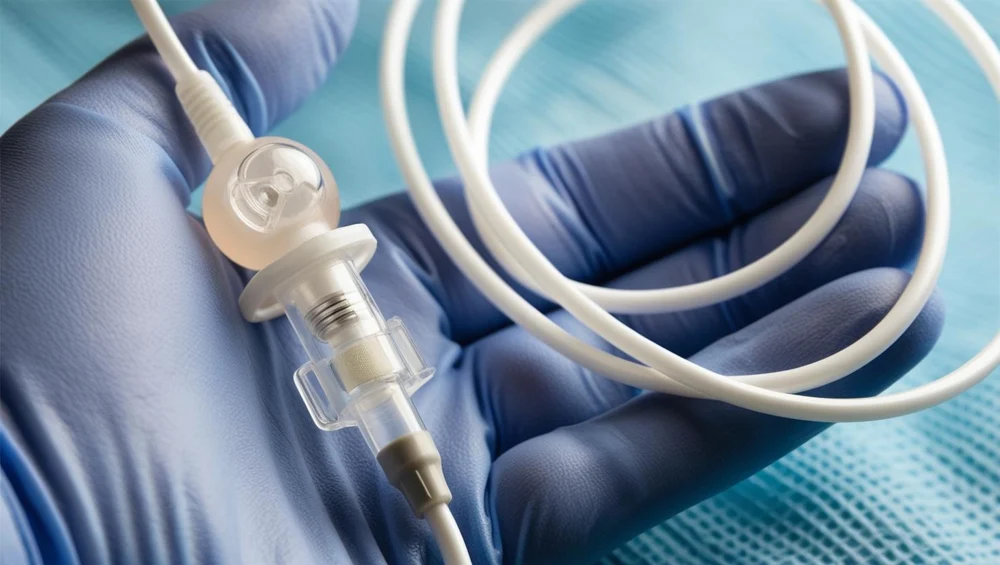
A ball held on a seat by a compression spring, in a rigid sealed housing. It opens when the pressure difference across it exceeds the spring preload divided by the seat area, and it has no path to ambient pressure anywhere.
Also called: Vp Shunt, Ventriculoperitoneal Shunt. Arabic: تحويلة السائل الدماغي الشوكي. Device Lab 28 of 69 in BMEssentia Medical City, 2 configurations.
Overview: the configurations
Fixed differential-pressure valve
A ball held on a seat by a compression spring, in a rigid sealed housing. It opens when the pressure difference across it exceeds the spring preload divided by the seat area, and it has no path to ambient pressure anywhere.
Anti-siphon arrangement, ambient-referenced at the body surface
The same ball, spring and seat, with a second stage whose flexible diaphragm is open on one face to the pressure at the patient’s own body surface at the valve site. When the pressure inside falls below that reference, the diaphragm is pushed onto a throttle seat and restricts the flow.
How it works: the main parts
What each part does, from the CSF Shunt lessons in the 3D Device Lab.
- Flanged ventricular inlet tip
- This is the only part of the device that faces the fluid it is there to move, and it is a closed-ended silicone tube with holes in its side wall. It has no moving part, no coating that does anything, and no way of telling you whether fluid is passing through it or not.
- Ventricular (proximal) catheter
- 3 mm of bore over 70 mm of implanted run. It is the proximal limb, and its whole job is to carry fluid from the tip to the connector with as little loss as possible.
- Right-angle burr-hole connector
- A small rigid moulded elbow that turns the proximal limb through ninety degrees and joins it to the rest of the device. It is the only place on the implant where two separate lengths of tubing are made into one path by a mechanical joint, which makes it the only place that can come apart without anything breaking.
- Reservoir dome
- A small self-sealing silicone dome sitting on a rigid base, in line with the flow. It is the only part of the implant a person can interact with from outside, and it is therefore the part most often mistaken for an instrument.
- Inlet seat and aperture
- A machined conical land with a small circular aperture at its throat. This is where a force becomes a pressure, and the number that does the converting is the area of that aperture.
- Occluder ball
- 0 mm sphere of hard polished material, held against the seat by the spring behind it. It is the only part of the implant that moves in normal use, and it moves through a distance far too small to see.
- Compression spring
- A helical compression spring wound from wire forty micrometres thick. It is the only source of stored energy in the entire device, and it is the reason the thing works at all without a battery.
- Valve housing
- The rigid shell that holds the seat, the ball and the spring in fixed relation to each other and seals the whole assembly from everything around it. On this configuration it is completely closed, and the fact that it has no opening to its surroundings is not a detail of manufacture.
Common faults and what to check
Most reported device problems (FDA MAUDE)
| Device problem | Reports |
|---|---|
| Infusion or Flow Problem | 2,825 |
| Explanted | 2,695 |
| Break | 2,154 |
| Obstruction of Flow | 1,510 |
| Leak/Splash | 1,487 |
| Mechanical Problem | 1,309 |
Raw counts of adverse event reports for this device type (FDA product code JXG), all years. Not adjusted for the number of units in use, so they show what gets reported, not failure rates. Report text is never copied.
Planned maintenance checks
From the BMEssentia procedure library: every 12 months, about 15 minutes, electrical class II.
Engineering looks after the valve adjustment and reading tools; shunts are implants with traceable stock.
| Check | Pass when |
|---|---|
| Tools Inspect the indicator, adjustment and locator tools. | No damage; magnets intact. |
| Verification Read and set the manufacturer's test valve. | Reads and sets correctly. |
Test instruments: Manufacturer's valve verification tool.
Recent FDA recalls
| Recall | Product and reason |
|---|---|
| Z-2173-2026 2026-05-13 | Integra LifeSciences Corp. (NeuroSciences): Codman CerebroFlo EVD Catheter with Endexo Technology. Contains 5 sets. Product ID: 37.550.501. Out-of-specification endotoxin result that did not meet the acceptance criteria. Root cause: Process control. |
| Z-0977-2025 2025-01-17 | Integra LifeSciences Corp.: CODMAN CERTAS Plus Programmable Valve Inline Small Valve Only. Model Number: 828810 Potential for certain SKUs and lot numbers were distributed with the incorrect product description on the internal and external labels. Root cause: Labeling Change Control. |
| Z-0978-2025 2025-01-17 | Integra LifeSciences Corp.: CODMAN CERTAS Plus Programmable Valve Inline Small Valve Only. Model Number: 828810PL. Potential for certain SKUs and lot numbers were distributed with the incorrect product description on the internal and external labels. Root cause: Labeling Change Control. |
| Z-0979-2025 2025-01-17 | Integra LifeSciences Corp.: CODMAN CERTAS Plus Programmable Valve Right Angle Valve Only. Model Number: 828820. Potential for certain SKUs and lot numbers were distributed with the incorrect product description on the internal and external labels. Root cause: Labeling Change Control. |
| Z-2136-2024 2024-06-12 | Integra LifeSciences Corp.: CODMAN BACTISEAL EVD Catheter Set - Indicated for gaining access to the ventricles of the brain and can be used with Defect in the external sterile packaging (pouch) leading to a gap or/and weakness of the seal that may compromise the product sterility. Root cause: Process control. |
From the FDA recall database (openFDA), newest first, imported 2026-10-22. 108 recalls on record for this device type. Recall text is the FDA's public text; each recall links to the official record.
Learn it, see it in 3D, ask about it
- Ask Essentia about the CSF Shunt: answers from named sources, with the device open in its 3D Device Lab beside the answer.
- The CSF Shunt on the BMEssentia Platform: the Device Library course, 13 sections from physics to maintenance.
- BMEssentia Medical City: Device Lab 28, the CSF Shunt fully assembled in 3D, with lab tasks and the simulations.
Previous: Insulin Pump. Next: Orthopedic Implants. All 69 devices.
Ask about the CSF Shunt
Sign in with your BMEssentia account, or create one, and ask anything about this device.
Ask Essentia