

Essentia / Devices / Orthopedic Implants
Device Lab 29
Orthopedic Implants
5 mm thick with nine combination holes, screwed to the outside of a bone. The screws thread into the plate as well as into the bone, so the angle between them is fixed and the construct does not rely on friction between plate and periosteum. It is the highest-volume implant in orthopaedics and the one whose mechanics are most often misread.
Also called: Hip Implant, Knee Implant, Orthopaedic Implant, Joint Replacement. Arabic: الغرسات العظمية. Device Lab 29 of 69 in BMEssentia Medical City, 6 configurations.
Overview: the configurations
Locking plate and screws, diaphyseal bridging construct
5 mm thick with nine combination holes, screwed to the outside of a bone. The screws thread into the plate as well as into the bone, so the angle between them is fixed and the construct does not rely on friction between plate and periosteum. It is the highest-volume implant in orthopaedics and the one whose mechanics are most often misread.
Intramedullary nail, statically locked
7 mm holes. It sits where the bone's own neutral axis is, which is the single fact that makes it a different machine from the plate.
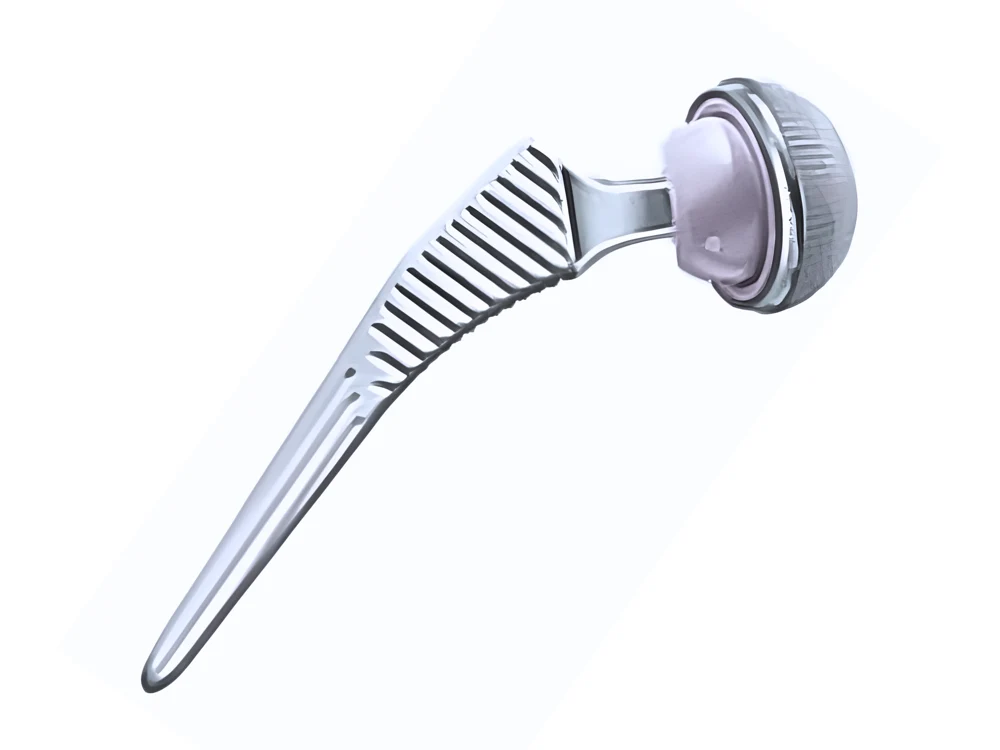
Total hip: cemented femoral stem, press-fit acetabular shell
0 mm polyethylene liner. Two interfaces on one construct, deliberately: one that transfers load continuously from the moment it is mixed, and one that transfers nothing but friction until bone grows into it.
Total knee: femoral component, tibial tray and polyethylene insert
0 mm. The highest-volume joint replacement there is, and the only implant in this tray that does not fail by breaking.
How it works: the main parts
What each part does, from the Orthopedic Implants lessons in the 3D Device Lab.
- Size range rack and the increment between sizes
- A stepped rack holding the same implant seven times over, ascending from the smallest to the largest, each one sealed in its own barrier with the size printed where a gloved hand can read it at arm’s length. It is the least interesting-looking object on the bench and it decides more about the mechanics than anything else on it.
- Trial components and templating overlays
- A blue tray of anodised parts that look like the implant and are not it, five of them in ascending size, with a transparent graduated acetate lying over the top. The anodised colour exists so that a trial can never be mistaken for the thing that stays in.
- Double sterile barrier packaging and lot record
- Two barriers, not one: an inner blister tray with a peelable lid and an outer pouch round it, with a label carrying the size, the lot and a sterilisation indicator that has changed colour. It is packaging in the sense that a pressure vessel is a container.
- Instrument case and implant tray
- A grey case with its lid hinged back, a silicone bracket mat inside with ribbed slots, and a label on the base. Everything for one construct lives in it and is accounted for out of it, and the ribs are the reason nothing inside it rattles.
- Insertion driver and torque-limiting handle
- A steel shaft with a hexalobular tip at one end, a rubber handle at the other, and a graduated clutch between them that slips at a set torque. It is the only instrument in the room that puts a number on a force, and the number it puts on decides how hard a screw is allowed to grip.
- Passivated oxide surface and its finish specification
- Three coupons of the same alloy on a small stand, identical in composition and different in finish, from a mirror through a satin to a matte. On top of all three is an oxide film a few nanometres thick that cannot be seen at all, and under all three is the reason one of them would last and another would not.
- Cut-section board and load-path schematic
- A dark board on an easel with the cross-sections drawn on it and, on a plinth in front, the same sections built as objects at six times life size, with the bone they sit beside drawn at the same enlargement and the neutral axis marked as a thin orange line through the middle of it.
- Alloy and polymer coupon board
- Six coupons on a small dark board, each labelled with its modulus: titanium alloy, cobalt-chromium, stainless steel, polyethylene, bone cement and a polymer stiff enough to be structural. Beside them, implied rather than mounted, is bone at seventeen gigapascals, and that is the number all six are being compared against.
Explore it in the Device Lab
- Two springs, one moment, and which axis: Set the bench to each configuration in turn and read one number: the share. 96 on the hip stem and 100 on the pedicle construct, and it is undefined on the knee because nothing lies alongside it.
- A cube, a fourth power and a first power: Three sensitivities on one bench and they are not interchangeable.
- Ten million cycles, and an exponent of minus twenty-seven: Start the frame and watch the counter. A million cycles a year means ten years is ten million, which is precisely where an endurance limit is quoted, so the service life of an implant is the x-axis of the standard curve and not a coincidence worth ignoring.
- A cone, an unrecorded force and a coefficient nobody measured: Select the hip configuration and work the taper controls, because the pair of numbers they produce is the least intuitive thing on this device.
- A joint that does not break: Select the knee and look for a share. There is not one, and that absence is the lesson: the tray sits on a cut surface in compression, nothing lies alongside it in bending, and no moment is divided.
Common faults and what to check
Most reported device problems (FDA MAUDE)
| Device problem | Reports |
|---|---|
| Device Dislodged or Dislocated | 18,367 |
| Fracture | 17,275 |
| Naturally Worn | 16,684 |
| Loss of or Failure to Bond | 10,914 |
| Appropriate Device Problem Term/Code Not Available | 10,288 |
| Unstable | 9,382 |
Raw counts of adverse event reports for this device type (FDA product code LPH, JWH, MBH), all years. Not adjusted for the number of units in use, so they show what gets reported, not failure rates. Report text is never copied.
Planned maintenance checks
From the BMEssentia procedure library: every 12 months, about 30 minutes, electrical class II, applied part type B.
Implants are single use and traceable. Engineering maintains the surgical power tools and checks loan-kit processes.
| Check | Pass when |
|---|---|
| Power tools and batteries Inspect handpieces, chucks, batteries and chargers. | No damage. |
| Speed and battery Check speed with the tachometer; check battery capacity per manufacturer. | Per manufacturer. |
| Electrical safety Test mains consoles and chargers to IEC 62353. | Within limits. |
Test instruments: Tachometer for power tools; Electrical safety analyser (mains consoles).
Recent FDA recalls
| Recall | Product and reason |
|---|---|
| Z-0090-2027 2026-10-06 | Onkos Surgical, Inc.: Onkos Surgical Inc. My3D Personalized Pelvic Implant, Porous, Left Personalized pelvic implants inadvertently mixed up and distributed to incorrect customers. Root cause: Labeling mix-ups. |
| Z-0091-2027 2026-10-06 | Onkos Surgical, Inc.: Onkos Surgical Inc. My3D Personalized Pelvic Implant, Porous, Left Personalized pelvic implants inadvertently mixed up and distributed to incorrect customers. Root cause: Labeling mix-ups. |
| Z-3197-2026 2026-09-16 | Howmedica Osteonics Corp.: ALL POLY CONSTRAINED INSERT 54MM Affected devices were manufactured with Ultra High Molecular Weight Polyethylene (UHMWPE) raw material aged in excess of five years. Root cause: Process change control. |
| Z-3203-2026 2026-09-16 | Howmedica Osteonics Corp.: SCORPIO RECESSED METAL BACKED PATELLA Affected devices were manufactured with Ultra High Molecular Weight Polyethylene (UHMWPE) raw material aged in excess of five years. Root cause: Process change control. |
| Z-2883-2026 2026-08-05 | United Orthopedic Corp.: Brand Name: U2 Total Knee System Due to an incomplete process of the component screw by a subcontractor which prevents the properly assembling of stem trail. Root cause: Process design. |
From the FDA recall database (openFDA), newest first, imported 2026-10-22. 1,386 recalls on record for this device type. Recall text is the FDA's public text; each recall links to the official record.
Learn it, see it in 3D, ask about it
- Ask Essentia about the Orthopedic Implants: answers from named sources, with the device open in its 3D Device Lab beside the answer.
- The Orthopedic Implants on the BMEssentia Platform: the Device Library course, 13 sections from physics to maintenance.
- BMEssentia Medical City: Device Lab 29, the Orthopedic Implants fully assembled in 3D, with lab tasks and the simulations.
Previous: CSF Shunt. Next: Prosthetic Limbs. All 69 devices.
Ask about the Orthopedic Implants
Sign in with your BMEssentia account, or create one, and ask anything about this device.
Ask Essentia