

Essentia / Devices / Insulin Pump
Device Lab 27
Insulin Pump
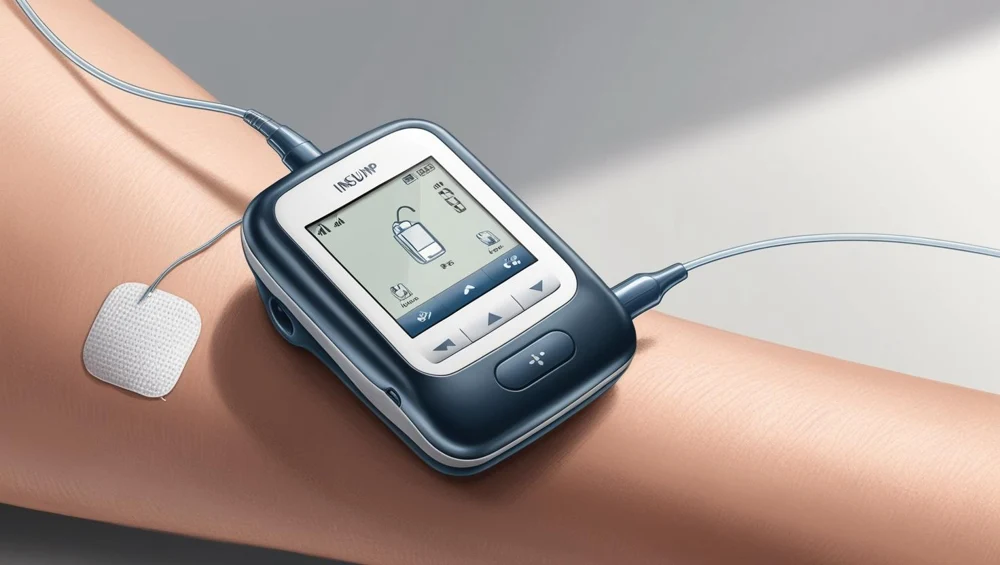
A moulded case the size of a pager, worn on a waistband, containing a cell, a controller, a gearbox-and-lead-screw drive and a 3 mL reservoir barrel whose plunger the screw advances. A window in the side shows the barrel and the plunger. 60 m long leaves the bottom of the case and ends at a cannula under a dressing.
Also called: INSULIN PUMP. Arabic: مضخة الأنسولين. Device Lab 27 of 69 in BMEssentia Medical City, 2 configurations.
Overview: the configurations
Tethered syringe-driver pump with a compliant infusion set
A moulded case the size of a pager, worn on a waistband, containing a cell, a controller, a gearbox-and-lead-screw drive and a 3 mL reservoir barrel whose plunger the screw advances. A window in the side shows the barrel and the plunger. 60 m long leaves the bottom of the case and ends at a cannula under a dressing.
On-body patch pump with a rigid metering chamber and no set
A smooth lozenge adhered directly to the skin, containing a 2 mL reservoir, a cell, a controller and a rigid metering chamber of 1 mm bore swept 50 micrometres at a time between two mechanically seated check valves. There is no set and nothing leaves the pod: 40 mm of soft silicone link inside the shell carries the fluid from the outlet valve to the cannula. Delivery is a count of completed strokes, and that count is also how occlusion is detected.
How it works: the main parts
What each part does, from the Insulin Pump lessons in the 3D Device Lab.
- Reservoir barrel and the fluid it holds
- A transparent barrel holding three millilitres, nine and a half millimetres across the bore, visible through a window in the side of the case with a plunger part way down it. On the other configuration it is a collapsing pouch inside a sealed pod instead, holding two millilitres, and nothing about it can be seen at all.
- The moving seal between the mechanism and the fluid
- A ribbed elastomer plunger four millimetres thick running in the barrel, with two sealing ribs and a short steel rod at its back. On the other configuration a single O-ring on a piston one millimetre across.
- Outlet port, septum and the connection to the line
- A short moulded boss at the bottom of the case with a pierced rubber septum in it and, on the tethered configuration, a tapered fitting below that. It is three millimetres of plastic, and it is the last place in the whole system where anything about the fluid is known.
- The compliance chain, which is the whole device and is not a part
- Not a component at all. It is the total springiness of everything between the metering element and the outlet, drawn on the schematic stand as four sections at twenty-two times life size with a bar under each showing its share.
- Trapped gas, and the compliance it multiplies
- A bubble. One microlitre of it is one point two four millimetres across; ten microlitres is two point six seven.
- Soft cannula, dressing and the schematic interface
- A dressing on the outside of the clothing, a small moulded hub and, on the schematic stand and nowhere else, a section of the cannula itself at twenty-two times life size beside a labelled tissue section. No puncture is depicted anywhere in this model.
- The actuator that turns electricity into displacement
- A stepper motor five and a half millimetres in radius and fourteen long, with two leads, on the tethered configuration. On the patch, a shape-memory alloy wire a third of a millimetre thick, a lever on a pivot and a return spring.
- Position feedback, and the only delivery figure the device has
- An optical disc with twelve slots turning with the motor shaft, and a slotted optical switch reading it. On the patch configuration, a contact that closes when the piston reaches the end of its stroke.
Explore it in the Device Lab
- The pressure hierarchy, and where the device lives in it: Set the bench to its nominal state and read the five pressures on the ladder. They are the whole device.
- The alarm delay, and the identity that explains it: Block the outlet on the bench and read the delay. Then read the line time constant beside it. One is minutes and the other is milliseconds, and they are the same physics.
- The increment, and why delivery is not smooth: Watch the manometer needle while the outlet is blocked. The pressure does not rise smoothly. It rises in treads, one every ten seconds, and the sixty-fourth tread crosses the threshold.
- Storage against delivery, and the bolus that comes back: Run the rig against a blocked outlet until it alarms, and compare two readings. The counter says one point seven seven microlitres. The balance says nothing arrived.
- One bubble, and the architecture it ruins: Set one microlitre of gas on each configuration in turn and read the multiplier. The tethered pump delay grows by a factor of one point three nine. The patch pump delay grows by seven point nine six.
Common faults and what to check
Most reported device problems (FDA MAUDE)
| Device problem | Reports |
|---|---|
| Device Displays Incorrect Message | 250,779 |
| Break | 105,456 |
| Patient Device Interaction Problem | 70,661 |
| Device Operates Differently Than Expected | 65,647 |
| No Display/Image | 61,210 |
| Mechanical Problem | 52,552 |
Raw counts of adverse event reports for this device type (FDA product code LZG, OYC), all years. Not adjusted for the number of units in use, so they show what gets reported, not failure rates. Report text is never copied.
Planned maintenance checks
From the BMEssentia procedure library: every 12 months, about 30 minutes, electrical class II, applied part type BF.
Patient-owned pumps are maintained by the manufacturer. Hospital checks cover the pumps the hospital holds and the in-patient policy.
| Check | Pass when |
|---|---|
| Case, buttons and reservoir bay Inspect for cracks, water ingress and a secure battery cap. | No cracks; cap secure. |
| Delivery accuracy Measure delivery at a basal rate with the analyser over the manufacturer's test period. | Within the manufacturer's accuracy. |
| Occlusion and clock Block the line and confirm the occlusion alarm; check the clock. | Alarm per manufacturer; clock correct. |
Test instruments: Infusion device analyser (micro-flow).
Recent FDA recalls
| Recall | Product and reason |
|---|---|
| Z-2604-2026 2026-06-30 | Insulet Corporation: Omnipod DASH Pod. Includes the below Model/REF Numbers: External soft cannula damage during manufacturing that results in insulin leaking around the Pod instead of being delivered to the user regardless of basal or bolus delivery. Root cause: Process design. |
| Z-2605-2026 2026-06-30 | Insulet Corporation: Omnipod (Eros) Pod. Includes the below Model/REF Numbers: External soft cannula damage during manufacturing that results in insulin leaking around the Pod instead of being delivered to the user regardless of basal or bolus delivery. Root cause: Process design. |
| Z-1748-2026 2026-04-02 | Medtronic MiniMed, Inc.: Paradigm Insulin Pump (MMT-712, MMT-715) All Medtronic MiniMed infusion pumps (Paradigm series, 600 series, and BLE 700 series) were found to be affected by unintended over- and under-delivery of insulin when the pump is elevated or lowered relative to the. Root cause: Device Design. |
| Z-1743-2026 2026-04-02 | Medtronic MiniMed, Inc.: MiniMed 640G Insulin Pump (MMT-1711, MMT-1712, MMT-1751, MMT-1752) All Medtronic MiniMed infusion pumps (Paradigm series, 600 series, and BLE 700 series) were found to be affected by unintended over- and under-delivery of insulin when the pump is elevated or lowered relative to the. Root cause: Device Design. |
| Z-1745-2026 2026-04-02 | Medtronic MiniMed, Inc.: MiniMed 720G Insulin Pump (MMT-1809, MMT-1810, MMT-1859, MMT-1860, MMT-1867) All Medtronic MiniMed infusion pumps (Paradigm series, 600 series, and BLE 700 series) were found to be affected by unintended over- and under-delivery of insulin when the pump is elevated or lowered relative to the. Root cause: Device Design. |
From the FDA recall database (openFDA), newest first, imported 2026-10-22. 160 recalls on record for this device type. Recall text is the FDA's public text; each recall links to the official record.
Learn it, see it in 3D, ask about it
- Ask Essentia about the Insulin Pump: answers from named sources, with the device open in its 3D Device Lab beside the answer.
- The Insulin Pump on the BMEssentia Platform: the Device Library course, 13 sections from physics to maintenance.
- BMEssentia Medical City: Device Lab 27, the Insulin Pump fully assembled in 3D, with lab tasks and the simulations.
Previous: Cochlear Implant. Next: CSF Shunt. All 69 devices.
Ask about the Insulin Pump
Sign in with your BMEssentia account, or create one, and ask anything about this device.
Ask Essentia