

Essentia / Devices / Cryotherapy System
Device Lab 17
Cryotherapy System
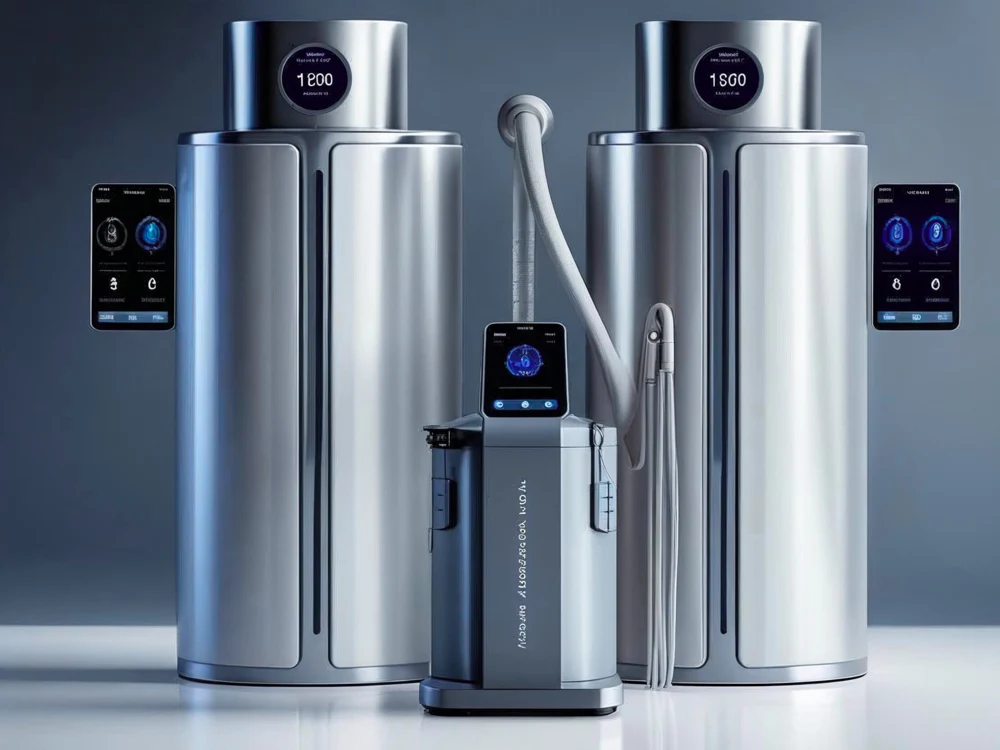
One probe, placed freehand through the skin under imaging, and one gas channel behind it. The ice grows as a single ball around the active length, and everything about the treatment is decided by where that one probe went. There is nothing to overlap and no spacing to plan, so the whole of the geometry is a single choice made once with a needle in a hand.
Also called: Cryotherapy, Cryosurgery, Cryoablation. Arabic: نظام العلاج بالتبريد. Device Lab 17 of 69 in BMEssentia Medical City, 2 configurations.
Overview: the configurations
Single-probe percutaneous cryoablation under imaging guidance
One probe, placed freehand through the skin under imaging, and one gas channel behind it. The ice grows as a single ball around the active length, and everything about the treatment is decided by where that one probe went. There is nothing to overlap and no spacing to plan, so the whole of the geometry is a single choice made once with a needle in a hand.
Multi-probe array with overlapping isotherms
Several probes driven from a manifold, each on its own valve, placed to a template so the spacing is a designed number rather than an estimate. The ice from the probes becomes confluent and so, if the spacing is right, do the lethal isotherms, and a warming catheter protects the one structure nearby that must not freeze.
How it works: the main parts
What each part does, from the Cryotherapy System lessons in the 3D Device Lab.
- Argon and helium cylinders and their yokes
- Two steel cylinders standing in a yoke beside the console, chained at two heights, each with a handwheel on top and an outlet keyed so that it will only mate with its own regulator. One is marked argon and one helium.
- Two-stage regulator and high-pressure supply line
- A stainless body clamped to the cylinder outlet, with two round gauges on it and a handwheel underneath. The upper gauge reads what is left in the cylinder; the lower one reads what is being delivered to the console.
- High-pressure circuit, filter and burst disc
- Behind the cabinet wall: a tall filter canister with a drain at the bottom, a machined block carrying three solenoid coils, a stainless pipe run rather than hose, and a small brass housing on the side with a thin metal disc clamped inside it. The disc is the least impressive object in the assembly and it is the only part of the circuit guaranteed to fail before anything else does.
- Counter-current heat exchanger
- Inside the probe shaft, in the last five centimetres before the tip: a fine helix of tubing wound round a central line, sitting inside a return annulus. It is the part of this device that looks least like a refrigerator and it is the reason the device is one.
- Joule-Thomson orifice and expansion chamber
- A small plate across the gas path, near the base of the active length, with a hole in it sixty micrometres across. Downstream of it, a chamber the length of the tip.
- Vacuum-jacketed probe shaft
- A rigid steel needle, a couple of millimetres across, with ten-millimetre marks etched along it and a visible collar some way from the point. Everything on the hub side of that collar is a vacuum flask.
- Freezing tip and active length
- The bare metal at the end of the probe: a couple of centimetres of polished steel closed by a trocar point. It is the only part of this device that is a refrigerator, and its surface area is the single number the entire thermal calculation is built on.
- Low-pressure return and exhaust
- A fat corrugated hose from each probe hub back to a port low on the console, a silencer inside the cabinet, and a stack leaving the top of it. The hose is much fatter than the supply hose even though it carries exactly the same gas at exactly the same rate, and the reason it is fatter is the whole of what this component teaches.
Explore it in the Device Lab
- The gap between what you can see and what you did: Set a probe, a tissue and a freeze time, and read four numbers together: the ice radius, the radius of the twenty-below boundary, the radius of the forty-below boundary, and the fraction of the ice volume inside each.
- Two gases, one hole, opposite signs: Compute the Joule-Thomson coefficient for argon, nitrogen and helium at room temperature from their van der Waals constants, and compute each gas’s inversion temperature from the same two numbers.
- The cycle changes the criterion, not the field: Run one cycle, then two, with the probe, the tissue, the pressure and the freeze time identical, and compare the iceball with the destroyed volume.
- Perfusion as a length: Step the tissue from resting muscle to liver to kidney and read two things: the perfusion length, and the fraction of the iceball that reached the destructive threshold.
- Spacing, and the waist nobody planned for: Two probes, one spacing, and two questions that look like the same question and are not: at what separation do the iceballs merge, and at what separation is the destroyed zone between the probes as wide as one probe’s own?
Common faults and what to check
Most reported device problems (FDA MAUDE)
| Device problem | Reports |
|---|---|
| Device Operates Differently Than Expected | 341 |
| Appropriate Device Problem Term/Code Not Available | 225 |
| Temperature Problem | 195 |
| Excessive Cooling | 193 |
| Break | 149 |
| Thermal Decomposition of Device | 129 |
Raw counts of adverse event reports for this device type (FDA product code GEH), all years. Not adjusted for the number of units in use, so they show what gets reported, not failure rates. Report text is never copied.
Planned maintenance checks
From the BMEssentia procedure library: every 12 months, about 60 minutes, electrical class I, applied part type BF.
| Check | Pass when |
|---|---|
| Console, hoses and cylinders Inspect the console, high-pressure hoses, regulators and cylinder restraints. | No damage; cylinders secured. |
| Electrical safety Test to IEC 62353. | Within limits. |
| Gas pressure and probe test Check supply pressure against the reference; run the manufacturer's freeze test. | Per manufacturer. |
| Room oxygen monitor Expose the sensor to test gas. | Alarm at its set limit. |
Test instruments: Gas pressure reference; Electrical safety analyser; Oxygen monitor test (room).
Recent FDA recalls
| Recall | Product and reason |
|---|---|
| Z-0080-2027 2026-10-02 | Limitless Cryo Spa LLC: Glypto Device, Glypto Cryo Machine Lack of 510(k) clearance. Root cause: Under Investigation by firm. |
| Z-2938-2026 2026-08-12 | Erbe USA Inc: ERBECRYO 2 Cryosurgical Unit A strong pull on the high-pressure transfer hose of cryosurgical unit may lead to pneumatic short circuit between he gas inlet and the connector resulting in CO2 leaking into the return path, leading to excessive. Root cause: Device Design. |
| Z-1566-2026 2026-03-20 | Erbe USA Inc: Flexible Cryoprobe (OD 1.1mm, L1.15mm) w/ oversheath (OD2.6mm, L817mm) Probes may rupture/burst during activation Root cause: Process control. |
| Z-1567-2026 2026-03-20 | Erbe USA Inc: Flexible Cryoprobe (OD 1.7mm, L1.15mm) Probes may rupture/burst during activation Root cause: Process control. |
| Z-1568-2026 2026-03-20 | Erbe USA Inc: Flexible Cryoprobe (OD 2.4mm, L1.15mm) Probes may rupture/burst during activation Root cause: Process control. |
From the FDA recall database (openFDA), newest first, imported 2026-10-22. 107 recalls on record for this device type. Recall text is the FDA's public text; each recall links to the official record.
Learn it, see it in 3D, ask about it
- Ask Essentia about the Cryotherapy System: answers from named sources, with the device open in its 3D Device Lab beside the answer.
- The Cryotherapy System on the BMEssentia Platform: the Device Library course, 13 sections from physics to maintenance.
- BMEssentia Medical City: Device Lab 17, the Cryotherapy System fully assembled in 3D, with lab tasks and the simulations.
Previous: Hyperthermia System. Next: Autoclave. All 69 devices.
Ask about the Cryotherapy System
Sign in with your BMEssentia account, or create one, and ask anything about this device.
Ask Essentia