

Essentia / Devices / Hyperthermia System
Device Lab 16
Hyperthermia System
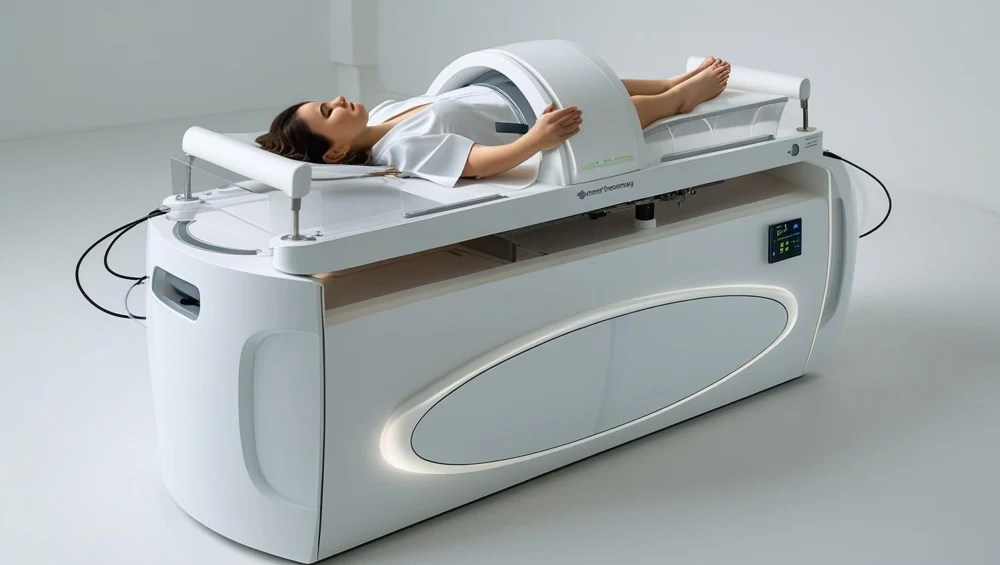
56 MHz through a matching network. At this frequency the wavelength in muscle is about a metre, so nothing here is a wave: the electrodes drive a current and the field is whatever the plates and the body between them make it. A water bolus sits against the skin under each electrode, and it is the only reason the arrangement is usable at all.
Also called: Hyperthermia Treatment System. Arabic: نظام العلاج بالحرارة. Device Lab 16 of 69 in BMEssentia Medical City, 2 configurations.
Overview: the configurations
Capacitive radiofrequency heating between opposed electrodes
56 MHz through a matching network. At this frequency the wavelength in muscle is about a metre, so nothing here is a wave: the electrodes drive a current and the field is whatever the plates and the body between them make it. A water bolus sits against the skin under each electrode, and it is the only reason the arrangement is usable at all.
Phased microwave applicator array with a steered focus
Eight water-loaded apertures in a ring around the patient, each on its own amplifier with its own amplitude and phase against a common reference. At these frequencies the wavelength in muscle is comparable to the body, so the elements interfere, and setting the phases so that their contributions arrive together at one point steers a focus there. The bolus that fills the ring is part of the antenna rather than an accessory to it.
How it works: the main parts
What each part does, from the Hyperthermia System lessons in the 3D Device Lab.
- Radiofrequency generator, exciter and final amplifier
- Two rack modules low in the cabinet, one of them small and one of them most of the weight. The small one is a crystal oscillator and a driver; the large one is a bank of transistors bolted to a finned heatsink, with a circulator and a load bolted beside it.
- Impedance matching network and tuner
- A box on the applicator support rather than in the cabinet, close enough to the applicator that the line between them is short. Inside it two glass cylinders with copper spirals visible through them, a coil of heavy copper wire, and a small stepper motor on top of each cylinder.
- Directional coupler and forward-reflected power measurement
- A short length of line with two small ports on it and a detector behind each one, inside the cabinet on the way out. It is the least impressive object in the energy chain and it is the only one that can tell you the difference between the power the generator made and the power the patient accepted.
- Coaxial feed line, balun and applicator connector
- Rigid silvered line inside the cabinet, a flexible braided run out to the applicator support, and a heavy threaded connector at every change. At the applicator end there is a short cylinder around the cable that is not a connector at all: it is a balun, and without it the outside of the cable is half the antenna.
- Temperature-controlled water bolus and membrane
- On the capacitive pair, two flat bags of water: one between the upper electrode and the skin, one recessed into a cut-out in the couch pad under the patient’s back. On the array, a single volume of water filling the whole bore, with the patient inside it.
- Deionised water circuit, chiller and degasser
- The bottom third of the cabinet. A refrigeration unit with a compressor and a finned condenser, a reservoir with a sight level, a roller pump, a tall clear column that removes dissolved gas, a small stainless cell with two electrodes in it, and a heater.
- Multi-sensor fibre-optic thermometry and its catheters
- Fine fibres inside closed-tip catheters about a millimetre and a half across, with small beads visible along the last few centimetres of each one and a connector block on the front of the console. There is no wire anywhere in them.
- Thermometry mapping drive and reference bath
- A small motorised carriage on a stand at the head of the couch, with a lead screw, a clamp holding the proximal end of a fibre, a scale along the travel, and a stirred stainless vessel beside it. The carriage moves about a hundred millimetres in five-millimetre steps and it does so throughout the treatment.
Explore it in the Device Lab
- The exchange rate, and why it breaks: Set a temperature and a time and read four numbers together: the dose rate at that temperature, the dose rate one degree above it, one degree below it, and the time each of those would need to reach the same total.
- The coldest point governs, and nothing looks for it: Set a perfusion spread across the target and read the temperature at both of its poles, then the dose at each, then the ratio between them.
- Perfusion answers back: Step the power up in equal increments and watch the temperature. It does not rise in equal increments, and the reason is in the denominator.
- One ratio, and the two configurations invert it: Compute the specific absorption in fat against the specific absorption in muscle, twice, for the two ways a field can meet a layer.
- The focus, and the frequency that makes it useless: Step the frequency through the range the array offers and read two numbers at each setting: how far the field penetrates, and how wide the interference maximum is.
Common faults and what to check
Planned maintenance checks
From the BMEssentia procedure library: every 12 months, about 90 minutes, electrical class I, applied part type BF.
| Check | Pass when |
|---|---|
| Applicators, bolus and cables Inspect the applicators, the water bolus and its circuit, RF cables and probes. | No damage or leaks. |
| Electrical safety Test to IEC 62353. | Within limits. |
| RF power and reflected power Measure delivered power into the load at several settings and compare with the console. | Within the manufacturer's accuracy. |
| Temperature probes Check every probe against the reference thermometer at two bath temperatures. | Within the manufacturer's accuracy. |
Test instruments: RF power meter and dummy load (manufacturer's); Calibrated reference thermometer and water bath; Electrical safety analyser.
Recent FDA recalls
No FDA recalls were found for this device type's product codes in the last import.
Learn it, see it in 3D, ask about it
- Ask Essentia about the Hyperthermia System: answers from named sources, with the device open in its 3D Device Lab beside the answer.
- The Hyperthermia System on the BMEssentia Platform: the Device Library course, 13 sections from physics to maintenance.
- BMEssentia Medical City: Device Lab 16, the Hyperthermia System fully assembled in 3D, with lab tasks and the simulations.
Previous: MCCE. Next: Cryotherapy System. All 69 devices.
Ask about the Hyperthermia System
Sign in with your BMEssentia account, or create one, and ask anything about this device.
Ask Essentia