

Essentia / Devices / Colonoscope
Device Lab 35
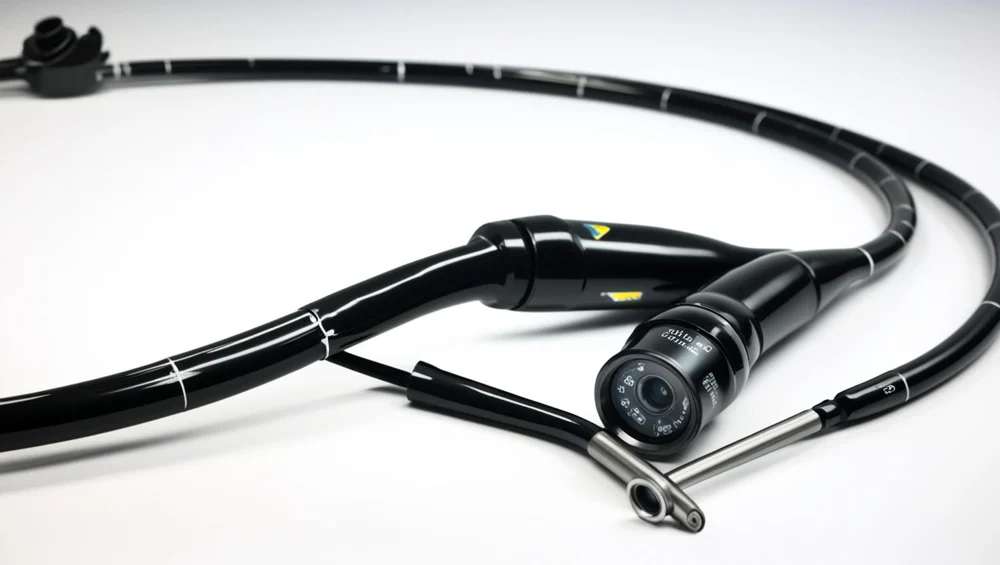
Colonoscope
Room air is drawn through an intake filter by a diaphragm pump inside the light source, held at a delivery pressure by a mechanical relief, and vented continuously past a hole in the air and water valve until somebody covers the hole. There is no flow measurement anywhere in the path and no setting except a two- or three-step pump speed.
Also called: Colonoscopy. Arabic: منظار القولون. Device Lab 35 of 69 in BMEssentia Medical City, 2 configurations.
Overview: the configurations
Ambient-air insufflation from a pump in the light source
Room air is drawn through an intake filter by a diaphragm pump inside the light source, held at a delivery pressure by a mechanical relief, and vented continuously past a hole in the air and water valve until somebody covers the hole. There is no flow measurement anywhere in the path and no setting except a two- or three-step pump speed.
Regulated carbon dioxide insufflation from an external supply
Carbon dioxide arrives from a cylinder or a wall outlet, through a yoke with a contents gauge, into a regulator that meters a set flow electronically and passes it through a bacterial filter and a non-return valve into the instrument air channel. Four components and three failure modes exist here that do not exist on the other configuration at all.
How it works: the main parts
What each part does, from the Colonoscope lessons in the 3D Device Lab.
- Distal tip face and the only end that matters
- A flat disc of moulded polymer thirteen point two millimetres across, on the end of a tube one thousand six hundred and eighty millimetres long. Four apertures are let into it: an objective window, two illumination windows, and the mouth of the instrument channel.
- Bending section, articulation links and the elastomeric sheath
- The last hundred millimetres before the tip, and visibly a different thing from the tube behind it: no braid pattern under the surface, a softer feel, and a covering that is rubber rather than the harder polymer of the shaft. It is the only part of the instrument that changes shape on purpose.
- Angulation wires, coil pipes and the travel they carry
- Four stranded steel wires, each running the whole length of the instrument inside its own close-wound coil pipe, positioned on the diagonals of the cross-section about four point five millimetres out from the centre. At the far end they terminate on the last articulation ring.
- Angulation knobs, drums and the friction brakes
- Two coaxial discs on one face of the control body, the larger one outboard for up and down and the smaller one inboard for left and right, each with three raised lugs so a thumb can find and turn it without looking. Outboard of each sits a small lever, which is a friction brake.
- Counter-wound braid, helical band and the torque path
- Two layers under the outer sheath that you can feel through it rather than see: a flat metal strip wound in a long helix, and over that a woven mesh of fine wires laid in both directions at once. Together they are about seven tenths of a millimetre thick and they are the reason the instrument can be steered by twisting it.
- Insertion tube wall, the stiffness gradient and the depth graduations
- One thousand six hundred and eighty millimetres of grey tube thirteen point two millimetres across, with black rings printed on it at every hundred millimetres from two hundred onwards. It is noticeably floppier near the tip than near the handle if you flex it along its length.
- Variable-stiffness adjuster and the coil it tensions
- A knurled collar at the base of the control body, just above where the insertion tube leaves it, with a scale marked nought to three on it. Turning it makes the shaft measurably firmer along most of its length, and it is the only control on the instrument that changes the instrument rather than pointing it.
- Instrument and suction channel, and 1.78 metres of it
- A single lumen three point seven millimetres across running one thousand seven hundred and eighty millimetres from the distal face to a junction inside the control body, where it becomes two branches. It is the largest thing inside the wall and the only one anything solid ever goes down.
Explore it in the Device Lab
- Two functions of one unobservable, and both of their zeros: Leave everything alone and move only the wrap. Read the force factor and the advance factor at nothing, at a quarter turn, at a half, at three quarters, at a full turn, and past it.
- One reading, two tip states, and a factor of three and a half: Set the wrap to nothing and the push to five newtons, and read the tip force. Then set the wrap to one complete turn, leave the push at five newtons, and read it again.
- A load that falls as the square of a length nobody measures: Set the push to one newton and sweep the free span from a hundred millimetres to eight hundred, watching the critical load and the signature.
- Two gases, two different orders of kinetics: This experiment is the comparison. Set the same distension on both configurations and read the gradient, the absorption rate, the floor and the standing load.
- Three bounds, and one of them rewards doing less: Three experiments on the reprocessing chain, and each of them produces a number rather than a description.
Common faults and what to check
Most reported device problems (FDA MAUDE)
| Device problem | Reports |
|---|---|
| Failure to Clean Adequately | 24,160 |
| No Display/Image | 8,949 |
| Communication or Transmission Problem | 8,575 |
| Poor Quality Image | 5,548 |
| Device Reprocessing Problem | 5,352 |
| Microbial Contamination of Device | 5,123 |
Raw counts of adverse event reports for this device type (FDA product code FDF), all years. Not adjusted for the number of units in use, so they show what gets reported, not failure rates. Report text is never copied.
Planned maintenance checks
From the BMEssentia procedure library: every 12 months, about 60 minutes, electrical class I, applied part type BF.
Same programme as other flexible endoscopes: leak test, angulation, channels, traceable reprocessing.
| Check | Pass when |
|---|---|
| Insertion tube and tip Inspect the long insertion tube for kinks and wear, the bending section and lens. | No damage. |
| Leak test Pressurise and flex while immersed. | No continuous bubble stream. |
| Angulation, stiffness, air and water Check angulation, the variable stiffness ring, insufflation and lens washing. | Each works across its range. |
| Electrical safety of the stack Test to IEC 62353 as a medical system. | PE ≤ 0.30 Ω; leakage within limits. |
Test instruments: Leak tester; Electrical safety analyser.
Standards engineers test against
IEC 60601-2-18: endoscopic equipment
The particular standard for endoscopes and their light sources and processors.
ISO 15883: washer-disinfectors
The series for washer-disinfectors: part 1 general requirements, part 2 for surgical instruments, part 4 for flexible endoscopes.
Recent FDA recalls
| Recall | Product and reason |
|---|---|
| Z-0056-2025 2024-10-11 | Olympus Corporation of the Americas: EVIS EXERA III Video System Center Model Number CV-190. Intended to be used with OLYMPUS camera heads, endoscopes, light Certain serial numbers of the CV-190 do not start up properly because parts that deviated from the specification were assembled into the power supply unit. Root cause: Nonconforming Material/Component. |
| Z-1206-2024 2024-02-29 | Olympus Corporation of the Americas: Colonoscope, Model Number CF-HQ190I. Specific repaired colonovideoscopes were assembled without an adhesive which protects them from certain physical conditions such as high levels of vibration, fluctuation in temperature or severe shock loads. Root cause: Nonconforming Material/Component. |
| Z-1207-2024 2024-02-29 | Olympus Corporation of the Americas: Colonoscope, Model Number CF-HQ190L. Specific repaired colonovideoscopes were assembled without an adhesive which protects them from certain physical conditions such as high levels of vibration, fluctuation in temperature or severe shock loads. Root cause: Nonconforming Material/Component. |
| Z-1211-2024 2024-02-29 | Olympus Corporation of the Americas: Colonoscope, Model Number PCF-H190L. Specific repaired colonovideoscopes were assembled without an adhesive which protects them from certain physical conditions such as high levels of vibration, fluctuation in temperature or severe shock loads. Root cause: Nonconforming Material/Component. |
| Z-0415-2024 2023-11-29 | Aizu Olympus Co., Ltd.: CF-HQ190L EVIS EXERA III COLONOVIDEOSCOPE Specific devices may have an improperly repaired light guide connector due to missing adhesive to secure the suction channel mouthpiece to the scope connector. Root cause: Process control. |
From the FDA recall database (openFDA), newest first, imported 2026-10-22. 25 recalls on record for this device type. Recall text is the FDA's public text; each recall links to the official record.
Learn it, see it in 3D, ask about it
- Ask Essentia about the Colonoscope: answers from named sources, with the device open in its 3D Device Lab beside the answer.
- The Colonoscope on the BMEssentia Platform: the Device Library course, 13 sections from physics to maintenance.
- BMEssentia Medical City: Device Lab 35, the Colonoscope fully assembled in 3D, with lab tasks and the simulations.
Previous: Endoscope. Next: Ultrasound. All 69 devices.
Ask about the Colonoscope
Sign in with your BMEssentia account, or create one, and ask anything about this device.
Ask Essentia