

Essentia / Devices / Thermometer
Device Lab 64
Thermometer
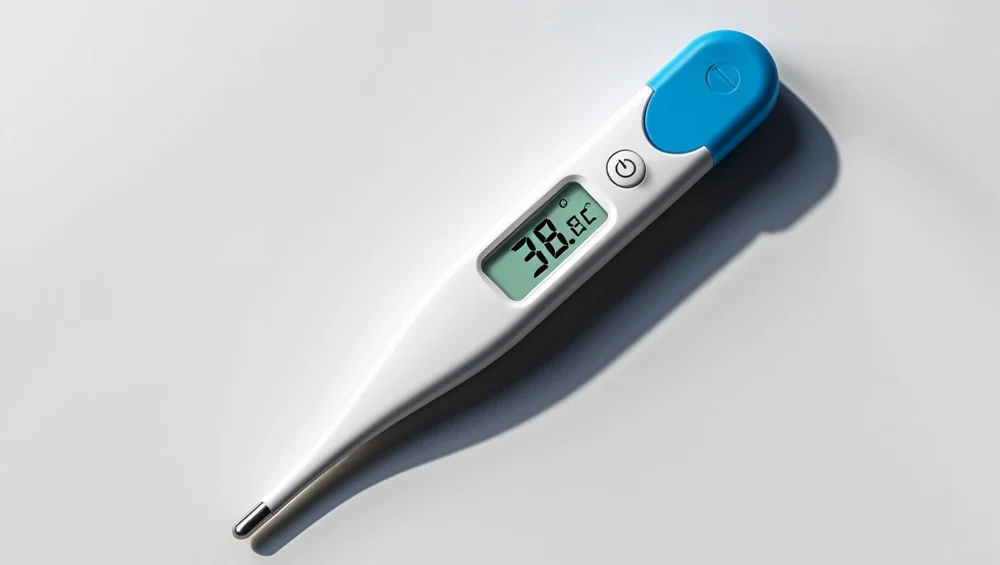
A stainless-sheathed negative-temperature-coefficient bead on a lead, placed in a closed axillary pocket, reporting the temperature the bead has reached.
Also called: Clinical Thermometer. Arabic: مقياس الحرارة. Device Lab 64 of 69 in BMEssentia Medical City, 2 configurations.
Overview: the configurations
Contact thermistor probe, sheathed, at a closed axillary pocket
A stainless-sheathed negative-temperature-coefficient bead on a lead, placed in a closed axillary pocket, reporting the temperature the bead has reached.
Non-contact infrared thermometer, fixed standoff, at the forehead surface
A thermopile behind a lens and a field stop, converting the net radiative exchange with a patch of forehead into a temperature using an emissivity fixed in firmware.
How it works: the main parts
What each part does, from the Thermometer lessons in the 3D Device Lab.
- Instrument stand, articulated arm and cradle
- A weighted disc 520 millimetres across on five rubber pads, an aluminium column just over a metre tall, and a two-segment arm on ball joints with a fitting at the far end. On one configuration that fitting is an open tray the instrument lies in.
- Single-use barrier over the sensing face
- A thin polyethylene sleeve about 62 millimetres long with a moulded collar at the open end, pulled on over the sensing face before every use and taken off after it. The same consumable serves both configurations, and on both it is the only thing between the instrument and a succession of different people.
- Stainless sensing tip and the mass it has to warm
- 5 millimetres across and 8 millimetres long with a hemispherical end, at the patient end of a flexible lead. It looks like nothing at all and it is the numerator of everything difficult about this configuration.
- Negative-temperature-coefficient bead and its resistance law
- A sintered metal-oxide bead a little over a millimetre across with two fine leads out of it, potted into the closed end of the tip. Its resistance falls steeply as it warms, and that steepness is the only reason a cheap converter can resolve a hundredth of a kelvin.
- Sheath between the tip and the housing, which is the drain
- The continuation of the same stainless tube, 30 millimetres of it inside the closed pocket and 60 millimetres standing out in room air, with a witness band where one becomes the other. It is the reason this configuration reads low even after it has finished settling.
- Strain relief boot where the lead leaves the housing
- A tapered rubber boot about 22 millimetres long with four moulded ribs, where the lead comes out of the nose of the case. It is the most boring component on the instrument and it is where these probes die.
- Flexible lead and its conductors
- 2 millimetre jacketed cable from the sheath to the boot, with two clips holding it where it would otherwise catch. It routes up and clear of the body rather than straight across it, which is a choice with a reason.
- Bench board: the approach, and the error at the moment of reading
- A 440 by 330 millimetre board on its own post beside the couch, drawing the exponential approach against time with a mark where somebody actually reads and another where the instrument decides it has finished. Across the top it says that no instrument shows you this, and it means it.
Explore it in the Device Lab
- The instrument that has to become the thing it measures: Set the contact configuration on the bench and read the number at five seconds, at ten, at fifteen, at thirty and at sixty. Then read the time constant off the board and check that the sequence is the exponential it claims to be.
- The probe as a thermal path to somewhere colder: Leave the contact configuration to settle completely, so nothing anywhere is still changing, and then look at what it reports. 767 kelvin below the site. There is no transient left to blame and no fault anywhere.
- A radiance divided by an assumption: Set the non-contact configuration at its standoff, so the geometry is exactly right, and then move only the true emissivity of the surface. 98 because there is no control for it.
- A field of view that grows until it is averaging the room: Take the non-contact configuration off its standoff and move it away from the site while watching the reported value and the spot diameter together. Nothing about the instrument changes.
- The term that is in neither instrument: Leave both instruments alone and move only the room. Then move only the tissue layer. Neither of those is a control on anything and both of them move the answer more than anything you can adjust.
Common faults and what to check
Most reported device problems (FDA MAUDE)
| Device problem | Reports |
|---|---|
| Excessive Heating | 317 |
| False Negative Result | 210 |
| Low Readings | 171 |
| Incorrect, Inadequate or Imprecise Result or Readings | 156 |
| Computer Software Problem | 76 |
| High Readings | 59 |
Raw counts of adverse event reports for this device type (FDA product code FLL), all years. Not adjusted for the number of units in use, so they show what gets reported, not failure rates. Report text is never copied.
Planned maintenance checks
From the BMEssentia procedure library: every 12 months, about 10 minutes, electrical class II, applied part type BF.
| Check | Pass when |
|---|---|
| Probe, lens and case Inspect the probe, the lens window and the battery compartment. | Lens clean and intact. |
| Accuracy check Check against the manufacturer's calibrator or blackbody at two temperatures. | Within the manufacturer's accuracy. |
Test instruments: Calibrator or blackbody reference supplied by the manufacturer; Reference thermometer.
Standards engineers test against
ISO 80601-2-56: clinical thermometers
The standard for clinical thermometers for body temperature.
Recent FDA recalls
| Recall | Product and reason |
|---|---|
| Z-3256-2026 2026-09-22 | DeRoyal Industries Inc: REF: 81-030415 Myocardial temperature probes contain an incorrect needle. Root cause: Under Investigation by firm. |
| Z-0233-2026 2025-10-23 | Baxter Healthcare Corporation: Oral Probe (Product code 02893-000), accessory used with Welch Allyn SureTemp Plus 690 (Product codes 01690-200 and Affected oral/axillary probes were inadvertently programmed with the rectal probe configuration. Root cause: Process control. |
| Z-2339-2024 2024-07-11 | Baxter Healthcare Corporation: Braun Thermoscan PRO 6000 Ear Thermometer The Braun Thermoscan PRO 6000 ear thermometers may have been shipped with a compact disc (CD) containing an outdated version of the Instructions for Use (IFU). Root cause: Process control. |
| Z-2482-2021 2021-07-20 | Welch Allyn Inc: Braun ThermoScan PRO 6000 Ear Thermometer-indicated for the intermittent measurement of human body temperature for If the device is exposed to fluid ingress and is used before the cleaning fluid has completely dried, there is a risk of the device overheating potentially causing a burn to the user or the ear canal of the patient Root cause: Labeling design. |
| Z-0990-2020 2019-10-28 | Cardinal Health 200, LLC: Genius 2 Tympanic Thermometer (discontinued) The frequency of calibration for the Genius Tympanic Thermometer as stated in the operating manual may not ensure that thermometers always remain within the stated accuracy range ( 0.2C for Genius 2 and 0.3C for Genius 3. Root cause: Under Investigation by firm. |
From the FDA recall database (openFDA), newest first, imported 2026-10-22. 19 recalls on record for this device type. Recall text is the FDA's public text; each recall links to the official record.
Learn it, see it in 3D, ask about it
- Ask Essentia about the Thermometer: answers from named sources, with the device open in its 3D Device Lab beside the answer.
- The Thermometer on the BMEssentia Platform: the Device Library course, 13 sections from physics to maintenance.
- BMEssentia Medical City: Device Lab 64, the Thermometer fully assembled in 3D, with lab tasks and the simulations.
Previous: Stethoscope. Next: Centrifuge. All 69 devices.
Ask about the Thermometer
Sign in with your BMEssentia account, or create one, and ask anything about this device.
Ask Essentia