

Essentia / Devices / Fetal Monitor
Device Lab 47
Fetal Monitor
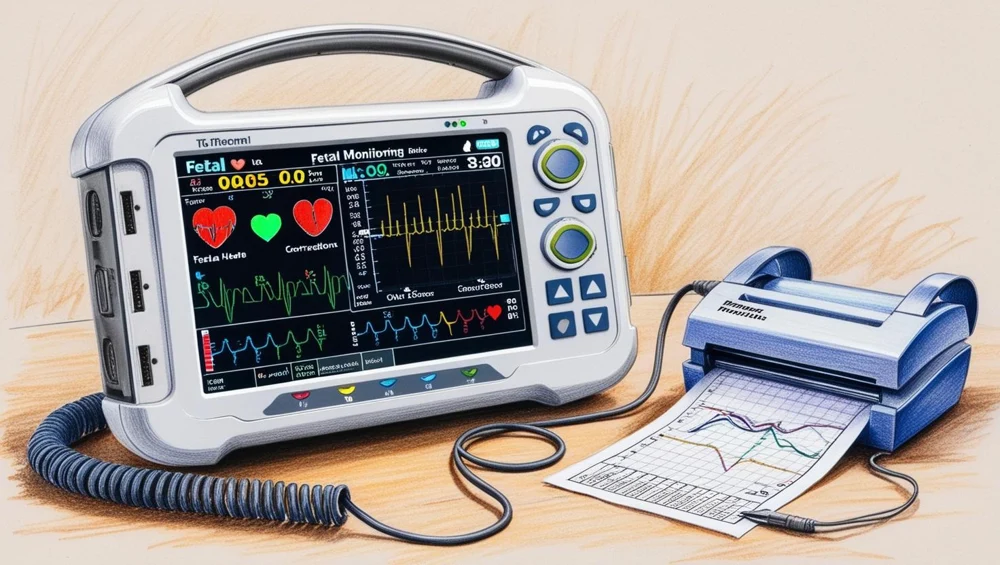
Two transducers held on the abdomen by elastic belts. One transmits continuous-wave ultrasound and listens for the Doppler shift from moving fetal cardiac structures; the rate is the lag at which an autocorrelation of that envelope peaks. The other is a strain gauge on a guard ring reading the tension in its own belt, and its axis is unitless because nothing it measures is a pressure.
Also called: Ctg, Cardiotocograph. Arabic: جهاز مراقبة الجنين. Device Lab 47 of 69 in BMEssentia Medical City, 2 configurations.
Overview: the configurations
External, Doppler ultrasound and tocodynamometer
Two transducers held on the abdomen by elastic belts. One transmits continuous-wave ultrasound and listens for the Doppler shift from moving fetal cardiac structures; the rate is the lag at which an autocorrelation of that envelope peaks. The other is a strain gauge on a guard ring reading the tension in its own belt, and its axis is unitless because nothing it measures is a pressure.
Internal, fetal scalp electrode and intrauterine pressure catheter
A spiral electrode turned into the fetal scalp against a maternal reference plate, giving a genuine fetal electrocardiogram from which the interval between one R wave and the next is timed directly; and a fluid-filled catheter in the amniotic cavity against an external strain gauge zeroed to atmosphere, giving a pressure in millimetres of mercury with a true zero.
How it works: the main parts
What each part does, from the Fetal Monitor lessons in the 3D Device Lab.
- Enclosure, trolley and cable management
- A squat moulded box about a third of a metre across, standing on a small wheeled trolley at the head of a couch. A carrying handle is recessed into the top, vent slots run down both flanks, a shelf under it holds a box of chart paper, and two round holsters on the side hold the transducers when they are not on anybody.
- Keyed transducer sockets and the front panel
- Four round sockets in a row along the lower front panel, each inside a coloured ring and each with a printed legend under it: blue for the ultrasound transducer, pink for the toco, yellow for the fetal electrode and grey for the pressure line. Each one has a keyway cut into the shell.
- Numeric and waveform display
- A landscape panel filling the upper left of the front, showing two bands with time running left to right, a column of large numerics down the right, and a bar for signal quality along the bottom. The fetal rate is the biggest number on the machine and the maternal rate sits directly beneath it.
- Thermal chart recorder and paper path
- A door across the lower front with a latch, a tear bar above it, and a strip of ruled paper emerging from a slot and hanging down. Behind the door are a thermal print head the full width of the paper, a rubber platen roller and a drive.
- Paper speed selector, 1 to 3 cm per minute
- A small knurled rotary control on the lower left of the panel with three detents and three printed numbers beside it: one, two and three. Below them, in small type, the units, centimetres per minute.
- Maternal heart rate channel
- A small sensor clipped to a fingertip with a short cable back to the panel, and a second numeric on the screen directly under the fetal one. On the internal configuration the same number can be derived from the maternal complex the scalp electrode already sees.
- Signal quality index and loss of contact
- A bar of five segments on the front panel beside the sockets, green when the signal is good and amber or red when it is not, with a printed legend under it. On this build a separate bench panel on top of the enclosure shows what the bar is derived from, which no real monitor does.
- Maternal event marker handset
- A short moulded handset on a coiled cable, with a single large button, lying on the couch beside her hand. She presses it when she feels something.
Explore it in the Device Lab
- Where the rate quantum comes from: Hold everything else still and change only the sample interval the lag search runs on, then watch the reported rate and the spacing of the values it can take.
- Which peak the correlator took: Change only the size of the second mechanical event in the envelope, and watch the correlogram rather than the number.
- Whose heart is on the upper trace: Move the transducer towards the maternal midline and watch three things at once: the reported rate, the maternal rate, and the quality indicator.
- What the lower trace is really measuring: Change the belt tension and the abdominal wall thickness one at a time, with nothing about the contraction changing, and watch the amplitude and the timing separately.
- What a zero and a unit buy: On the internal configuration, move the height of the pressure transducer against the catheter tip, then separately damp the catheter, and watch the resting tone and the Montevideo total.
- What the paper speed does to the same recording: Change only the paper speed and look at the chart, not at the numbers.
Common faults and what to check
Most reported device problems (FDA MAUDE)
| Device problem | Reports |
|---|---|
| No Audible Alarm | 185 |
| No Audible Prompt/Feedback | 116 |
| Incorrect Measurement | 107 |
| Device Alarm System | 91 |
| Device Operates Differently Than Expected | 63 |
| Incorrect, Inadequate or Imprecise Result or Readings | 51 |
Raw counts of adverse event reports for this device type (FDA product code HGM, KNG), all years. Not adjusted for the number of units in use, so they show what gets reported, not failure rates. Report text is never copied.
Standards engineers test against
IEC 60601-2-37: ultrasonic diagnostic and monitoring equipment
The particular standard for diagnostic ultrasound.
Recent FDA recalls
| Recall | Product and reason |
|---|---|
| Z-2522-2026 2026-06-22 | Philips North America Llc: Philips Avalon Fetal Monitor, FM20, Part number M2702A, Part M2703A Monitor has incorrect assembly of the speaker connector which can cause device cables to be pulled out of the housing and increase the risk of intermittent or permanent loss of speaker output. Root cause: Process control. |
| Z-2523-2026 2026-06-22 | Philips North America Llc: Philips Avalon Fetal Monitor, FM 30 Part numberM2703A Monitor has incorrect assembly of the speaker connector which can cause device cables to be pulled out of the housing and increase the risk of intermittent or permanent loss of speaker output. Root cause: Process control. |
| Z-1140-2026 2026-01-22 | Edan Diagnostics: Brand Name: EDAN As a result of receiving an FDA It Has Come to Our Attention Letter (IHCTOA Letter) regarding potential cybersecurity issues with various of the firm device. Root cause: Device Design. |
| Z-1141-2026 2026-01-22 | Edan Diagnostics: Brand Name: EDAN As a result of receiving an FDA It Has Come to Our Attention Letter (IHCTOA Letter) regarding potential cybersecurity issues with various of the firm device. Root cause: Device Design. |
| Z-1151-2026 2026-01-22 | Edan Diagnostics: Brand Name: EDAN As a result of receiving an FDA It Has Come to Our Attention Letter (IHCTOA Letter) regarding potential cybersecurity issues with various of the firm device. Root cause: Device Design. |
From the FDA recall database (openFDA), newest first, imported 2026-10-22. 29 recalls on record for this device type. Recall text is the FDA's public text; each recall links to the official record.
Learn it, see it in 3D, ask about it
- Ask Essentia about the Fetal Monitor: answers from named sources, with the device open in its 3D Device Lab beside the answer.
- The Fetal Monitor on the BMEssentia Platform: the Device Library course, 13 sections from physics to maintenance.
- BMEssentia Medical City: Device Lab 47, the Fetal Monitor fully assembled in 3D, with lab tasks and the simulations.
Previous: DEXA Scanner. Next: Infant Incubator. All 69 devices.
Ask about the Fetal Monitor
Sign in with your BMEssentia account, or create one, and ask anything about this device.
Ask Essentia