

Essentia / Devices / Lithotripter (ESWL)
Device Lab 69
Lithotripter (ESWL)
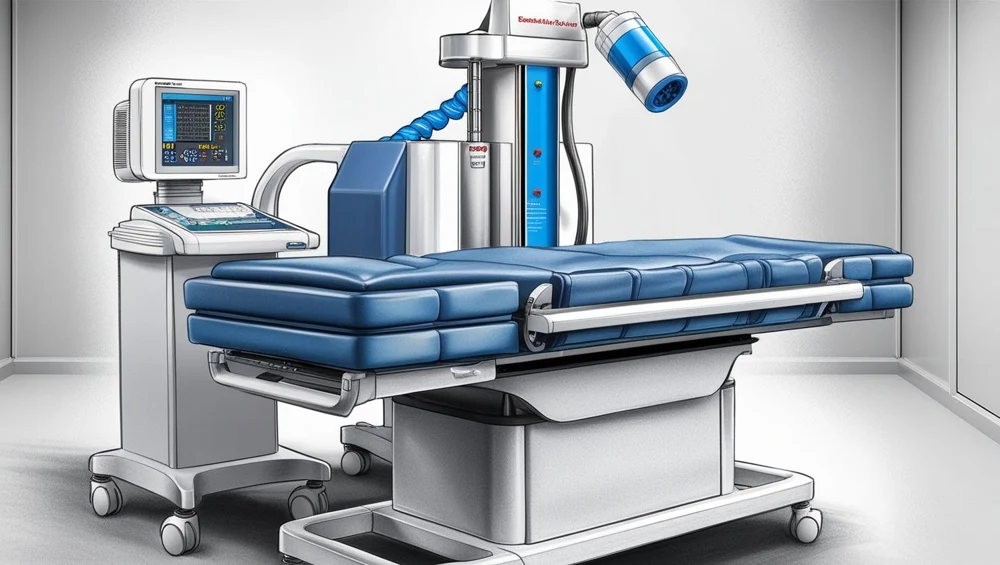
A spark fired between two electrode tips under degassed water, at the near focus of a truncated ellipsoidal brass reflector. The spark vaporises a small volume of water into plasma; the bubble expands faster than sound in water and the shock front it launches is reflected by the ellipsoid onto the second focus inside the patient. The geometry does the focusing and nothing else has to.
Also called: Lithotripter, Lithotripsy, Shock Wave Lithotripsy. Arabic: جهاز تفتيت الحصى بالموجات الصدمية. Device Lab 69 of 69 in BMEssentia Medical City, 2 configurations.
Overview: the configurations
Electrohydraulic spark-gap lithotripter
A spark fired between two electrode tips under degassed water, at the near focus of a truncated ellipsoidal brass reflector. The spark vaporises a small volume of water into plasma; the bubble expands faster than sound in water and the shock front it launches is reflected by the ellipsoid onto the second focus inside the patient. The geometry does the focusing and nothing else has to.
Electromagnetic coil and lens lithotripter
A capacitor discharged through a flat spiral coil behind a thin copper membrane, separated from it by an insulating film. The current pulse induces opposing eddy currents in the membrane, the two fields repel, and the membrane is thrown away from the coil hard enough to launch a planar pressure wave into the water in front of it. An acoustic lens then focuses that plane wave to a point.
How it works: the main parts
What each part does, from the Lithotripter (ESWL) lessons in the 3D Device Lab.
- Water cushion and coupling membrane
- A domed rubber membrane full of water on the top of the therapy head, with a bellows behind it and a film of gel on top. It is the only part of this machine that touches the patient.
- Coupling quality monitor
- Two or three small cameras looking sideways across the coupling interface from inside the head, and a picture of what they see on the console. It exists to make visible the one thing that ruins treatments and cannot otherwise be seen.
- Degassed water conditioning circuit
- A tank with a sight glass, a small pump and a heater, plumbed to the therapy head with two lines. It exists to take the dissolved air out of a few litres of water and keep it out.
- High-voltage capacitor bank
- Three cylinders the size of coffee flasks in the bottom of the machine, with a red bar across their terminals and a warning label nobody reading it is reassured by. This is where a second of ordinary mains power is stored up so that it can be spent in a millionth of one.
- Charging and trigger circuit
- A board with a row of indicator lamps behind a ventilated panel, and a thick coaxial run leaving it towards the emitter. It decides when the stored energy goes, and how consistently.
- Fluoroscopy X-ray tube
- A cylindrical housing under the table with a collimator on its front, aimed up through the patient at the treatment point. It is the only source of ionising radiation anywhere in this machine.
- X-ray image receptor
- A cylindrical can on the opposite arm of the gantry from the tube, facing it through the patient. Older machines use an image intensifier; newer ones a flat panel in the same place doing the same job.
- Ultrasound localisation probe
- A small probe on an articulated arm that reaches over to the flank, with its own image on the console. It finds the stone without any radiation at all, and it is the only thing here that can watch during treatment.
Explore it in the Device Lab
- A squeeze that arrives as a pull: A compressive pulse crosses from tissue into stone. Some of it reflects at that first boundary and the rest travels through. When what travelled through reaches the far side of the stone and meets tissue again, it reflects a second time, and this time the coefficient is negative.
- The half of the mechanism a fast treatment throws away: Behind the compressive spike the pulse goes negative for several microseconds, and liquid under tension does not stretch, it tears. Bubbles grow on the stone surface, expand for a few hundred microseconds, and then collapse violently. A bubble collapsing against a solid surface does not collapse symmetrically: it involutes and drives a jet of liquid at several hundred metres a second into whatever it was touching.
- Why the sharper machine is the worse one: Take two sources delivering comparable total energy. One puts it into a zone about eleven millimetres across at around fifty megapascals; the other into about five millimetres at nearly ninety. Measured on stones, the broad low-pressure one comminutes roughly twice as well.
- Two per cent that costs a fifth: Everything between the emitter and the stone has to pass the wave along, and almost everything does. Water, gel, skin, fat and muscle are close enough in acoustic impedance that the losses at each boundary are small.
- Accurately aimed at the wrong place: The machine converges its wave onto one point, and the imaging is centred on one point, and everything depends on those being the same point. If they are, putting the stone on the crosshairs puts it in the focus. If they are not, the machine is precise, the image is correct, the operator is competent, and the treatment is going into tissue with no stone in it.
Common faults and what to check
Most reported device problems (FDA MAUDE)
| Device problem | Reports |
|---|---|
| Device Displays Incorrect Message | 24 |
| Device Operates Differently Than Expected | 21 |
| Normal | 14 |
| Device Inoperable | 11 |
| Loss of Power | 9 |
| Device Issue | 7 |
Raw counts of adverse event reports for this device type (FDA product code LNS), all years. Not adjusted for the number of units in use, so they show what gets reported, not failure rates. Report text is never copied.
Planned maintenance checks
From the BMEssentia procedure library: every 12 months, about 120 minutes, electrical class I, applied part type B.
| Check | Pass when |
|---|---|
| Therapy head, coupling cushion and table Inspect the therapy head membrane, the water system and the table. | No leaks or membrane damage. |
| Electrical safety Test to IEC 62353. | Within limits. |
| Focus and trigger Run the manufacturer's focus alignment check and the ECG trigger test. | Pass. |
Test instruments: Manufacturer's focus and output test tools; Electrical safety analyser.
Standards engineers test against
IEC 60601-2-36: extracorporeally induced lithotripsy
The particular standard for shock wave lithotripters.
Recent FDA recalls
| Recall | Product and reason |
|---|---|
| Z-0265-2016 2015-09-24 | Siemens Medical Solutions USA, Inc: MODULARIS VARIOSTAR Display freeze of MODULARIS hand control results in information not being updated on the display. Root cause: Software design. |
From the FDA recall database (openFDA), newest first, imported 2026-10-22. 1 recalls on record for this device type. Recall text is the FDA's public text; each recall links to the official record.
Learn it, see it in 3D, ask about it
- Ask Essentia about the Lithotripter (ESWL): answers from named sources, with the device open in its 3D Device Lab beside the answer.
- The Lithotripter (ESWL) on the BMEssentia Platform: the Device Library course, 13 sections from physics to maintenance.
- BMEssentia Medical City: Device Lab 69, the Lithotripter (ESWL) fully assembled in 3D, with lab tasks and the simulations.
Previous: X-ray. All 69 devices.
Ask about the Lithotripter (ESWL)
Sign in with your BMEssentia account, or create one, and ask anything about this device.
Ask Essentia