

Essentia / Devices / Blood Gas Analyser
Device Lab 45
Blood Gas Analyser
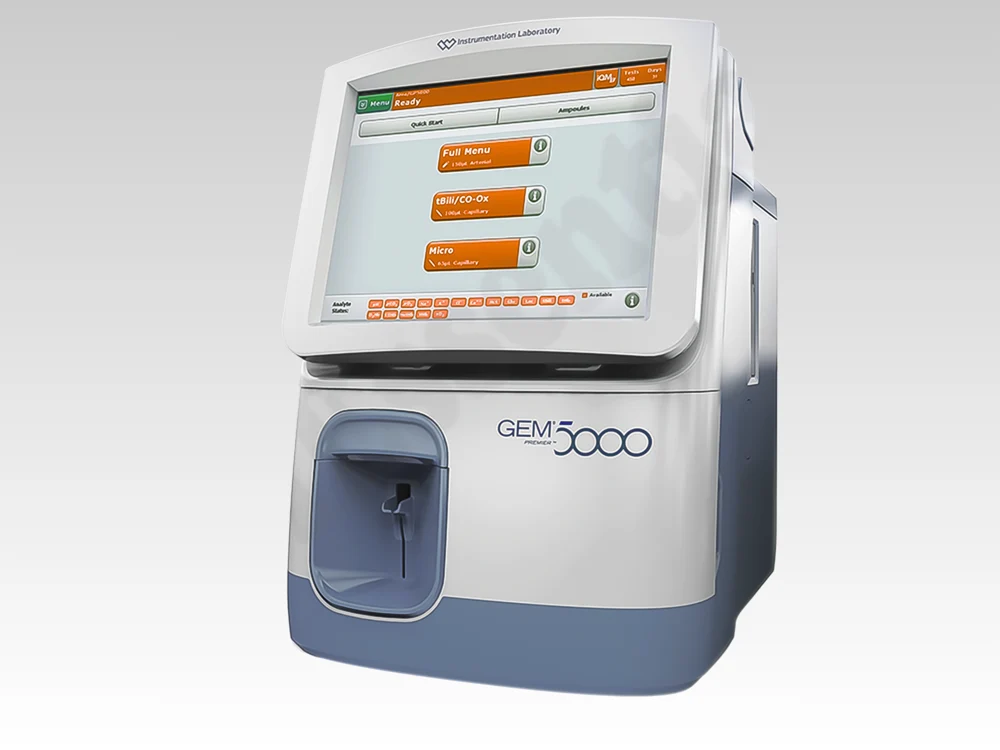
A bench instrument about the size of a small printer, with a tilt-out front carrying a single fluid pack that holds both calibrant buffers, both gas-equilibrated solutions, the rinse and the waste. A peristaltic pump draws ninety-five microlitres of sample up an aspirating probe and through a one-millimetre capillary that passes four electrodes in series inside a block held at thirty-seven degrees. A co-oximeter sits in the same path and measures haemoglobin and its species spectrophotometrically.
Also called: Blood Gas Analyzer, Abg Analyser. Arabic: محلل غازات الدم. Device Lab 45 of 69 in BMEssentia Medical City, 2 configurations.
Overview: the configurations
Benchtop laboratory analyser, fluid-pack reagents
A bench instrument about the size of a small printer, with a tilt-out front carrying a single fluid pack that holds both calibrant buffers, both gas-equilibrated solutions, the rinse and the waste. A peristaltic pump draws ninety-five microlitres of sample up an aspirating probe and through a one-millimetre capillary that passes four electrodes in series inside a block held at thirty-seven degrees. A co-oximeter sits in the same path and measures haemoglobin and its species spectrophotometrically.
Cartridge point-of-care analyser, one calibration per cartridge
A handheld instrument the length of a hand, with a slot in the end. The sensors are thin films printed on a silicon or polymer chip inside a single-use cartridge together with a foil pouch of calibrant fluid. Inserting the cartridge closes twelve contacts; the instrument punctures the pouch, floods the sensors with calibrant, reads one point, then displaces the calibrant with sixty-five microlitres of blood and reads the sample.
How it works: the main parts
What each part does, from the Blood Gas Analyser lessons in the 3D Device Lab.
- Sample inlet and preanalytical path
- A steel needle on a swing-out arm, a drip tray under it, and a syringe held against it for four seconds. That is the entire interface between this instrument and the patient, and it is the last link in a chain that started in an artery somewhere else in the building.
- Thermostatted measuring block at 37 °C
- An aluminium jacket around the measuring chamber, a heater foil under it, a thermistor in the side of it, and a blanket of insulation around the lot. It holds thirty-seven degrees to within about a tenth, and it is not doing that for the patient comfort of a hundred microlitres of blood.
- Reference electrode and its junction
- A silver wire coated in silver chloride, sitting in saturated potassium chloride, with a porous plug where that solution meets the sample. It produces a potential that is supposed to depend on nothing at all, and it is half of every potentiometric reading this instrument makes.
- pH glass membrane electrode
- A bulb or a capillary of a special glass, fifty micrometres thick, with a buffer of known pH sealed inside it and a wire in that buffer. A difference in hydrogen ion activity across that glass produces a potential, and that is the whole of what it does.
- Severinghaus carbon dioxide electrode
- A pH electrode with a twenty-five-micrometre silicone rubber membrane stretched over it and a ten-micrometre film of bicarbonate solution trapped in between. It measures carbon dioxide, and there is nothing in it that is sensitive to carbon dioxide.
- Clark oxygen electrode
- A platinum disc a fraction of a millimetre across, held at about six hundred and fifty millivolts negative to a silver anode, behind a twenty-micrometre polypropylene membrane. It is the only channel on this instrument that is not a voltage, and it is the only one whose errors do not get amplified.
- Electrometer and picoammeter front end
- A screened can the size of a matchbox as close to the electrodes as it can physically be, with a gold guard ring round its input and the shortest lead in the instrument going to it. It exists because the pH electrode is very nearly an open circuit.
- Digitiser and channel multiplexer
- A multiplexer, a converter and a settling delay. It is the least interesting board in the instrument and it sets the finest change in pH the machine is capable of reporting.
Explore it in the Device Lab
- The exchange rate between millivolts and the report: Put an offset on the pH electrode, one millivolt at a time, and watch what a millivolt is worth.
- What bicarbonate inherits: Put two millivolts of INDEPENDENT error on the two potentiometric channels and read four numbers in order: the pH error, the carbon dioxide error, the bicarbonate error, and whether either of the first two failed a limit. Then put the same shift on the REFERENCE instead and read them again, because the second experiment is the surprising one.
- Where the calibration lives: Set the true electrode slope away from the assumed one, then read the error at each of the samples on the bench and at each control level.
- Why the oxygen channel behaves differently: Double the oxygen tension and watch the current double. Then double it again. Then compare that behaviour with what the pH channel does.
- The half cell both channels are measured against: Put an offset on the reference electrode and watch which channels move. Then fault the pH glass alone and watch again.
- What thirty-seven degrees is for: Move the measuring block away from thirty-seven and watch two separate things happen.
Common faults and what to check
Most reported device problems (FDA MAUDE)
| Device problem | Reports |
|---|---|
| Incorrect, Inadequate or Imprecise Result or Readings | 445 |
| Low Test Results | 355 |
| High Test Results | 284 |
| Incorrect Or Inadequate Test Results | 224 |
| Non Reproducible Results | 152 |
| High Readings | 139 |
Raw counts of adverse event reports for this device type (FDA product code CHL), all years. Not adjusted for the number of units in use, so they show what gets reported, not failure rates. Report text is never copied.
Planned maintenance checks
From the BMEssentia procedure library: every 12 months, about 60 minutes, electrical class I.
Point-of-care analysers sit under the laboratory's quality system. Engineering checks support it; they do not replace QC.
| Check | Pass when |
|---|---|
| Sample path and printer Inspect the sample inlet, tubing, waste and the printer or interface. | No leaks or blood residue. |
| Electrical safety Test as Class I equipment. | PE ≤ 0.30 Ω; leakage within IEC 62353 limits. |
| Temperature and QC review Check the measuring block temperature and review the last month of QC and calibration records with the lab. | Temperature within tolerance; QC within limits. |
Test instruments: Electrical safety analyser; Thermometer reference.
Recent FDA recalls
| Recall | Product and reason |
|---|---|
| Z-0190-2027 2026-10-15 | Radiometer Medical ApS: The ABL90 FLEX and ABL90 FLEX PLUS analyzers are intended for use by trained technologists, nurses, physicians and In vitro diagnostic analyzer had a risk of potentially inaccurate results requiring changes to instructions for use and: 1) Sample types, including whole blood samples no longer suitable for testing FHbF and ctBil, 2). Root cause: No Marketing Application. |
| Z-2899-2026 2026-08-06 | Instrumentation Laboratory: GEM Premier 7000 with iQM3 The active ingredient concentration in the lysing bag solution of specific GEM Premier 7000 with iQM3 PAK lots did not meet established manufacturing specifications. Root cause: Nonconforming Material/Component. |
| Z-2900-2026 2026-08-06 | Instrumentation Laboratory: GEM Premier 5000 PAK The active ingredient concentration in the lysing bag solution of specific GEM Premier 5000 lots did not meet established manufacturing specifications. Root cause: Nonconforming Material/Component. |
| Z-2821-2026 2026-07-29 | Instrumentation Laboratory: GEM Premier 5000 with IQM2 Potential for Bar Code Reader (BCR) wands, used with the GEM Premier 5000 and GEM Premier 7000 systems, to assign patient results to an incorrect patient ID. Root cause: Software Design Change. |
| Z-2822-2026 2026-07-29 | Instrumentation Laboratory: Brand Name: GEM Premier 7000 with iQM3 Potential for Bar Code Reader (BCR) wands, used with the GEM Premier 5000 and GEM Premier 7000 systems, to assign patient results to an incorrect patient ID. Root cause: Software Design Change. |
From the FDA recall database (openFDA), newest first, imported 2026-10-22. 185 recalls on record for this device type. Recall text is the FDA's public text; each recall links to the official record.
Learn it, see it in 3D, ask about it
- Ask Essentia about the Blood Gas Analyser: answers from named sources, with the device open in its 3D Device Lab beside the answer.
- The Blood Gas Analyser on the BMEssentia Platform: the Device Library course, 13 sections from physics to maintenance.
- BMEssentia Medical City: Device Lab 45, the Blood Gas Analyser fully assembled in 3D, with lab tasks and the simulations.
Previous: Oesophageal Manometry. Next: DEXA Scanner. All 69 devices.
Ask about the Blood Gas Analyser
Sign in with your BMEssentia account, or create one, and ask anything about this device.
Ask Essentia