

Essentia / Devices / Urodynamics System
Device Lab 43
Urodynamics System
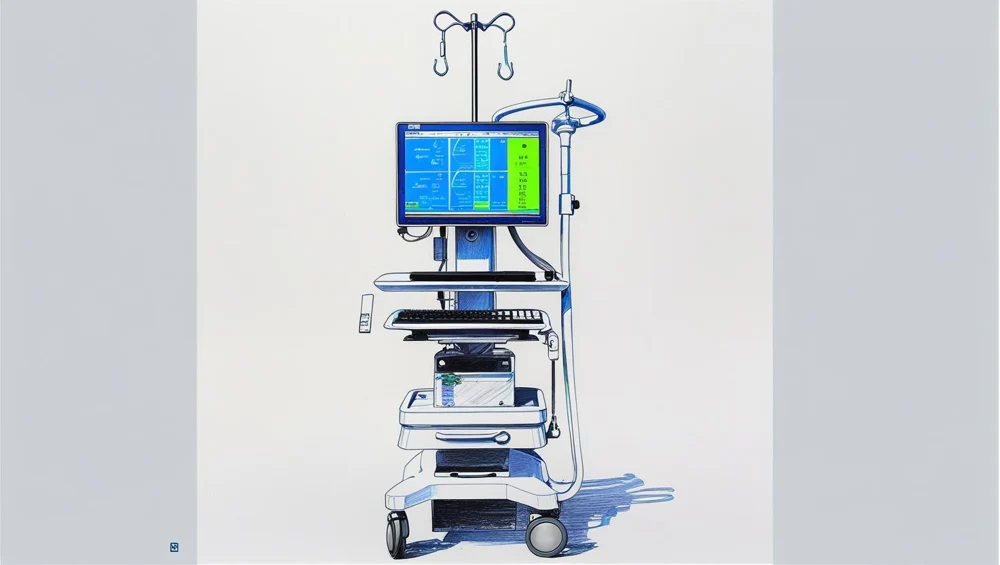
Two fluid-filled catheter lines to two external transducers on a common levelling bar on the pole, each with a three-way tap to atmosphere for zeroing, a slow flush to keep the lines patent, and a rectal balloon catheter charged with a small volume of fluid or air. The reference level is established once, by putting both diaphragms at the same declared height, and every pressure in the study is quoted against it.
Also called: Urodynamics. Arabic: نظام ديناميكا البول. Device Lab 43 of 69 in BMEssentia Medical City, 2 configurations.
Overview: the configurations
Fluid-filled lines with external transducers
Two fluid-filled catheter lines to two external transducers on a common levelling bar on the pole, each with a three-way tap to atmosphere for zeroing, a slow flush to keep the lines patent, and a rectal balloon catheter charged with a small volume of fluid or air. The reference level is established once, by putting both diaphragms at the same declared height, and every pressure in the study is quoted against it.
Catheter-mounted tip transducers
Pressure sensors mounted on the catheters themselves, one facing the bladder lumen and one on the rectal catheter, each with its own bridge amplifier and its own calibration. There is no fluid line and no external diaphragm, so there is no tap to open to atmosphere at the measuring site and no levelling bar to set. An air-charged catheter, where a small balloon at the tip is coupled to an external sensor through a gas column, sits between the two configurations and is recorded in the dossier as a variant rather than as a third configuration.
How it works: the main parts
What each part does, from the Urodynamics System lessons in the 3D Device Lab.
- Vesical filling and measuring catheter
- A fine tube, a little over two millimetres across and a few hundred millimetres long, with two separate passages inside it and a moulded hub at the outside end where the two separate. One passage delivers fluid into the bladder.
- Abdominal line and its rectal balloon
- A thinner tube than the vesical one, with a single passage, ending in a small soft balloon a centimetre or so across. It is the channel that makes the whole measurement possible, and it is the component most often treated as an accessory to the interesting one.
- Catheter fixation and the drape window
- Adhesive tape, two strain reliefs and one rectangular opening in a sheet. Nothing about it is electronic and nothing about it is optional, because every pressure in the study is quoted against a geometry that this is the only thing holding still.
- Peristaltic filling pump and its rate
- A small rotating head clamped to the pole, with three rollers on a rotor pinching a length of soft tube against a curved race. Turn the rotor and each roller pushes a sealed pocket of fluid along the tube.
- Filling line, warming and the infused-volume count
- A length of tubing from the reservoir to the catheter with three things in it: a chamber where drops are visible, a warming section, and a clamp that can stop everything by hand. Plus the count of how much has gone in, which is not an object at all and is one of the two most important numbers in the study.
- Irrigant reservoir and its hanger
- A bag of sterile fluid on a hook on the pole, with graduations up one side. It is the simplest object on the machine and it carries the one number in the study that nothing electronic produced.
- Vesical pressure channel
- Everything between the pressure inside the bladder and a number on a screen: a pressure path, a sensing element, a calibration that turns a bridge voltage into centimetres of water, a filter, and a converter. On this device it is one half of a subtraction, which means its accuracy matters much less than its comparability.
- Abdominal pressure channel
- The same electronics as the vesical channel, doing the same job, on the other cavity. It is the channel that gets less attention, and almost every failure of the subtraction is a failure of this one or of its relationship to the other.
Explore it in the Device Lab
- What the subtraction keeps and what it throws away: Leave everything else alone and move both measuring heights together. Then move only one of them. Watch the two absolute pressures in one experiment and the difference in the other.
- What a cough leaves behind, and exactly how much: Set both channels alike and ask for a cough. Then spoil one of them, slower, more heavily damped, whatever a bubble does, and ask again. Read the residual on the detrusor trace both times.
- A compliance that belongs partly to the pump: Hold the wall exactly where it is and change only the pump rate. Fill to the same volume every time and read the pressure at the end of the fill and the compliance computed from it.
- The error that is invisible in one number and decisive in another: Put a constant offset on one channel. Then read two things: the compliance, and the detrusor pressure at the moment of peak flow. One of them has not moved at all and the other has moved by exactly the offset.
- A peak flow that belongs partly to the instrument: Change only the smoothing window on the flowmeter and read the peak flow and the total volume. Then shorten the void and do it again.
Common faults and what to check
Most reported device problems (FDA MAUDE)
| Device problem | Reports |
|---|---|
| Deflation Problem | 11 |
| Leak/Splash | 11 |
| No Flow | 10 |
| Device Operates Differently Than Expected | 10 |
| Calibration Problem | 5 |
| Partial Blockage | 5 |
Raw counts of adverse event reports for this device type (FDA product code FEN, EXQ), all years. Not adjusted for the number of units in use, so they show what gets reported, not failure rates. Report text is never copied.
Planned maintenance checks
From the BMEssentia procedure library: every 12 months, about 45 minutes, electrical class I, applied part type BF.
| Check | Pass when |
|---|---|
| Transducers, pump and flowmeter Inspect transducers, lines, the infusion pump and the flowmeter. | No leaks. |
| Electrical safety Test to IEC 62353. | Within limits. |
| Pressure and flow accuracy Apply reference pressures to each channel; pour a known volume through the flowmeter. | Within the manufacturer's accuracy. |
Test instruments: Pressure reference (water column or calibrated manometer); Calibrated volume and scale for the flowmeter; Electrical safety analyser.
Recent FDA recalls
| Recall | Product and reason |
|---|---|
| Z-2076-2019 2019-07-17 | LABORIE MEDICAL TECHNOLOGIES, CORP: U3-3 Solar Blue, Laptop integrated power supply used with the Solar Blue Urodynamics for assessing lower urinary tract Power supply unit (PS-SBL) not correctly labeled, and insulation material used at the low voltage DC end does not meet all applicable flammability rating requirements. Root cause: Nonconforming Material/Component. |
| Z-2744-2018 2018-07-03 | ConvaTec, Inc: AbViser AutoValve IAP (intra- abdominal pressure) Monitoring Device, Patient mount: a) REF ABV300, b) REF ABV301 Bubble Leak Testing on AbViser AutoValve IAP Monitoring Devices without Transducer confirmed the potential for a pinhole breach in the sterile barrier. Root cause: Nonconforming Material/Component. |
| Z-1711-2009 2009-07-21 | Laborie Medical Technologies Cor: Laborie Medical Technologies Urodynamic Catheters, Twin Lumen 6 Fr , 40cm For Cystometry. Catalog Number: CAT-206. Laborie Medical Technologies reports that there was a mix up in the labeling and packaging of their Urodynamic Catheters. Root cause: Packaging process control. |
| Z-0229-2007 2006-12-01 | Laborie Medical Technologies: Laborie Transducer Cartridge with Luer Lock Mislabeling: Product labeled with incorrect "Use Before" date and pouch labels missing lot number. Root cause: Other. |
From the FDA recall database (openFDA), newest first, imported 2026-10-22. 4 recalls on record for this device type. Recall text is the FDA's public text; each recall links to the official record.
Learn it, see it in 3D, ask about it
- Ask Essentia about the Urodynamics System: answers from named sources, with the device open in its 3D Device Lab beside the answer.
- The Urodynamics System on the BMEssentia Platform: the Device Library course, 13 sections from physics to maintenance.
- BMEssentia Medical City: Device Lab 43, the Urodynamics System fully assembled in 3D, with lab tasks and the simulations.
Previous: EMG. Next: Oesophageal Manometry. All 69 devices.
Ask about the Urodynamics System
Sign in with your BMEssentia account, or create one, and ask anything about this device.
Ask Essentia