

Essentia / Devices / Pulse Oximeter
Device Lab 52
Pulse Oximeter
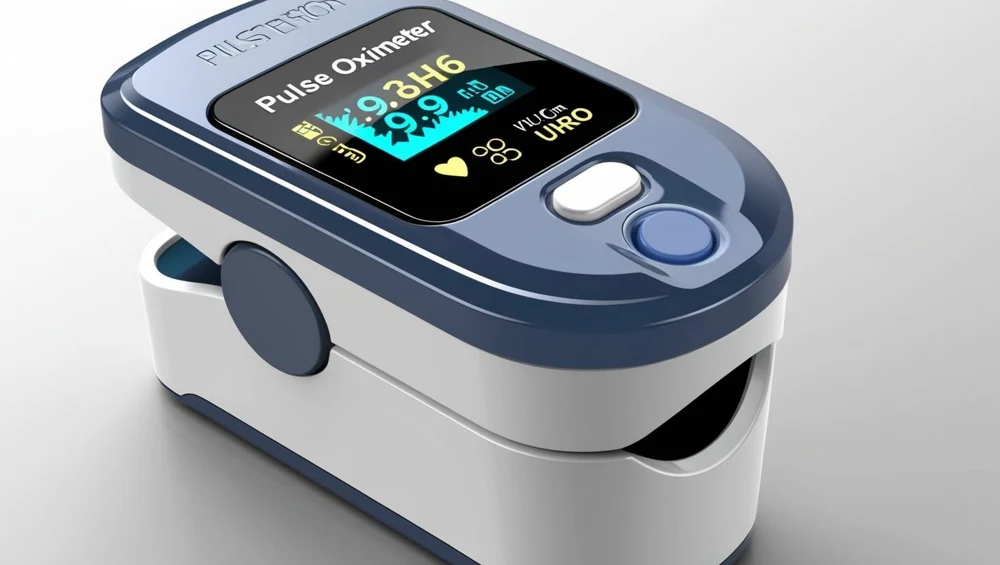
A sprung clip that closes across a digit, with the two emitters in one jaw and the photodiode directly opposite in the other. The optical path is a straight line through the tissue, its length is whatever the digit is, and the housing is shaped and coloured to keep room light out of the space between the two jaws. A single cable carries the emitter drive down and the photodiode current back, to a bedside monitor on a rolling stand.
Also called: Spo2. Arabic: مقياس التأكسج النبضي. Device Lab 52 of 69 in BMEssentia Medical City, 2 configurations.
Overview: the configurations
Transmittance sensor, a spring clip across a digit
A sprung clip that closes across a digit, with the two emitters in one jaw and the photodiode directly opposite in the other. The optical path is a straight line through the tissue, its length is whatever the digit is, and the housing is shaped and coloured to keep room light out of the space between the two jaws. A single cable carries the emitter drive down and the photodiode current back, to a bedside monitor on a rolling stand.
Reflectance sensor, a flat-site pad at a fixed separation
A thin adhesive pad carrying the two emitters and the photodiode on the same face, a declared distance apart, with an opaque optical barrier moulded between them and a headband to hold it against a flat site. Light enters the tissue, scatters, and some of it turns round and reaches the detector; the deepest such path has a semicircular lower bound of exactly pi/2 times the separation, so the sampled depth is set by a number on a drawing rather than by the anatomy. The same cable and the same monitor.
How it works: the main parts
What each part does, from the Pulse Oximeter lessons in the 3D Device Lab.
- Red emitter at 660 nm, its die, lens and centre-wavelength bin
- A red light-emitting diode roughly a quarter of a millimetre across, mounted in the emitter jaw of the sensor behind a small moulded lens, its die bonded to a lead frame and its emission aimed straight at the site. It is one of exactly two light sources on this representative device.
- Infrared emitter at 940 nm, and why the pair straddles the crossing
- The second and final light source: an infrared diode sitting beside the red one in the same jaw, behind the same kind of moulded lens, invisible to the eye and indistinguishable from its neighbour by inspection. Its declared representative centre wavelength is 940 nm.
- Silicon photodiode, its active area and its spectral responsivity
- A single reverse-biased silicon photodiode with an active area of a few square millimetres, sitting behind a window in the opposing jaw of a clip sensor or alongside the emitters on a flat pad. It produces a current proportional to the optical power falling on it.
- Multiplexed emitter drive and the three-slot timing
- A small constant-current sink with a switch matrix and a timing generator, on the board inside the monitor rather than in the sensor. It turns each emitter on for a short slot, in a repeating frame of three slots, red, infrared, and one with both emitters off, at a declared representative rate of 500 samples per second per slot.
- The dark slot, and the subtraction that removes the room
- The only component on this device with no hardware of its own. It is the third slot of the frame, both emitters off, the photodiode read anyway, and one subtraction performed on the numbers.
- Transimpedance amplifier and the current it turns into a voltage
- An operational amplifier with a large feedback resistor across it, on the monitor board at the end of the sensor cable. The photodiode's current flows into its summing node and comes out as a voltage; the resistor's value is the conversion factor, and a small capacitor across that resistor keeps the stage stable and sets its bandwidth.
- The alternating and direct separation, and why the ratio needs both
- Two filters and a division, performed on the digitised stream of one channel. The steady part is the mean level of the detected light over several cardiac cycles; the pulsating part is the peak-to-peak swing riding on it.
- Analogue-to-digital converter and where the quantisation floor sits
- A declared sixteen-bit converter on the monitor board, sampling at a representative 500 samples per second in each slot of the frame, triggered by the same sequencer that lights the emitters. It takes the voltage the transimpedance stage produced and turns it into an integer.
Common faults and what to check
Most reported device problems (FDA MAUDE)
| Device problem | Reports |
|---|---|
| Incorrect Measurement | 2,356 |
| No Audible Alarm | 1,395 |
| Display or Visual Feedback Problem | 1,113 |
| Device Operates Differently Than Expected | 825 |
| Low Readings | 765 |
| Device Alarm System | 740 |
Raw counts of adverse event reports for this device type (FDA product code DQA), all years. Not adjusted for the number of units in use, so they show what gets reported, not failure rates. Report text is never copied.
Recent FDA recalls
| Recall | Product and reason |
|---|---|
| Z-1356-2026 2026-02-12 | SUREPULSE MEDICAL LTD: Surepulse VS Cap Extra Small Retroactively reported; Labeling contains incorrect sizing guide for Cap, a component of the heart rate monitor. Root cause: Labeling Change Control. |
| Z-1357-2026 2026-02-12 | SUREPULSE MEDICAL LTD: Surepulse VS Cap Small Retroactively reported; Labeling contains incorrect sizing guide for Cap, a component of the heart rate monitor. Root cause: Labeling Change Control. |
| Z-1358-2026 2026-02-12 | SUREPULSE MEDICAL LTD: Surepulse VS Cap Medium Retroactively reported; Labeling contains incorrect sizing guide for Cap, a component of the heart rate monitor. Root cause: Labeling Change Control. |
| Z-1359-2026 2026-02-12 | SUREPULSE MEDICAL LTD: Surepulse VS Cap Large Retroactively reported; Labeling contains incorrect sizing guide for Cap, a component of the heart rate monitor. Root cause: Labeling Change Control. |
| Z-1360-2026 2026-02-12 | SUREPULSE MEDICAL LTD: Surepulse VS Cap Extra Large Retroactively reported; Labeling contains incorrect sizing guide for Cap, a component of the heart rate monitor. Root cause: Labeling Change Control. |
From the FDA recall database (openFDA), newest first, imported 2026-10-22. 128 recalls on record for this device type. Recall text is the FDA's public text; each recall links to the official record.
Learn it, see it in 3D, ask about it
- Ask Essentia about the Pulse Oximeter: answers from named sources, with the device open in its 3D Device Lab beside the answer.
- The Pulse Oximeter on the BMEssentia Platform: the Device Library course, 13 sections from physics to maintenance.
- BMEssentia Medical City: Device Lab 52, the Pulse Oximeter fully assembled in 3D, with lab tasks and the simulations.
Previous: Surgical Stapler. Next: Spirometer. All 69 devices.
Ask about the Pulse Oximeter
Sign in with your BMEssentia account, or create one, and ask anything about this device.
Ask Essentia