

Device Lab 41
EEG
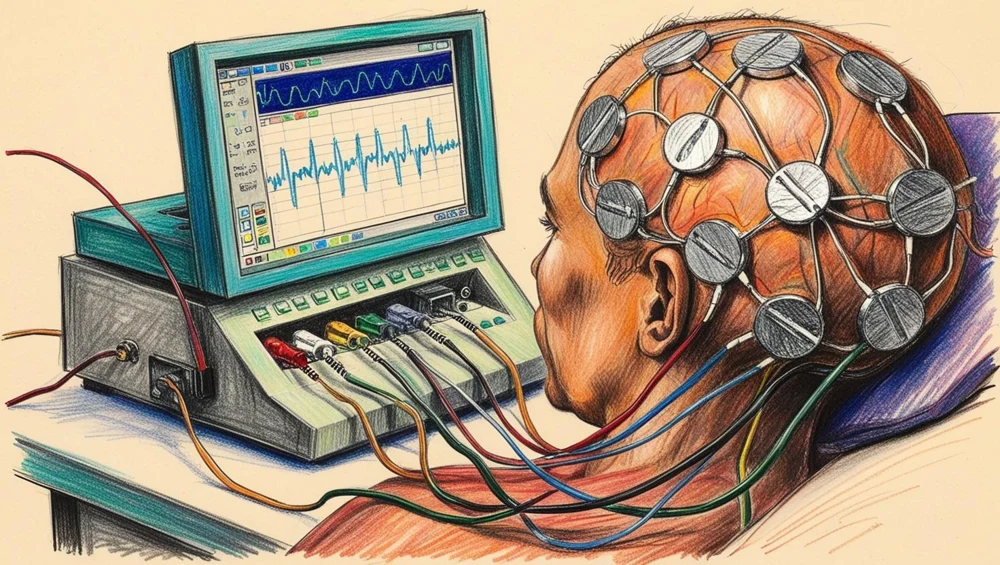
Nineteen recording electrodes placed at every position of the international 10-20 system, measured onto the head with a tape rather than estimated, with the two earlobes as a linked reference and a ground at Fpz. Half an hour of recording with a technologist in the room, who measures every impedance before it starts, watches the traces while it runs, and re-applies an electrode the moment one of them drifts.
Also called: Electroencephalograph. Arabic: جهاز تخطيط الدماغ الكهربائي. Device Lab 41 of 69 in BMEssentia Medical City, 2 configurations.
Overview: the configurations
Routine diagnostic recording, full 10-20 array
Nineteen recording electrodes placed at every position of the international 10-20 system, measured onto the head with a tape rather than estimated, with the two earlobes as a linked reference and a ground at Fpz. Half an hour of recording with a technologist in the room, who measures every impedance before it starts, watches the traces while it runs, and re-applies an electrode the moment one of them drifts.
Continuous monitoring, reduced array
Eight recording electrodes over the frontal and temporal regions, a single reference at Cz and a ground at Fpz, applied to hold for days rather than for half an hour, and left running in an intensive care bay with nobody in the room. It answers a different question: not what this brain looks like now, but whether something happened in the last three days.
How it works: the main parts
What each part does, from the EEG lessons in the 3D Device Lab.
- Electrode leads and their screening
- Twenty-two thin coloured wires leaving twenty-two silver cups, sweeping back over the scalp and gathered into one clip at the crown, from where a single braid runs to the headbox. They look like the least interesting part of the machine and they carry a signal that is a hundred times smaller than the interference around them.
- Headbox and electrode inputs
- A small moulded box on a stand at the patient shoulder, its face printed as a head seen from above: the vertex in the middle, the circumference around the rim, a notch for the nose. One socket per electrode, laid out where that electrode goes.
- Input protection and patient current limiting
- A board inside the headbox carrying a resistor and a pair of clamping diodes for every input. It does nothing at all in normal use and it is the reason the machine can be connected to a person.
- Differential amplifier, one per channel
- A row of small packages on a board, one for every recording channel, each with a single resistor beside it that sets its gain. This is the component the device exists around: it subtracts one electrode from another and multiplies the difference.
- Ground electrode and common-mode feedback
- One more cup, usually on the forehead, with a green lead, and a small board in the amplifier that does something to it. It is the electrode most often described wrongly: it is not a reference, and it is not a safety earth.
- System reference electrode
- On the routine configuration, two ear clips joined together. On the continuous one, a single cup at the vertex.
- Twenty-four bit digitiser
- A row of converters, sampling every channel hundreds of times a second and turning the whole record into numbers before it has travelled a metre. Everything before it is analogue and fragile; everything after it can be copied without loss.
- High-pass, low-pass and notch filters
- Three settings, shown as three legends on the front of the amplifier, applied to numbers after the recording rather than to the signal before it. Every one of them removes evidence along with noise.
Explore it in the Device Lab
- The reference is in every channel that names it: Put a fault on the reference electrode and count how many channels carry it, in each of the three montages in turn.
- What actually sets the rejection: Set the two electrode impedances equal and note the interference. Then unbalance them and watch it grow, and compare the rejection the channel achieves against the figure the amplifier is sold with.
- Two channels with opposite polarity: Put a fault on one electrode and count the channels that carry it, with the polarity of each, in a bipolar montage. Then do it on an electrode at the end of a chain.
- A floor as well as a ceiling: Take one electrode out of the window in each direction in turn, too high, then too low, and look at what each does to the record.
- Where the muscle went: Raise the muscle content in the record, then change the sampling rate and watch what the fast activity does.
Common faults and what to check
Most reported device problems (FDA MAUDE)
| Device problem | Reports |
|---|---|
| Incorrect Measurement | 30 |
| Sparking | 23 |
| Smoking | 19 |
| Mechanical Problem | 17 |
| Detachment of Device or Device Component | 14 |
| Overheating of Device | 14 |
Raw counts of adverse event reports for this device type (FDA product code GWQ, OMC), all years. Not adjusted for the number of units in use, so they show what gets reported, not failure rates. Report text is never copied.
Planned maintenance checks
From the BMEssentia procedure library: every 12 months, about 60 minutes, electrical class I, applied part type BF.
| Check | Pass when |
|---|---|
| Headbox, cables and electrodes Inspect the headbox, its cable, the electrode leads, the photic stimulator and the camera. | No damage; connectors firm. |
| Electrical safety Test the amplifier and PC trolley as a system to IEC 62353 (the PC must be on an isolation transformer or part of the medical system). | PE ≤ 0.30 Ω; equipment leakage ≤ 500 µA; applied part BF ≤ 5000 µA. |
| Calibration signal on every channel Feed the simulator's calibration signal to all channels and compare the displayed amplitude. | Every channel within the manufacturer's accuracy; no dead or noisy channel. |
| Filters and impedance Check the high- and low-pass filters with sine inputs; run the impedance check on the test resistors. | Per manufacturer. |
Test instruments: EEG or multi-channel signal simulator (calibration sine and square wave); Electrical safety analyser; Impedance test resistor set.
Standards engineers test against
IEC 60601-2-26 and IEC 60601-2-40: EEG and EMG equipment
IEC 60601-2-26 covers electroencephalographs; IEC 60601-2-40 covers electromyographs and evoked response equipment.
Recent FDA recalls
| Recall | Product and reason |
|---|---|
| Z-2353-2026 2026-06-05 | Micromed S.p.A.: SD LTM 64 PLUS, EEG Amplifier/recorder, Model/Catalog Number: SD LTM 64 PLUS, Software Version: firmware 2021.02, Natus has become aware of two complaints related to the SD LTM 64 PLUS where the EEG traces acquired from two or four different amplifiers used in a multiple amplifier configuration (128 or 256 channels) running firmware. Root cause: Software Design Change. |
| Z-2138-2025 2025-07-18 | Natus Neurology DBA Excel Tech., Ltd. (XLTEK): Natus Brain Monitor Breakout Box, Part Number 021911 Natus received two complaints of left side labeling show impedance for right side. Root cause: Process control. |
| Z-3143-2024 2024-09-13 | SEER MEDICAL PTY LTD: Seer Home System is an ambulatory electroencephalograph (EEG) system intended for at-home use for extended EEG and video During CAPA investigations of sight production inconsistencies, it was highlighted that previous Electromagnetic Compatibility (EMC) assessments related to RF radiated emissions may not be reasonably equivalent to the. Root cause: Under Investigation by firm. |
| Z-1942-2024 2024-05-31 | WAVi Co.: WAVi Research EEG Desktop System is comprised of the WAVi Research EEG Desktop Software with Instruction Manual and Following an FDA-issued Warning Letter, the firm requested return of their research EEG system components due to the closing of their research study. Root cause: No Marketing Application. |
| Z-0865-2021 2021-01-14 | Nihon Kohden America Inc: PSG-1100 Sleep Diagnostic System. Medical device non-conformance to electrical safety standard (IEC 60601-1). Root cause: Device Design. |
From the FDA recall database (openFDA), newest first, imported 2026-10-22. 23 recalls on record for this device type. Recall text is the FDA's public text; each recall links to the official record.
Learn it, see it in 3D, ask about it
- Ask Essentia about the EEG: answers from named sources, with the device open in its 3D Device Lab beside the answer.
- The EEG on the BMEssentia Platform: the Device Library course, 13 sections from physics to maintenance.
- BMEssentia Medical City: Device Lab 41, the EEG fully assembled in 3D, with lab tasks and the simulations.
Previous: Holter. Next: EMG. All 69 devices.
Ask about the EEG
Sign in with your BMEssentia account, or create one, and ask anything about this device.
Ask Essentia