

Essentia / Devices / Blood Pressure Monitor
Device Lab 54
Blood Pressure Monitor
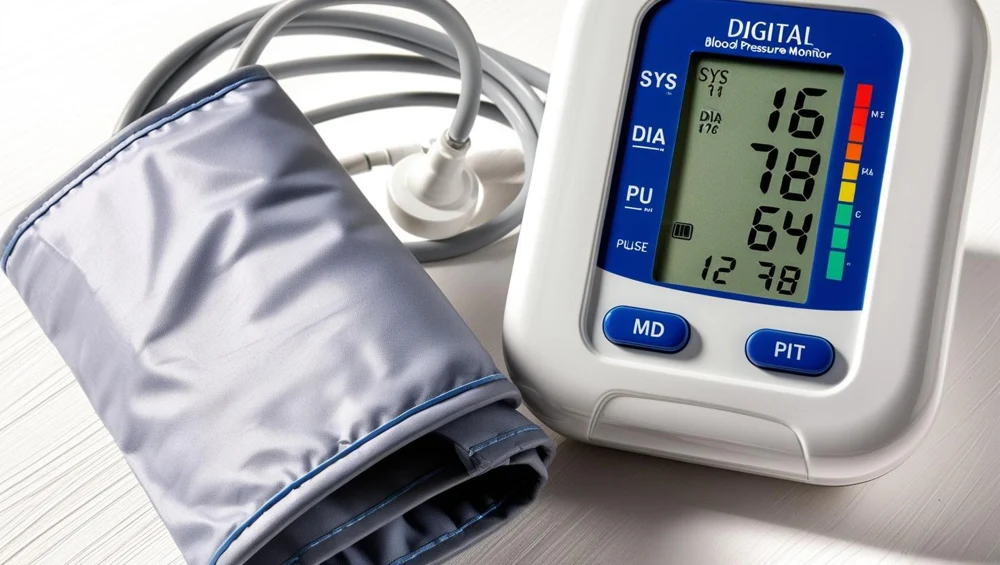
A boxed instrument on a stand with a motor pump, a solid-state pressure sensor, a servo-controlled bleed valve and a display of three numbers. It inflates the cuff above the point where the artery shuts, then lets the pressure down at a rate it holds constant, and watches the small pressure oscillation each beat puts into the cuff gas. The envelope of that oscillation peaks where the cuff pressure equals the mean arterial pressure, because that is where the artery is at its most compliant, and the systolic and diastolic figures are then read off the envelope at declared fractions of its peak.
Also called: Nibp, Sphygmomanometer. Arabic: جهاز قياس ضغط الدم. Device Lab 54 of 69 in BMEssentia Medical City, 2 configurations.
Overview: the configurations
Automatic oscillometric monitor, motor pump and servo bleed valve
A boxed instrument on a stand with a motor pump, a solid-state pressure sensor, a servo-controlled bleed valve and a display of three numbers. It inflates the cuff above the point where the artery shuts, then lets the pressure down at a rate it holds constant, and watches the small pressure oscillation each beat puts into the cuff gas. The envelope of that oscillation peaks where the cuff pressure equals the mean arterial pressure, because that is where the artery is at its most compliant, and the systolic and diastolic figures are then read off the envelope at declared fractions of its peak.
Manual aneroid sphygmomanometer with a stethoscope
An aneroid capsule behind a dial, a hand bulb with a non-return valve, a bleed screw and a stethoscope held over the brachial artery below the cuff. The cuff is inflated by hand above the point where the artery shuts and let down through the screw, and the observer marks the dial at the first sound and at the last. There is no electronics anywhere in the instrument and nothing in it records anything.
How it works: the main parts
What each part does, from the Blood Pressure Monitor lessons in the 3D Device Lab.
- Cuff shell and the width that decides the error
- A stiff rectangle of coated fabric, twelve centimetres across the part that matters and rather more than that across the whole of it, with a hemmed edge at each side and a bladder in a pocket inside. It is the only transducer this instrument has.
- Inflatable bladder, its length and the wrap it makes
- A flat rubber bag, welded round its edge, with a single port out of one face. Twenty-five centimetres long and twelve wide on a standard adult cuff.
- Hook-and-loop closure, the index line and the range marks
- A patch of hooks, a patch of loops, a metal D-ring at one end and a printed line with a window it is supposed to land inside. Six pence worth of parts, and between them they decide how much of the printed width is actually in contact with the limb.
- Connecting tube, the connector and the gas volume behind it
- Six hundred millimetres of small-bore tube with a push connector at each end. On one configuration it runs to a socket on a boxed instrument and on the other to a tee under a dial.
- The upper arm, its measured circumference and the artery beneath it
- An upper arm, thirty point four centimetres round on the body in this room, with a vessel running down the inner side of it at something like two and a half centimetres beneath the skin. It is half of the device and no part of it is manufactured, specified, calibrated or recorded anywhere.
- Arm support and the height scale zeroed on heart level
- A padded rest on a post with a graduated scale beside it, and the zero of that scale is placed at the heart datum measured on the body itself rather than at a height somebody chose. The pad holds the forearm.
- Measurement chair, back support and footplate
- A chair with a back, a pan at a real clinic height, four legs and a footplate. It is in the component list of a measuring instrument, which looks like a mistake until you notice that everything else in the room measures a pressure and this decides what pressure there is to measure.
- Cuff size rack and the limb tape that chooses from it
- A stand carrying five bladders on five pegs, from fifty-five millimetres wide to a hundred and ninety-two, each with a range of limb circumferences printed underneath it, and a tape measure on a hook at the end. It is the one idea of this device turned into furniture.
Explore it in the Device Lab
- One ratio, and the limb radius cancelling out of it: Leave everything else alone and move only the limb circumference. Read the width ratio, the transmission ratio and the three reported pressures on the bench board. Then put the circumference back and move the cuff width instead, until the ratio returns to what it was.
- An offset, a factor, and the subtraction that separates them: Set the limb fifteen centimetres below the datum and read all four quantities: the three reported pressures and their pulse pressure. Then set it fifteen above. Then put it back and make the cuff too narrow instead, and read the same four.
- Where an envelope peak comes from, and where its flanks come from: This experiment needs the configuration that detects an oscillation. Read the envelope on the bench, find its peak, and compare the peak pressure against the mean the bench is set to. Then move the two fraction controls and watch two reported pressures change with nothing physical changing.
- A fixed hole, and why it cannot hold a rate: This experiment needs the hand-operated configuration. Set the bleed screw so that the cuff falls at three millimetres of mercury a second at a hundred, then read the rate the bench reports at the systolic cuff pressure and at the diastolic one.
- What a beat costs, and which way it costs it: On either configuration, raise the deflation rate and watch four things: the interval between beats in pressure, the number of beats inside the window, the reported pulse pressure, and the mid-point between the two reported pressures.
Common faults and what to check
Most reported device problems (FDA MAUDE)
| Device problem | Reports |
|---|---|
| Computer Software Problem | 1,542 |
| Incorrect, Inadequate or Imprecise Result or Readings | 1,436 |
| High Readings | 857 |
| Unable to Obtain Readings | 562 |
| Inflation Problem | 484 |
| Device Operational Issue | 391 |
Raw counts of adverse event reports for this device type (FDA product code DXN), all years. Not adjusted for the number of units in use, so they show what gets reported, not failure rates. Report text is never copied.
Standards engineers test against
ISO 80601-2-30 and ISO 81060-2: automated non-invasive blood pressure
ISO 80601-2-30 is the safety and performance standard for automated NIBP monitors: the accuracy of the cuff pressure measurement against a reference (manufacturers commonly state ±3 mmHg), a limit on maximum cuff pressure and on how long the cuff stays inflated, and alarms.
Recent FDA recalls
| Recall | Product and reason |
|---|---|
| Z-1508-2025 2025-04-02 | PYRAMES INC: Boppli: Bedside Device Kit, REF: 54-0002 Single-use battery-powered blood pressure monitor, for use on neonates and infants, due to vibratory noise, may not adequately detect changes in blood pressure per specification. Root cause: Software design. |
| Z-0032-2025 2024-10-08 | MEDLINE INDUSTRIES, LP - Northfield: MEDLINE AUTOMATIC DIGITAL BLOOD PRESSURE UNIT, REF MDS1001 It has been determined that certain Blood Pressure Monitors containing a faulty microchip have failed to power on or have shown display screen issues after the initial few uses, as well as overheating at times making the. Root cause: Under Investigation by firm. |
| Z-0033-2025 2024-10-08 | MEDLINE INDUSTRIES, LP - Northfield: MEDLINE AUTOMATIC DIGITAL BLOOD PRESSURE UNIT, REF MDS1001U. It has been determined that certain Blood Pressure Monitors containing a faulty microchip have failed to power on or have shown display screen issues after the initial few uses, as well as overheating at times making the. Root cause: Under Investigation by firm. |
| Z-0034-2025 2024-10-08 | MEDLINE INDUSTRIES, LP - Northfield: MEDLINE Automatic Digital Blood Pressure Monitor, REF MDS1001UT. It has been determined that certain Blood Pressure Monitors containing a faulty microchip have failed to power on or have shown display screen issues after the initial few uses, as well as overheating at times making the. Root cause: Under Investigation by firm. |
| Z-1509-2024 2024-04-10 | Baxter Healthcare Corporation: Hillrom Welch Allyn Connex ProBP 3400 Digital Blood Pressure Device, marketed under the following models: Baxter received reports of an issue related to the construction of the power cord not meeting the insulation rating per country-specific requirements and international electrical standards. Root cause: Nonconforming Material/Component. |
From the FDA recall database (openFDA), newest first, imported 2026-10-22. 36 recalls on record for this device type. Recall text is the FDA's public text; each recall links to the official record.
Learn it, see it in 3D, ask about it
- Ask Essentia about the Blood Pressure Monitor: answers from named sources, with the device open in its 3D Device Lab beside the answer.
- The Blood Pressure Monitor on the BMEssentia Platform: the Device Library course, 13 sections from physics to maintenance.
- BMEssentia Medical City: Device Lab 54, the Blood Pressure Monitor fully assembled in 3D, with lab tasks and the simulations.
Previous: Spirometer. Next: Glucometer. All 69 devices.
Ask about the Blood Pressure Monitor
Sign in with your BMEssentia account, or create one, and ask anything about this device.
Ask Essentia